Sustainability event archive
Here you will find all events from previous semesters that can be credited towards the "Sustainability and Global Responsibility" certificate in addition to the "Intercultural Competence" certificate. An event can only be credited towards one of the two certificates.
To find events in the event archive, we recommend using the browser search function (CTRL+F)
Block seminars | (GSiK point; department) | |||
| Mon, 09.10 | 8-10 a.m. | Global Circle: Exploring Artificial Intelligence: What it is, who it affects, and what do we change? | B; interdisciplinary | |
| Wed, 18.10 | 10-12 | B, C, D; Slavic Studies | ||
| Wed. 18.10 | 14-16 | B, C; Teaching degree | ||
| Thu, 19.10 | 2 - 4 p.m. | B, C; teacher training | ||
| Thu, 26 Oct, | 6-7 p.m. | B, C; interdisciplinary | ||
| Sat., 28.10/ Sat., 18.11/ Sat., 16.12 | 9 am - 1 pm/ all day | School of the art of living - learning to live a sustainably fulfilled life | B, C; interdisciplinary | |
| Mon, 30.10 | 10-12 a.m. | Global Circle: Online, interactive media: How does it affect our mental health? | B; interdisciplinary | |
| Fri, 27.10/ Fri, 24.11/ Sat, 25.11 | 4-8 p.m. | Pedagogical communication and interaction: Learning to speak critically of racism | A, B, C; pedagogy | |
| Fri, 27.10, Fri, 10.11, Sat, 11.11, Fri, 08.12, Sat, 09.12 | 12-14 h | B, C; Teacher training | ||
| Tue, 07.11, Tue, 21.11, Tue, 05.12 | 4-6 p.m. | B, C; teacher training | ||
| Fri., 15.12 Sat., 16.12/ Sun., 17.12 | 12-18 h 10-17 h | Introduction to asylum law for teachers: Here. And now? Simulation game and legal reappraisal | B, C; Pedagogy | |
| Fri., 12.01 Sat., 13.01 Sun., 14.01 | All day | B, C; pedagogy | ||
| Thu, 01.02/ Fri, 23.02/ Sat, 24.02 + Sun, 25.02, | 16-18 h/ 13-18 h/ 9-18 h | Sustainability education - education for sustainable development | B, C; Teacher training | |
Mon., 04.03/ | 8-10 am/ 6-8 pm | Virtual Exchange Climate Justice: From Inequality to Inclusion | B, C; interdisciplinary | |
Lectures | ||||
| Wed, 25.10 | 6-8 pm | Fixed roles since prehistoric times? A question for prehistoric gender studies | A, B, C; interdisciplinary | |
| Thu, 02.11 | 12-14 h | Consumption and sustainability: selected socio-geographical perspectives | B, C; interdisciplinary | |
| Wed, 08.11 | 16-18 hrs | Dealing professionally with diversity in the global classroom as a teacher | B, C; teacher training | |
| Thu, 09.11 | from 6 pm | GSiK week 2023: WORK/Education "Classism. The (often) ignored form of discrimination" | A, B, C; interdisciplinary | |
| Wed, 08.11 | from 6 pm | A, B, C; interdisciplinary | ||
| Tue, 07.11 | from 6 pm | A, B, C; interdisciplinary | ||
| Mon, 06.11 | from 6 pm | GSiK week 2023: HEALTH "Equality of care as a social challenge" | A, B, C; interdisciplinary | |
| Wed. 15.11 | 6-8 pm | B, C; teaching degree programme | ||
| Thu, 16 Nov | 12-14 h | B, C; interdisciplinary | ||
| Mon, 20 Nov | 18-20 h | Representation and participation of young people in agricultural policy-making - Insights from Peru. | B, C; interdisciplinary | |
| Mon, 20 Nov | 7-8 p.m. | Just or equal? The discussion about gender-sensitive educational media | A, B, C; interdisciplinary | |
| Tue, 28.11 | 19-20:30 | B, C; interdisciplinary | ||
| Wed., 29.11 | 6-8 p.m. | (What) education for sustainable development? Approaching a complex problem | B, C; teacher training | |
| Thu, 30.11 | 12-14 h | Spatial, social and ecological effects - critical perspectives on the German retail sector | B, C; interdisciplinary | |
| Wed., 06.12 | 6-8 pm | Power and violence - on the delimiting and demarcating function of institutions | B,C; Intervention psychology, Catholic theology | |
| Wed, 06.12 | 6-8 p.m. | Successful Educational Actions for socially sustainable thinking and action | B, C; Teacher training | |
| Mon, 11.12 | 19-20:30 | Studying in the first generation - overcoming hurdles for first-time graduates | A, B; interdisciplinary | |
| Thu, 14.12 | 12-14 h | From the global to the planetary: Planetary thinking and the planetary commons | B, C; interdisciplinary | |
| Wed, 20.12 | 6-8 pm | Supporting students in developing innovative projects - examples from the practice of IJF e.V. | B, C; teaching degree | |
| Wed, 10 Jan | 6-8 p.m. | B, C; teaching degree | ||
| Wed, 10 Jan | 6-8 p.m. | B, C; Law | ||
| Thu, 11 Jan | 12-14 h | B, C; interdisciplinary | ||
| Wed, 17 Jan | 6-8 p.m. | Prevention and therapy for violent experiences in childhood and adolescence | B,C; Intervention Psychology, Catholic Theology | |
| Wed, 24 Jan | 6-8 p.m. | Abuse of power at universities: structural causes and levels of potential measures | B,C; Intervention Psychology, Catholic Theology | |
| Wed, 24 Jan. | 6-8 pm | A, B, C; interdisciplinary | ||
| Thu, 25 Jan | 12-14 h | B, C; interdisciplinary | ||
| Thu, 01.02 | 5-7 pm | B, C; interdisciplinary | ||
| Thu, 08.02 | 12-14 h | B, C; interdisciplinary | ||
Seminars | ||||
| Tue, 24.10 | 12-14 h | B, C; Protestant Theology | ||
Workshops | ||||
| Mon, 06.11 | 16:30-19:30 | A, B, C; interdisciplinary | ||
| Fri, 08.12 | 9-17 hrs | Implementing equal opportunities together Workshop on gender and diversity competence | A, B; interdisciplinary | |
| Thu, 18 Jan | 12-16 h | "Gamifying climate change - the triCO2lor simulation game" - 4th impact workshop | B, C; teaching degree | |
| Wed, 31 Jan | 16-18 h | B, C; interdisciplinary | ||
Workshops | (GSiK point; department) | |||
| 22.04.23 | 4-6 p.m. | B; interdisciplinary | ||
| 29.04.23 | 10 am - 1 pm | B; interdisciplinary | ||
| 24.05.23 | 6-8 p.m. | Workshop: Gender inequalities in the labour market and the importance of negotiation | B, C; interdisciplinary | |
| 12.05.23 | 2-6 p.m. | (Everyday) racism (working title; as part of the Würzburg Week against Racism) | A, B; interdisciplinary | |
| 13.05.23 | 11:30 am - 1 pm | B; interdisciplinary | ||
| 07.07.23 | 10am-6pm | Workshop: Ten sources on vegetarianism and veganism (two parts, Friday and Saturday) | B, C; interdisciplinary | |
Lectures | ||||
| 09.05.23 | 6-8 pm | Guest Lecture: The Relationship of Roma Women with Educational centres During the COVID-19 Pandemic | B, C; Adult education/further education | |
| 10.05.23 | 14-16 hrs | Guest Lecture: How to promote and evaluate the social impact of our interventions? | B, C; Adult education/continuing education | |
| 11.05.23 | 18-20:30 | Climate conscious? Is sustainability research part of the protest? | B, C; Sustainability Forum | |
| 06.06.23 | 6-7.30 pm | B, C; Sustainability Forum | ||
| 14.06.23 | 14-16 h | B, C; Sustainability Forum | ||
| 11.07.23 | 6-8 pm | A, B, D; interdisciplinary | ||
| 17.07.23 | 6-7.30 pm | Sustainability in Bavaria - State parliament candidates discuss solutions | B, C; Sustainability Forum | |
Seminars | ||||
| Tuesdays, weekly (from 18.04) | 10-12 a.m. | Political ethics and business ethics | B, C; Catholic theology | |
Tuesdays, weekly (from 18.04) | 10-12 a.m. | Interdisciplinary teaching: Save the forest! But which one? | B, C; teacher training | |
| Tuesdays, weekly (from 18.04) | 14-16 h | Sustainability in everyday (school) life - shaping education for sustainable development: Our consumption fair-changes the world | B, C; teacher training | |
| Wednesdays, weekly (from 19.04) | 5-7 p.m. | Introductory course on transformation law Law Clinic | B, C; Law | |
| Thursdays, weekly (from 20.04) | 4-6 p.m. | B, C; Pedagogy | ||
| Fridays, irregular (from 21.04) | 12-14/15/16 h | Think tank: System Change!? What teaching and learning formats does JMU need to transform teaching? | B, C; Teaching degree | |
| Tuesdays, weekly + excursion from 31.05-03.06 (from 25.04) | 14-16 h | Protect habitats! But how? Concepts of nature and species conservation in Germany | B, C; European Ethnology/ Ethnology | |
| Tuesdays, weekly (from 25.04) | 2 - 4 p.m. | Transcultural aspects in German lessons | B, C; Teacher training | |
Wednesdays, weekly | 10-12 a.m. | B, C; teacher training programme | ||
| Thursdays, weekly (from 27.04) | 2-4 p.m. | In search of new stories. Telling multispecies worlds | B, C; European Ethnology/ Folklore Studies | |
| Thursdays, weekly (from 27.04) | 4-6 p.m. | B, C; Protestant theology and religious education | ||
| Wednesdays, fortnightly (from 17.05) | 2-6 p.m. | B, C; Faculty of Law | ||
Block seminars | ||||
| 01.-05.08.23 | all day | B, C; European Ethnology/ Folklore Studies | ||
03.05/07.05/ | 18-20 hrs/ | B, C; Pedagogy | ||
| 03.05/07.05/ 27.08-02.09.23 | 18-20 hrs/ all day | Project workshop | 2nd PG: Education for sustainable development in theory and practice | B, C; Pedagogy | |
| 01.09-10.09.23 | all day | Planetary Health. Climate, Environment & Health - Summer School | B, C, D; Faculty of Medicine | |
Lectures | (GSiK point; department) | ||||
| 05.04. | 18:00 c.t. | Projection of climatic extremes - oracle or science? (Lecture series "KlimaDiskurse") | B, C, N; interdisciplinary | ||
| 28.04. | from 5 pm | Living Campus Walk | N; interdisciplinary | ||
| 02.05. | 16:00 c.t. | Conserving Harpy Eagles - Lessons from the Darien Gap, Panama | B, N; Biology | ||
| 03.05. | 18:00 c.t. | The urban climate of Würzburg and its trees | B, C, N; Geography | ||
| 09.05. | 16:00 c.t. | Protected Areas in the Carpathians of Ukraine - How the war in Ukraine changed consevation work | B, N; Biology | ||
| 12.05. | 18:00 - 20:00 | B, C, N; interdisciplinary | |||
| 18.05. | 18:00 c.t. | A, B, D, N; interdisciplinary | |||
| 19.05. | 18:00-20:00 c.t. | Let's Talk About: White Saviourism & Volontarism | A, B, D, N; interdisciplinary | ||
| 23.05. | 16:00 c.t. | B, N; Biology | |||
| 25.05. | 14:00 c.t | A, B, C, N; jurisprudence | |||
| 25.05. | 4-6 p.m. | B, C, N; Teacher training | |||
| 02.06. | 12:00 c.t. | B, N; European Ethnology | |||
| 13.06. | 16:00 c.t. | From conflict to co-existence - Evidence based solutions for the farmer-cheetah conflict in Namibia | B, N; Biology | ||
| 17.06. | 10:00 a.m. c.t. | Musical bamboo: flute making, natural resources and sustainability in the Bolivian Andes | B, C, D, N; Ethnomusicology | ||
| 22.06. | 14:00 c.t. | Introduction to asylum and refugee law (lecture series on refugee and migration law) | B, C; N; jurisprudence | ||
| 22.06. | 16-18h | B, C, N; Teacher training | |||
| 23.06. | 12:00 c.t. | B, N; European Ethnology | |||
| 24.06. | 10:00 a.m. c.t. | Beyond Singing: The role of popular musicians in the democratic process in Ghana's 4TH republic | B, C, D, N; Ethnomusicology | ||
| 27.06. | 16:00 c.t. | The Pantanal - Giant anteaters, jaguars and cowboys coping with environmental change | B, N; Biology | ||
| 29.06. | 4-6 p.m. | Our consumption "fair-changes" the world. Sustainability education in primary schools with examples from the LehrLernGarten at the University of Würzburg | B, C; N; Teacher training | ||
| 30.06. | 12:00 c.t. | B, N; European Ethnology | |||
| 05.07. | 18:00-20:00 c.t. | The overlooked racism? In favour of an eastward expansion of the German debate on racism" | A, B, C, D, N; interdisciplinary | ||
| 07.07. | 12:00 c.t. | B, N; European Ethnology | |||
| 08.07. | 10:00 a.m. c.t. | Musical Representation of Oil Exploration, Environmental Degradation, (In)justice and (Dis)placement in Niger Delta of Nigeria | B, C, D, N; Ethnomusicology | ||
| 13.07. | 4-6 pm | "Reflectories" - Stories to reflect. Making decisions in virtual stories and recognising global connections | B, C, N; teaching degree | ||
| 13.07.22 | 18:00 hrs | Feminist critique as social practice - a contribution to gender justice (lecture series of the AK Gender) | A, B, C; interdisciplinary | ||
| 14.07. | 12:00 c.t. | B, N; European Ethnology | |||
| 22. & 23.07. | 14:00 c.t. | Simulation game: "On the run" (lecture series on refugee and migration law) | B,C, N; Law | ||
| 29.07.22 | 7 p.m. | DIE.ZUKUNFTS.WERKSTATT Lecture and discussion "Ökoroutine - Ökomoral - Wirtschaft ist mehr" | B, C, D; interdisciplinary | ||
Workshops | (GSiK point; department) | ||||
| 18.-29.04. | B, N; interdisciplinary | ||||
| 18.-29.04. | Global Circle: What does the war in Ukraine mean for the world? | B, D, N; interdisciplinary | |||
| 07.05. | 10:30-14:00 | The glorious 7 - Your city | B, N; interdisciplinary | ||
| 28.05. | 16:30-18:00 | The glorious 7 - Your permaculture | B, N; interdisciplinary | ||
| 30.05. 6 -17.06. | Global Circle "Artificial Intelligence, Global Skills, and the Future of Work" | B, C, N; interdisciplinary | |||
| 31.05. | 6 pm | B, C, D, N; interdisciplinary | |||
| 10.06. | 09:00-12:30 s.t. | A, B, D, N; interdisciplinary | |||
| 10.06. | 14:00-19:00 | Workshop: Multiplier training on sexism and gender | A, B, C, D, N; special education | ||
| 11.06. | 14:00-18:00 | The glorious 7 - Your clothes | B,N; interdisciplinary | ||
| 24.06. | from 17:00 | The glorious 7 - Your food | B,N; interdisciplinary | ||
| 15.07. | 15:00-16:30 (Group 1) 16:45-18:15 (Group 2) | The glorious 7 - Your honey | B,N; interdisciplinary | ||
| 13.08. | 11:00-14:00 | The glorious 7 - Your home remedies | B,N; interdisciplinary | ||
| 27.08. | 11:00-14:00 | The glorious 7 - Your ferment | B,N; interdisciplinary | ||
Block seminars | (GSiK point; | ||||
| 20.- 22.04.22 | 09-16 in presence, | Planetary health: climate, environment and health | B, C, N; Medicine | ||
| 26.04. | 16:30 | Sustainability in everyday (school) life - shaping education for sustainable development: Our consumption fair-changes the world | B, C, N; teacher training | ||
| 26.04. | 8 a.m. s.t. | Sustainability education in (primary) schools - our consumption "fair-changes" the world | B, C, N; teaching degree | ||
| 27.04. | 8-8:45 a.m. | SU II: Nature and environment learning area | B, C, N; teacher training | ||
| 27.04. | 16:30 | Interdisciplinary teaching - practical experience in the TeachingLearningGarden | B, C, N; teacher training programme | ||
28.04., | 16-17 | Critical Whiteness - making whiteness visible (intercultural training, 1st parallel group) | A, B, C, N; Pedagogy | ||
| 03, 04 May, 19 July and 28 August - 3 September | 6-8 p.m. | Education for sustainable development in theory and practice (project workshop) 3rd parallel group | B, C, N; Pedagogy | ||
| 05.05. and 17-19.05. | 17-18 hrs 12-17 hrs, 10-17 hrs | Introduction to asylum law for educators: Here. And now? Simulation game and legal reappraisal (intercultural competence, 2nd parallel group) | A, B, C, N; pedagogy | ||
06.05. | B, C, N; European ethnology/ethnology | ||||
| 27.04. | 9-10 a.m. | SU II: Environmental education and ESD in subject teaching | B, C, N; teacher training programme | ||
| 07.10.-16.07. | Summer School "Planetary Health" | B, C, D, N; Medicine | |||
Seminars | (GSiK point; department) | ||||
| Mondays from 02.05.22 | 10:00-12:00 | Working with refugees (project workshop, 4th parallel group) | B, C, D, N; Pedagogy | ||
| Mondays from 02.05.22 | 10:00-12:00 | Confident interaction with pupils through practical experience in the LehrLernGarten | B, C, N; Teacher training | ||
| Mondays from 25.05.22 | 14:00-16:00 | B, C, N; Catholic Theology | |||
| Mondays from 02.05.22 | 14:00-16:00 | Education for sustainable development (project workshop, 2nd parallel group) | B, C, N; Pedagogy | ||
| Mondays from 02.05.22 | 14:00-16:00 | Fundamentals of pedagogical action in the migration society (parallel group 3) | B, C, N; Pedagogy | ||
| Mondays from 25.05.22 | 16:00-18:00 | Gender and Ethics (Practical Theology: Christian Social Ethics) | A, B, C, N; Catholic theology | ||
Tuesdays | 10:00 - 12:00 a.m. | B, C, N; Catholic Theology | |||
| Tuesdays from 26.04.22 | 10:00 - 12:00 a.m. |
| B, N; Psychology | ||
| Tuesdays from 03.05.22 | 16:00 - 18:00 | "But it also has to be organic..." - Introduction to food and food culture research | B, C, N; European ethnology/ethnology | ||
Wednesdays | 8:00 - 10:00 a.m. | B, N; European ethnology/ethnology | |||
| Wednesdays from 04.05.22 | 16:00-18:00 | Education for sustainable development (project workshop, 5th parallel group) | B, C, N; Pedagogy | ||
| Thursdays from 05.05.22 | 12:00-14:00 | Challenged life: epidemics in humans, animals and plants | B, D, N; European ethnology/ethnology | ||
| Fridays from 29.04.22 | 10:00-12:00 | Land-schaf(f)t(s) scenarios | A, B, C, D, N; European ethnology/ethnology | ||
Fridays | 10:00-12:00 | Music and Sustainability (Current and historical topics in ethnomusicology 2) | B, C, N; Ethnomusicology | ||
| Fridays from 06.05.22 | 12:00-14:00 | B, C, D, N; Pedagogy | |||
| Fridays from 29.04.22 | 14:00-16:00 | 'Education for sustainable development' from a cultural anthropological perspective | B, C, D, N; European ethnology/ethnology | ||
Lectures | (GSiK point; department) | ||
| 04.11.2021 | 18:00 - 20:00 | Climate change as a social and economic challenge | B; interdisciplinary |
| 09.11.2021 | 17:00 - 18:30 hrs | B; Biology | |
| 11.11.2021 | 18:00 - 20:00 hrs | Climate protection as an international task | B; interdisciplinary |
| 13.11.2021 | 09:30 - 10:45 a.m. | GSiK Day 2021: What makes an expert? Knowledge and political action in past and present crises. | A, B; interdisciplinary |
| 16.11.2021 | 17:00 - 18:30 | The global role of megafauna in the Earth system - Opportunities for protecting nature | B; biology |
| 18.11.2021 | 18:00 - 20:00 hrs | The EU as an environmental and climate union - European legal requirements for environmental and climate protection | B; Law |
| 23.11.2021 | 17:00 - 18:30 hrs | Large scale ecological restoration - Cooperating with landowners in Brazil | B; Biology |
| 25.11.2021 | 18:00 - 20:00 hrs | B; law | |
| 02.12.2021 | 18:00 - 20:00 hrs | B; legal sciences | |
| 02.12.2021 | 19:00 - 21:00 hrs | interdisciplinary | |
| 08.12.2021 | 18:00 - 20:00 | B, D; interdisciplinary | |
| 09.12.2021 | 18:00 - 20:00 | B; legal sciences | |
| 09.12.2021 | 19:00 - 21:00 | B; interdisciplinary | |
| 14.12.2021 | 18:00-20:00 | Tropical ice? The power of art in the fight for 1.5° (lecture series "KlimaDiskurse") | interdisciplinary |
| 16.12.2021 | 18:00 - 20:00 | B; interdisciplinary | |
| 16.12.2021 | 19:00 - 21:00 hrs | Sustainability in the IT world (lecture series "Sustainability and global responsibility") | interdisciplinary |
| 11.01.2022 | 18-00-20:00 hrs | B; interdisciplinary | |
13.01.2022 | 12:15 - 13:45 | interdisciplinary | |
| 13.01.2022 | 18:00 - 20:00 | B; Law | |
| 13.01.2022 | 19:00 - 21:00 | interdisciplinary | |
| 17.01.2022 | 17:00 - 20:00 | Change of perspective, flight and prejudice + integration | B, C, D; teacher training |
| 18.01.2022 | 17:00 - 18:30 | A Tall Order - Securing a future for giraffe in the wild | Biology |
| 20.01.2022 | 18:00 - 20:00 | B; Law | |
| 25.01.2022 | 17:00 - 18:30 | B; Biology | |
| 27.01.2022 | 18:00 - 20:00 | Climate protection governance (environmental and climate protection as a challenge for law) | B; Law |
| 27.01.2022 | 19:00 - 21:00 | interdisciplinary | |
| 03.02.2022 | 18:00 - 20:00 | Environmental and climate protection as a challenge for the law: panel discussion | B; Law |
| 03.02.2022 | 19:00 - 21:00 | interdisciplinary | |
| 08.02.2022 | 18:00 - 20:00 | 10,000 fathoms of wood or a green human joy? (Lecture series "Climate Discourses") | B,C; interdisciplinary |
| 08.03.2022 | 18:00-20:00 | A, B, C; interdisciplinary | |
| 18.03.2022 | 14:00 hrs | Diversely sustainable - long-term corporate success through sustainability | B, C, D; interdisciplinary |
| 05.04.2022 | 18:00-20:00 | Projection of climatic extremes - oracle or science? (Lecture series "Climate Discourses") | B, C; interdisciplinary |
Workshops | (GSiK point; department) | ||
| 05.11.-6.11. | all day | 27th Würzburg European Law Days - The future of jurisprudence in Europe | |
| 13.11.2021 | 11:15 - 14:45 | GSiK Day 2021: Epistemic Violence - What Knowledge(s) has to do with Rule? | A, B; interdisciplinary |
| 13.11.2021 | 11:15 - 14:45 | GSik Day 2021: Back again or never gone? On the topicality of anti-Semitism and conspiracy myths | B, D; interdisciplinary |
| 13.11.2021 | 11:15 -14:45 | GSik Day 2021: "Information barriers and the hunt for anthropomorphic digital warlocks | B, C, D; interdisciplinary |
| 13.11.2021 | 11:15 - 14:45 | GSik Day 2021: Topicality and strategies of science communication | B, D; interdisciplinary |
| 13.11.2021 | 11:15 - 14:45 | GSik Day 2021: Decolonising knowledge - a contribution from educational science | A, B, C; interdisciplinary |
| 25. 01.2022 | 18:00-20:30 | A, B; teaching degree | |
Block seminars | (GSiK point; | ||
| from 19 October | 8:00 - 9:30 a.m. | Sustainability education in (primary) schools - our consumption "fairly changes" the world | B, C; teacher training |
| from 20 October | 16:30 -17:30 | Interdisciplinary teaching - practical experience in the TeachingLearningGarden | B, C; teaching degree |
| from 21 October | 18:00-20:00 | Being human between nature, culture and society: Education for sustainable development (Group 4) | B, C; pedagogy |
| from 22 October | 10:30-11:30 a.m. | B, C; Teacher training | |
| from 12 January 2022 | 18:00 - 20:00 | A, C; interdisciplinary | |
Seminars | |||
| from 8 December | 17:00-18:30 | Planetary Health Academy | B; interdisciplinary |
| from 18 October | 10:15-11:45 a.m. | Confident interaction with pupils through practical experience in the LehrLernGarten | B, C; teaching degree |
| from 13 October | 09:00-17:00 | Compulsory elective subject Planetary Health - Climate, Environment and Health | B, C; Medicine |
| from 26 October | 16:00-18:00 | Law Clinic Transformation Law Focus: Commons PublicPartnerships | B, C; Law |
| from 27 October | 19:00-21:00 | B, C; Medicine | |
| Wednesdays | SU II: Nature and Environment | C; Teacher training | |
| Wednesdays | 14:00-16:00 | B, C; Pedagogy | |
| Wednesdays | SU II: Environmental education and ESD in subject teaching | C; Teacher training | |
| Thursdays | 08:00-10:00 a.m. | Veg_an. Vegetarian and vegan lifestyles between identity, consumption and ethics | C, D; European Ethnology/ Folklore |
| Thursdays | 12:00-14:00 | B, C; European ethnology/ethnology |
Events in the summer semester 2021
Global systems neither change automatically nor can they be changed at any time.
Terms such as crisis (turning point) or transition are therefore inherently imprecise.
The world systems analyst Immanuel Wallerstein (1930-2019) proposed a conceptual alternative:
"I suggest to you that the intermeshed concepts of 'crisis' and 'transition' - two of the commonest
words in our social scientific vocabulary - are nothing but avatars of Kairós" (Wallerstein 1991/2001: 146).
Kairós, the ancient Greek god of good opportunities, has a long tradition in European culture.
Here he stands for historical points in time when a (global) system is objectively in crisis and a
transition could be achieved - if people seize the opportunity (Kairós).
How is this interplay of objective and subjective factors to be thought of in practical terms?
This will be presented and discussed on this evening.
The speaker will be Dr Alexander Neupert-Doppler. He is a philosopher and political scientist and currently works at the Institute
for transformative sustainability research in Potsdam. Following books on the adversities of 'state fetishism' (2013)
and the possibilities of 'utopia' (2015), 'Die Gelegenheit ergreifen - Eine Politische Philosophie des Kairós' was published in 2019.
The lecture will take place via Zoom.
You will find the access data and the possibility to register for the participation list in our WueCampus room:https://go.uniwue.de/gsik-teilnahme
///
Speaker: Alexander Neupert-Doppler
Organised by: GSiK
Subject area: interdisciplinary
GSiK area: B
The event follows the idea of the "flipped classroom". Materials made available on WueCampus are prepared and discussed together in an online session.
You can either attend the weekly seminar "Global Health" or individual sessions equivalent to a lecture.
To participate, you can enrol in the WueCampus course yourself.
You can register your participation via another WueCampus course room athttps://go.uniwue.de/gsik-teilnahme.If you would like to attend the entire seminar, please re-register in the corresponding participation list for each date.
///
Speakers: Prof. Dr. August Stich, Eva-Maria Schwienhorst-Stich, Janina Zirkel, Karin Geffert
Organised by: Missionsärztliches Institut, Klinik für Tropenmedizin
Subject area: Medicine
GSiK area: B, C
Location: Online via ZOOM
The event follows the idea of the "flipped classroom". Materials made available on WueCampus are prepared and discussed together in an online session.
You can either attend the weekly seminar "Global Health" or individual sessions equivalent to a lecture.
To participate, you can enrol in the WueCampus course yourself.
You can register your participation via another WueCampus course room athttps://go.uniwue.de/gsik-teilnahme.If you would like to attend the entire seminar, please re-register in the corresponding participation list for each date.
///
Speakers: Prof. Dr. August Stich, Eva-Maria Schwienhorst-Stich, Janina Zirkel, Karin Geffert
Organised by: Missionsärztliches Institut, Klinik für Tropenmedizin
Subject area: Medicine
GSiK area: B, C
Location: Online via ZOOM
The event follows the idea of the "flipped classroom". Materials made available on WueCampus are prepared and discussed together in an online session.
You can either attend the weekly seminar "Global Health" or individual sessions equivalent to a lecture.
To participate, you can enrol in the WueCampus course yourself.
You can register your participation via another WueCampus course room athttps://go.uniwue.de/gsik-teilnahme.If you would like to attend the entire seminar, please re-register in the corresponding participation list for each date.
///
Speakers: Prof. Dr. August Stich, Eva-Maria Schwienhorst-Stich, Janina Zirkel, Karin Geffert
Organised by: Missionsärztliches Institut, Klinik für Tropenmedizin
Subject area: Medicine
GSiK area: B, C, D
Location: Online via ZOOM
Education for Sustainable Development (ESD) is an overarching educational goal in the CurriculumPLUS. Sustainability is anchored in the subjects of biology, geography, politics and economics as well as ethics and many other disciplines. In this exercise, we focus on the topic of "Plants and the goals of sustainable development".
The exercise combines the theoretical background of ESD with practical examples of target group-orientated teaching methods. Topics such as food security, climate protection, biodiversity and consumption can be taught in a practical way when working with school classes. Focal points are jointly designed in the development phase. Together we develop an educational programme that we carry out for invited pupils in the botanical garden.
The exercise takes place as part of the LLG module Methods for Nature and Environmental Education. You will get to know a wide range of teaching methods and analyse which teaching methods are suitable for which target group and which subject matter. Selected methods are put into practice with school classes. The realisation will be reflected on together. You will be able to apply the knowledge gained directly to the next implementation.
This course will take place in the winter semester 2020/2021. The organisation of the event will be adapted to the current JMU guidelines for (digital) teaching. Participating students will be informed about possible changes in good time.
///
Speaker: Thomas Mitschke
Organised by: Biology, Botanical Garden
Subject area: Teaching degree
GSiK area: B, C
Dates
02.11.2020 16:30 - 17:30 (preliminary discussion)
The course dates will be determined together on this date.
Location: "Green Classroom" (in the administration building of the Botanical Garden)
If you do not have time for the preliminary meeting but would like to take part in the exercise, please contact the lecturer.
Further information and registration on WueStudy.
The concept of education in "Education for Sustainable Development"
Calls for "education for sustainable development" (ESD) to encompass all areas of education are currently becoming ever louder. SDGs, design competence, future workshop: although (or precisely because) ESD is often presented as a consensus in terms of objectives, content and methods, it is worth questioning.
The position of the concept of education in the Bne concept is particularly controversial among educators. For example, it is criticised for instrumentalising and overestimating the possibilities of education.
The seminar will therefore address the question of which education for sustainable development does justice to a sustainable, good life. Last but not least, the objectives of the ESD concept and the underlying relationship between humans and nature will also be discussed.
We take an interdisciplinary approach with perspectives from ecology, psychology, sociology, education, communication, ethics and sustainable development. With simulation games and excursions (subject to change), we will also repeatedly embark on practical explorations.
This seminar takes place online via the video conferencing tool Zoom and is supported by the WueCampus platform.
///
Speakers: Wiebke Degler
Organised by: Sysematic Educational Science
Department: Pedagogy
GSiK areas: B, C
Dates:
3rd parallel group: 04.11.2020 - 10.02.2021 10:00-12:00
4th parallel group: 04.11.2020 - 10.02.2021 14:00-16:00
Further information and registration on WueStudy
The event follows the idea of the "flipped classroom". Materials made available on WueCampus are prepared and discussed together in an online session.
You can either attend the weekly seminar "Global Health" or individual sessions equivalent to a lecture.
To participate, you can enrol in the WueCampus course yourself.
You can register your participation via another WueCampus course room athttps://go.uniwue.de/gsik-teilnahme.If you would like to attend the entire seminar, please re-register in the corresponding participation list for each date.
///
Speakers: Prof. Dr. August Stich, Eva-Maria Schwienhorst-Stich, Janina Zirkel, Karin Geffert
Organised by: Missionsärztliches Institut, Klinik für Tropenmedizin
Subject area: Medicine
GSiK area: B, C, D
Location: Online via ZOOM
Excursions play an important role in various school subjects. The Botanical Garden is an ideal extracurricular learning location for the topic of "Vegetation and climate zones", among others. Here, pupils can understand the climate in the tropics, for example, practically and with all their senses. In addition, the adaptation of plants to their habitat can be explored and the characteristic plant communities of the vegetation zones can be taught. The threat to ecosystems and sustainable utilisation can also be addressed in the botanical garden. With a view from a geographical, biological and political perspective, the entire range of topics can be communicated in an interdisciplinary way. But what needs to be considered when teaching interdisciplinary subjects at an extracurricular learning location? These questions will be worked out practically in the exercise and taken into account when designing a curriculum-oriented educational programme. We will carry out this educational programme together for invited pupils in the botanical garden.
The exercise will take place as part of the LLG module Practical Experience. Accordingly, you will have the opportunity to work with 2 school classes. The realisation will be reflected on together. You will be able to apply the knowledge gained directly to the next implementation.
This course will take place in the winter semester 2020/2021. The organisation of the event will be adapted to the current JMU guidelines for (digital) teaching. Participating students will be informed about possible changes in good time.
///
Speakers*: Anke Camphausen
Organised by: Biology, Botanical Garden
Subject area: Teaching degree
GSiK area: B, C
Dates: 02.11.2020 16:30 - 17:30 (preliminary discussion) - The dates for implementation will be determined on this date.
Location: "Green Classroom" (in the administration building of the Botanical Garden)
Further information and registration on WueStudy.
Earthly life comes from water and consists largely of water - life on earth is inconceivable without water. This makes it all the more astonishing that many people in the Global North have until recently treated water as a matter of course without further reflection. With the current changes caused by climate change, water is increasingly coming into focus as an elixir of life and as a central contact zone for humans and other living beings.
The seminar takes up this new interest in the sciences and societies in the fluid element and asks how water is managed. In the sense of extended Blue Humanities, we will thematise water in the form of ponds, lakes, seas, rivers. streams, groundwater, etc. as contact zones and/or elements of life organisation for many species. Of particular interest is how water is the basis for the joint economic activity of humans, but also other living beings in agriculture, tourism, the energy industry and other fields of human resource management.
The seminar takes place weekly from 12-14 hrs.
///
Speakers: Prof. Dr. Michaela Fenske
Organised by: European Ethnology/ Folklore
Department: European Ethnology/ Folklore
GSiK areas: B, C
All further information and registration on WueStudy.
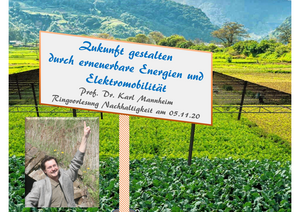
///
Speakers: Mannheim, K.
Organised by: AK Nachhaltigkeit
Subject area: interdisciplinary
GSiK areas: B
All lectures will take place online via Zoom.
You will find the access data and the possibility to register for the participation list in our WueCampus room: https://go.uniwue.de/gsik-teilnahme
The issue of sustainability has been an integral part of public discourse since the Rio Conference in 1992 at the latest and is once again gaining new relevance due to climate change. The seminar will examine how ideas of sustainable behaviour are implemented in practice by a wide range of actors, what goals they pursue and how sustainable behaviour determines their everyday lives and living environment.
The seminar takes place weekly from 4-6 pm.
///
Speakers: Daniel Best
Organised by: European Ethnology/ Folklore
Department: European Ethnology/ Folklore
GSiK areas: B, C
Further information and registration on WueStudy.
The event follows the idea of the "flipped classroom". Materials made available on WueCampus are prepared and discussed together in an online session.
You can either attend the weekly seminar "Global Health" or individual sessions equivalent to a lecture.
To participate, you can enrol in the WueCampus course yourself.
You can register your participation via another WueCampus course room athttps://go.uniwue.de/gsik-teilnahme.If you would like to attend the entire seminar, please re-register in the corresponding participation list for each date.
///
Speakers: Prof. Dr. August Stich, Eva-Maria Schwienhorst-Stich, Janina Zirkel, Karin Geffert
Organised by: Missionsärztliches Institut, Klinik für Tropenmedizin
Subject area: Medicine
GSiK area: B, C, D
Location: Online via ZOOM
Official opening of the Sustainable University Days Bavaria
Opening, greetings and subsequent keynote speakers LAK Bayern
At the official opening of the Sustainable University Days Bavaria, the Bavarian State Student Representation welcomes all participating students. From 11.30 to 12.15, Prof Dr Barbara Sponholz, spokesperson of the NHNB steering committee, will speak from Würzburg. Afterwards, there will be further items on the agenda, which will culminate in a panel discussion followed by a Q&A session with the audience: "Responsibility and role model of the university for the sustainable transformation of society at large?"
The livestream will take place on the LAK Bayern YouTube channel.
Participants can register for a GSiK certificate via a WueCampus course room athttps://go.uniwue.de/gsik-teilnahme.
You will be given a password for this during the event.
The Eco-Social University Days
How can we make our university and our society future-proof and sustainable? What concepts already exist? What can each individual do? The Eco-Social University Days are intended to provide a platform for such groundbreaking questions. At the first Eco-Social University Days in a long time, we want to focus on sustainability. Sustainable thinking is characterised by taking a broader view and considering the long term. In our opinion, a crisis is the perfect time to think about how we want to live in the coming decades, which dangers need to be averted and which structures should be reorganised. With the motto "Reshaping together now", we want to focus on what is feasible and on cooperation. As a place of change, innovation and education, universities are the central key to a development towards greater global responsibility. The ÖSHT will take place as part of the Sustainable University Days Bavaria. In addition, some events can be recognised for the GSiK certificate in sustainability and global responsibility. Join us, we look forward to seeing you!
The entire programme of the Ecosocial University Days will take place from 16.11.-28.11.20.
Current information from the Ecology Department
">Contact Ecology Department
///
Speakers: President of FAU Prof. Dr. Joachim Hornegger, Prof. Dr. Barbara Sponholz, further
Organised by: Department of Ecology
Subject area: interdisciplinary
GSiK area: B
Location: Online via YouTube Live Stream
Welcome to the Eco-Social University Days and presentation of the Sustainability Guidelines
Official welcome & interactive presentation of the Sustainability Guidelines
Prof. Dr Barbara Sponholz & Department of Ecology and Sustainability
Prof Dr Barbara Sponholz warmly welcomes all participants to the ÖSHT and lets us participate in the current developments at the university with regard to sustainability (~ 15 minutes). This is followed by the presentation of the Sustainability Guidelines by the Ecology Department. The Sustainability Guide is designed to help you live more sustainably in your everyday life. It also contains information on seals, CO2 balances, ideas for your own commitment and much more. The guide is your companion for a sustainable everyday life at the university. In addition, current sustainable projects and content are visualised for you in a mini-video series. You can download the guide for free here: https://www.uniwuerzburg.de/fileadmin/34000000/Referate_AKs/Ref_Oekologie/Leitfaden/Leitfaden_Januar20_final.pdf Join us and get tips and suggestions to make your everyday life more sustainable. We look forward to seeing you!
The lecture will take place online in the permanent Zoom room of the ÖSHT.
You can register your participation for a GSiK certificate via a WueCampus course room athttps://go.uniwue.de/gsik-teilnahme.
You will be given the password for this during the event.
The Eco-Social University Days
How can we make our university and our society future-proof and sustainable? What concepts already exist? What can each individual do? The Eco-Social University Days are intended to provide a platform for such groundbreaking questions. At the first Eco-Social University Days in a long time, we want to focus on sustainability. Sustainable thinking is characterised by taking a broader view and considering the long term. In our opinion, a crisis is the perfect time to think about how we want to live in the coming decades, which dangers need to be averted and which structures should be reorganised. With the motto "Reshaping together now", we want to focus on what is feasible and on cooperation. As a place of change, innovation and education, universities are the central key to a development towards greater global responsibility. The ÖSHT will take place as part of the Sustainable University Days Bavaria. All events can also be recognised for the GSiK certificate in sustainability and global responsibility. Join us, we look forward to seeing you!
The entire programme of the Eco-Social University Days will take place from 16.11.-28.11.20.
Current information from the Ecology Department
">Contact Ecology Department
///
Speakers: Prof. Dr. Barbara Sponholz
Organised by: Department of Ecology
Subject area: interdisciplinary
GSiK area: B
Location: Online via Zoom
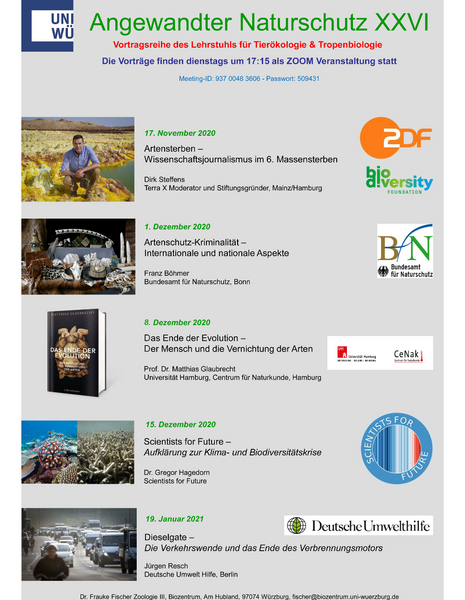
The event is part of the lecture series 'Applied Nature Conservation'.
Further information on the poster.
///
Speaker: Dirk Steffens
Organised by: Chair of Animal Ecology & Tropical Biology
Department: Biology
GSiK Area: B or C
The lecture will take place online via Zoom.
Access data Zoom:
You will find the access data for the Zoom meeting on the poster.
Confirmation of attendance:
During the event you can confirm your attendance for a GSiK certificate in the WueCampus course room at:
https://go.uniwue.de/gsik-teilnahme.You will receive the password for this during the event.
The event follows the idea of the "flipped classroom". Materials made available on WueCampus are prepared and discussed together in an online session.
You can either attend the weekly seminar "Global Health" or individual sessions equivalent to a lecture.
To participate, you can enrol in the WueCampus course yourself.
You can register your participation via another WueCampus course room athttps://go.uniwue.de/gsik-teilnahme.If you would like to attend the entire seminar, please re-register in the corresponding participation list for each date.
///
Speakers: Prof. Dr. August Stich, Eva-Maria Schwienhorst-Stich, Janina Zirkel, Karin Geffert
Organised by: Missionsärztliches Institut, Klinik für Tropenmedizin
Subject area: Medicine
GSiK area: B, C, D
Location: Online via ZOOM
Planetary Health is a scientific discipline, a philosophy for living and a social movement.
To participate in the lecture, you have to register beforehand by 4 PM CET Wednesday. Registration after this point will only allow you to join the following session, taking place two weeks later.
This lecture is part of the planetary health academy. Further lectures offered are:
02.12.2020, 5 PM: Planetary Health Dimensions
16.12.2020, 5PM: Planetary Health Ethics
13.01.2021, 5 PM: Gender and Global South Perspective
17.01.2021, 5 PM: Urban Development and Planetary Health

10.02.2021, 5 PM: Examples of transformation
https://planetary-health-academy.de/
The certification you can gain after attending all lectures is valued as a GSiK seminar.
Access to Zoom:
After registration
Confirmation of attendence:
Confirm your attendence for the GSiK certificate through registration.
///
Speakers: various
Organised by: German Climate and Health Alliance
Subject area: interdisciplinary
GSiK area: B
Location: Online via ZOOM (Access after registration)
Planetary Health is a scientific discipline, a philosophy for living and a social movement. The first lecture will give an introduction to key aspects, latest developments and emerging solutions. Dr Samuel Myers, Director of the Planetary Health Alliance, will focus on planetary health as a scientific discipline as well as emerging solutions. Melvine Otieno, initiator of the planetary health hub in Eastern Africa, will talk about the situation in Kenya and eastern Africa. Martin Herrmann, chair of the German Climate Change and Health Alliance, will point to the highly dynamic and fastly growing planetary health movement in the German speaking countries. The movement has its focus on converting knowledge into transformative action.
To participate in the lecture, you have to register beforehand by 4 PM CET Wednesday. Registration after this point will only allow you to join the following session, taking place two weeks later.
This lecture is part of the planetary health academy. Further lectures offered are:
02.12.2020, 5 PM: Planetary Health Dimensions
16.12.2020, 5PM: Planetary Health Ethics
13.01.2021, 5 PM: Gender and Global South Perspective
17.01.2021, 5 PM: Urban Development and Planetary Health

10.02.2021, 5 PM: Examples of transformation
https://planetary-health-academy.de/
///
Speakers: Samuel Myers, Martin Hermann, Melvine Otieno
Organised by: German Climate and Health Alliance
Subject area: interdisciplinary
GSiK area: B
Location: Online via ZOOM (Access after registration)
Simulation game "Discussing instead of planning - The Danni Conference "
Interactive simulation game with Fridays for Future Würzburg
Forest instead of tarmac! After the "Hambi", the "Danni" in Hesse became the next big symbol of the German climate movement. But how else can there be no consensus on how to deal with the forest? In an interactive simulation game, we want to hold a "Danni conference" with different roles distributed among the participants and get to know other perspectives together. We look forward to seeing you!
The lecture will take place online in the permanent Zoom room of the ÖSHT.
The registration of participation for a GSiK certificate takes place via a WueCampus course room athttps://go.uniwue.de/gsik-teilnahme.
You will be given the password for this during the event.
The Eco-Social University Days
How can we make our university and our society future-proof and sustainable? What concepts already exist? What can each individual do? The Eco-Social University Days are intended to provide a platform for such groundbreaking questions. At the first Eco-Social University Days in a long time, we want to focus on sustainability. Sustainable thinking is characterised by taking a broader view and considering the long term. In our opinion, a crisis is the perfect time to think about how we want to live in the coming decades, which dangers need to be averted and which structures should be reorganised. With the motto "Reshaping together now", we want to focus on what is feasible and on cooperation. As a place of change, innovation and education, universities are the central key to a development towards greater global responsibility. The ÖSHT will take place as part of the Sustainable University Days Bavaria. In addition, all events can be recognised for the GSiK certificate in sustainability and global responsibility. Join us, we look forward to seeing you!
The entire programme of the Eco-Social University Days will take place from 16.11.-28.11.20.
Current information from the Ecology Department
">Contact Ecology Department
///
Speakers: Fridays for Future Würzburg
Organised by: Department of Ecology
Subject area: interdisciplinary
GSiK area: B
Location: Online via Zoom
Lecture "Psychology of socio-ecological change "
interactive lecture with the Initiative Psychologie im Umweltschutz e.V.
What is environmental psychology? How do people interact with their environment? Environmental psychology is a discipline that deals with how people think, feel and act in their environment and with the interaction between people and their environment. Two questions are central to environmental psychology: How does the environment influence us humans? And: How do we humans influence the environment? These questions will be addressed in our interactive lecture. We look forward to seeing you!
The lecture will take place online in the permanent Zoom room of the ÖSHT.
You can register your participation for a GSiK certificate via a WueCampus course room athttps://go.uniwue.de/gsik-teilnahme.
You will be given the password for this during the event.
The Eco-Social University Days
How can we make our university and our society future-proof and sustainable? What concepts already exist? What can each individual do? The Eco-Social University Days are intended to provide a platform for such groundbreaking questions. At the first Eco-Social University Days in a long time, we want to focus on sustainability. Sustainable thinking is characterised by taking a broader view and considering the long term. In our opinion, a crisis is the perfect time to think about how we want to live in the coming decades, which dangers need to be averted and which structures should be reorganised. With the motto "Reshaping together now", we want to focus on what is feasible and on cooperation. As a place of change, innovation and education, universities are the central key to a development towards greater global responsibility. The ÖSHT will take place as part of the Sustainable University Days Bavaria. In addition, all events can be recognised for the GSiK certificate in sustainability and global responsibility. Join us, we look forward to seeing you!
The entire programme of the Eco-Social University Days will take place from 16.11.-28.11.20.
Current information from the Ecology Department
">Contact Ecology Department
///
Speakers: Initiative Psychologie im Umweltschutz e.V.
Organised by: Department of Ecology
Subject area: interdisciplinary
GSiK area: B
Location: Online via Zoom
Film evening "The true cost: What does your T-shirt really cost? "
Interactive film evening with mutual exchange
Student Initiative for Nature and Sustainability FHWS
The true cost: What does your T-shirt really cost? Who makes your clothes and what does that mean for the environment? We want to find out together with you and cordially invite you to an online film evening to watch the documentary "The true cost". Together, we want to develop our awareness of our consumption without pointing the finger at others. This will be followed by a plenary discussion in which we will talk about, reflect on and criticise the film. Join us from home and enjoy a great evening with us!
The lecture will take place online in the permanent Zoom room of the ÖSHT.
The registration of participation for a GSiK certificate takes place via a WueCampus course room athttps://go.uniwue.de/gsik-teilnahme.
You will be given the password for this during the event.
The Eco-Social University Days
How can we make our university and our society future-proof and sustainable? What concepts already exist? What can each individual do? The Eco-Social University Days are intended to provide a platform for such groundbreaking questions. At the first Eco-Social University Days in a long time, we want to focus on sustainability. Sustainable thinking is characterised by taking a broader view and considering the long term. In our opinion, a crisis is the perfect time to think about how we want to live in the coming decades, which dangers need to be averted and which structures should be reorganised. With the motto "Reshaping together now", we want to focus on what is feasible and on cooperation. As a place of change, innovation and education, universities are the central key to a development towards greater global responsibility. The ÖSHT will take place as part of the Sustainable University Days Bavaria. In addition, all events can be recognised for the GSiK certificate in sustainability and global responsibility. Join us, we look forward to seeing you!
The entire programme of the Eco-Social University Days will take place from 16.11.-28.11.20.
Current information from the Ecology Department
">Contact Ecology Department
///
Speakers: Student Initiative for Nature and Sustainability FHWS
Organised by: Ecology Department
Subject area: interdisciplinary
GSiK area: B
Location: Online via Zoom
Lecture "How can I make my technology and energy more sustainable? "
Interactive lecture followed by a plenary discussion
with Evander Hammer
In this interactive lecture, we will try to answer the question "How can I make my technology and energy more sustainable?" together. First of all, various sustainable options will be analysed and compared using the technology and energy cycle (approx. 30 minutes). A few keywords are shiftphones, the life cycle of batteries or sustainable energy providers. Afterwards, there will be a plenary discussion in which everyone can share their own experiences, thoughts or buying tips (approx. 15 minutes). We look forward to seeing you!
The lecture will take place online in the permanent Zoom room of the ÖSHT.
Registration for participation for a GSiK certificate takes place via a WueCampus course room athttps://go.uniwue.de/gsik-teilnahme.
You will be given the password for this during the event.
The Eco-Social University Days
How can we make our university and our society future-proof and sustainable? What concepts already exist? What can each individual do? The Eco-Social University Days are intended to provide a platform for such groundbreaking questions. At the first Eco-Social University Days in a long time, we want to focus on sustainability. Sustainable thinking is characterised by taking a broader view and considering the long term. In our opinion, a crisis is the perfect time to think about how we want to live in the coming decades, which dangers need to be averted and which structures should be reorganised. With the motto "Reshaping together now", we want to focus on what is feasible and on cooperation. As a place of change, innovation and education, universities are the central key to a development towards greater global responsibility. The ÖSHT will take place as part of the Sustainable University Days Bavaria. In addition, all events can be recognised for the GSiK certificate in sustainability and global responsibility. Join us, we look forward to seeing you!
The entire programme of the Eco-Social University Days will take place from 16.11.-28.11.20.
Current information from the Ecology Department
">Contact Ecology Department
///
Speaker: Evander Hammer
Organised by: Department of Ecology
Subject area: interdisciplinary
GSiK area: B
Location: Online via Zoom
Workshop "Tomorrow, tomorrow, just not today "
Interactive workshop with ;">registration
Psychologist4Future
"I'm going vegan from tomorrow!" "Soon I'll switch to green electricity." "From next year, I won't fly any more!" "From next week, I'll only buy unpackaged food." If you have plans like these and have always wanted to know how you can achieve them, then come and visit us! We cordially invite you to our varied workshop on the topic of climate-friendly everyday life. People underestimate climate change. Even though the scientific facts are clear. We want to consider together with you why it is quite normal that it doesn't always work, how we can best deal with it when it doesn't work, and what it takes to make it work. We will also look at psychological mechanisms as well as social action and the possible acceptance of this, but above all we want to reflect on your own behaviour with you. The aim is to come up with concrete ideas on how you can realise your resolutions. There will also be space to discuss what you are already doing and what is working well.
The lecture will take place online in the permanent Zoom room of the ÖSHT.
Registration by email to: oekosoz@uni-wuerzburg.de. There are 10 places in total.
Registration for participation for a GSiK certificate takes place via a WueCampus course room athttps://go.uniwue.de/gsik-teilnahme.
You will be given a password for this during the event.
The Eco-Social University Days
How can we make our university and our society future-proof and sustainable? What concepts already exist? What can each individual do? The Eco-Social University Days are intended to provide a platform for such groundbreaking questions. At the first Eco-Social University Days in a long time, we want to focus on sustainability. Sustainable thinking is characterised by taking a broader view and considering the long term. In our opinion, a crisis is the perfect time to think about how we want to live in the coming decades, which dangers need to be averted and which structures should be reorganised. With the motto "Reshaping together now", we want to focus on what is feasible and on cooperation. As a place of change, innovation and education, universities are the central key to a development towards greater global responsibility. The ÖSHT will take place as part of the Sustainable University Days Bavaria. In addition, all events can be recognised for the GSiK certificate in sustainability and global responsibility. Join us, we look forward to seeing you!
The entire programme of the Eco-Social University Days will take place from 16.11.-28.11.20.
Current information from the Ecology Department
">Contact Ecology Department
///
Speakers: Psychologist4Future
Organised by: Department of Ecology
Subject area: interdisciplinary
GSiK area: B
Location: Online via Zoom
The event follows the idea of the "flipped classroom". Materials made available on WueCampus are prepared and discussed together in an online session.
You can either attend the weekly seminar "Global Health" or individual sessions equivalent to a lecture.
To participate, you can enrol in the WueCampus course yourself.
You can register your participation via another WueCampus course room athttps://go.uniwue.de/gsik-teilnahme.If you would like to attend the entire seminar, please re-register in the corresponding participation list for each date.
///
Speakers: Prof. Dr. August Stich, Eva-Maria Schwienhorst-Stich, Janina Zirkel, Karin Geffert
Organised by: Missionsärztliches Institut, Klinik für Tropenmedizin
Subject area: Medicine
GSiK area: B, C
Location: Online via ZOOM
The main topic of this semester's series of events organised by the IPS Gender Working Group is 'Gender & Corona'.
Professor Dr Barbara Thiessen conducts research at Landshut University of Applied Sciences at the interface of care theories, gender and social work.
She will give an online lecture on Wednesday, 25 November 2020, 6 p.m. c.t. on Zoom entitled: The Corona crisis as an 'eye-opener': Care disasters in gender relations.
TheGender" working groupwill address the gender-specific inequalities that still exist in society under the motto "Same but different - what role does gender play?".
The lecture will take place online at the following Zoom link:
uni-wuerzburg.zoom.us/j/99050092295
Registration for participation takes place via another WueCampus course room athttps://go.uniwue.de/gsik-teilnahme.
///
Speaker: Prof.'in Dr. Barbara Thiessen
Organised by: AK Gender
Subject area: interdisciplinary
GSiK area: B, D
Location: Online via ZOOM
Lecture "Urban wilderness" - nature in the city
interactive lecture with Pascal Bunk
The term "urban wilderness" is an oxymoron, a contradiction in terms that only becomes clear at second glance. This 90-minute lecture is designed to give you this second look. You will get an introduction to terms such as wilderness, nature and ecosystems, find out why cities are becoming increasingly important for nature conservation and learn how we can easily develop our cities into biodiversity hotspots using the example of the CampusGarten.
The lecture will take place online in the permanent Zoom room of the ÖSHT.
Participation registration for a GSiK certificate takes place via a WueCampus course room athttps://go.uniwue.de/gsik-teilnahme.
You will be given the password for this during the event.
The Eco-Social University Days
How can we make our university and our society future-proof and sustainable? What concepts already exist? What can each individual do? The Eco-Social University Days are intended to provide a platform for such groundbreaking questions. At the first Eco-Social University Days in a long time, we want to focus on sustainability. Sustainable thinking is characterised by taking a broader view and considering the long term. In our opinion, a crisis is the perfect time to think about how we want to live in the coming decades, which dangers need to be averted and which structures should be reorganised. With the motto "Reshaping together now", we want to focus on what is feasible and on cooperation. As a place of change, innovation and education, universities are the central key to a development towards greater global responsibility. The ÖSHT will take place as part of the Sustainable University Days Bavaria. In addition, all events can be recognised for the GSiK certificate in sustainability and global responsibility. Join us, we look forward to seeing you!
The entire programme of the Eco-Social University Days will take place from 16.11.-28.11.20.
Current information from the Ecology Department
">Contact Ecology Department
///
Speakers: Pascal Bunk
Organised by: Department of Ecology
Subject area: interdisciplinary
GSiK area: B
Location: Online via Zoom
///
Speakers: Fischer, F.
Organised by: AK Nachhaltigkeit
Subject area: interdisciplinary
GSiK areas: B
All lectures will take place online via Zoom.
You will find the access data and the possibility to register for the participation list in our WueCampus room: https://go.uniwue.de/gsik-teilnahme

GSiK Day 2020: GLOBAL FAIRPLAY!?
Virtual student conference on 28 November 2020 on sustainability with a focus on global justice
In the global interplay of powers, the topic of "sustainability" is increasingly coming to the fore and could bring about a decisive change in the way people think and act. After all, global warming and its ecological consequences for all people are making the complexity and interdependencies visible worldwide. Political decisions and the lifestyle of each individual have a global impact that affects us all. How do we want to live together in the future? Thinking sustainably means thinking globally. Global fair play means not only finding and following common rules, but also recognising our fellow players as partners. It is about adopting an attitude that demonstrates respect and aims to respect and protect the physical and psychological integrity of all in fair play. What long-term strategies are we pursuing in order to shape fair play in this sense, not only locally but also globally? The effects will affect us all.
All information about the GSiK Day can be found on the website, including a detailed programme.
Registration is possible via WueStudy. External interested parties can register by e-mail.
Registration for participation for a GSiK certificate takes place via a WueCampus course room athttps://go.uniwue.de/gsik-teilnahme.
You will be given a password for this during the event.
The GSiK day is part of the Eco-Social University Days:
How can we make our university and our society future-proof and sustainable? What concepts already exist? What can each individual do? The Eco-Social University Days are intended to provide a platform for such groundbreaking questions. At the first Eco-Social University Days in a long time, we want to focus on sustainability. Sustainable thinking is characterised by taking a broader view and considering the long term. In our opinion, a crisis is the perfect time to think about how we want to live in the coming decades, which dangers need to be averted and which structures should be reorganised. With the motto "Reshaping together now", we want to focus on what is feasible and on cooperation. As a place of change, innovation and education, universities are the central key to a development towards greater global responsibility. The ÖSHT will take place as part of the Sustainable University Days Bavaria. In addition, all events can be recognised for the GSiK certificate in sustainability and global responsibility. Join us, we look forward to seeing you!
The entire programme of the Eco-Social University Days will take place from 16.11.-28.11.20.
Current information from the Ecology Department
">Contact Ecology Department
///
Speakers: various
Organised by: GSiK
Subject area: interdisciplinary
GSiK area: B
Location: Online via Zoom
The event is part of the lecture series 'Applied Nature Conservation'.
Further information on the poster.
///
Speaker: Franz Böhmer
Organised by: Chair of Animal Ecology & Tropical Biology
Department: Biology
GSiK Area: B or C
The lecture will take place online via Zoom.
Access data Zoom:
You will find the access data for the Zoom meeting on the poster.
Confirmation of attendance:
During the event you can confirm your attendance for a GSiK certificate in the WueCampus course room at:
https://go.uniwue.de/gsik-teilnahme.You will receive the password for this during the event.
Planetary Health is a scientific discipline, a philosophy for living and a social movement. In the second lecture, we will elaborate on some of the core dimensions of planetary health. In the first lecture series, we focused on the impact of climate change and biodiversity loss on health. This time we will have a closer look at environmental pollution as a consequence of human behaviour and mental health impacts related to climate and environmental change.
To participate in the lecture, you have to register beforehand by 4 PM CET Wednesday. Registration after this point will only allow you to join the following session, taking place two weeks later.
This lecture is part of the planetary health academy. Further lectures offered are:
02.12.2020, 5 PM: Planetary Health Dimensions
16.12.2020, 5PM: Planetary Health Ethics
13.01.2021, 5 PM: Gender and Global South Perspective
17.01.2021, 5 PM: Urban Development and Planetary Health

10.02.2021, 5 PM: Examples of transformation

https://planetary-health-academy.de/
Access to Zoom:
After registration
Confirmation of attendence:
Confirm your attendence for the GSiK certificate through registration.
///
Speakers: Gary Belkin, Nosiku Munyinda, Sonja Schönberg
Organised by: German Climate and Health Alliance
Subject area: interdisciplinary
GSiK area: B
Location: Online via ZOOM (Access after registration)
///
Speakers: Bobineau, J.
Organised by: AK Nachhaltigkeit
Subject area: interdisciplinary
GSiK areas: B
All lectures will take place online via Zoom.
You will find the access data and the possibility to register for the participation list in our WueCampus room: https://go.uniwue.de/gsik-teilnahme
///
Speakers: Bogaschewski, R.
Organised by: Sustainability working group
Subject area: interdisciplinary
GSiK areas: B
All lectures will take place online via Zoom.
You will find the access data and the possibility to register for the participation list in our WueCampus room: https://go.uniwue.de/gsik-teilnahme
The event is part of the lecture series 'Applied Nature Conservation'.
Further information on the poster.
///
Speaker: Dr Gregor Hagedorn
Organised by: Chair of Animal Ecology & Tropical Biology
Department: Biology
GSiK Area: B or C
The lecture will take place online via Zoom.
Access data Zoom:
You will find the access data for the Zoom meeting on the poster.
Confirmation of attendance:
During the event you can confirm your attendance for a GSiK certificate in the WueCampus course room at:
https://go.uniwue.de/gsik-teilnahme.You will receive the password for this during the event.
Planetary Health is a scientific discipline, a philosophy for living and a social movement.
Recognising the planetary health emergency radically changes the perspective on how we live, act and think. This implies critically reviewing existing ethical and philosophical concepts while we engage in transformative action at the same time. How do we understand our relationship to the natural agents and dynamics that we are part of? How do we work together in the face of the evolving emergency? How do we deal with the enormous injustice becoming apparent?
To participate in the lecture, you have to register beforehand by 4 PM CET Wednesday. Registration after this point will only allow you to join the following session, taking place two weeks later.
This lecture is part of the planetary health academy. Further lectures offered are:
02.12.2020, 5 PM: Planetary Health Dimensions
16.12.2020, 5PM: Planetary Health Ethics
13.01.2021, 5 PM: Gender and Global South Perspective
17.01.2021, 5 PM: Urban Development and Planetary Health

10.02.2021, 5 PM: Examples of transformation
https://planetary-health-academy.de/
Access to Zoom:
After registration
Confirmation of attendence:
Confirm your attendence for the GSiK certificate through registration.
///
Speakers: Jennifer Cole, Kai Spiekermann, Katharina Wabnitz, Teddie Potter
Organised by: German Climate and Health Alliance
Subject area: interdisciplinary
GSiK area: B
Location: Online via ZOOM (Access after registration)
Planetary Health is a scientific discipline, a philosophy for living and a social movement.
We will deepen our understanding of Planetary Health Ethics through focusing on two key themes related to justice: the gender perspective and the Global South perspective.
To participate in the lecture, you have to register beforehand by 4 PM CET Wednesday. Registration after this point will only allow you to join the following session, taking place two weeks later.
This lecture is part of the planetary health academy. Further lectures offered are:
02.12.2020, 5 PM: Planetary Health Dimensions
16.12.2020, 5PM: Planetary Health Ethics
13.01.2021, 5 PM: Gender and Global South Perspective
17.01.2021, 5 PM: Urban Development and Planetary Health

10.02.2021, 5 PM: Examples of transformation
https://planetary-health-academy.de/
Access to Zoom:
After registration.
Confirmation of attendence:
Confirm your attendence for the GSiK certificate through pre-regsitration.
///
Speakers: Courtney Howard, Vanessa Nakate, Women Leaders for Planetary Health
Organised by: German Climate and Health Alliance
Subject area: interdisciplinary
GSiK area: B
Location: Online via ZOOM (Access after registration)
///
Speakers: Paeth, H.
Organised by: AK Nachhaltigkeit
Subject area: interdisciplinary
GSiK areas: B
All lectures will take place online via Zoom.
You will find the access data and the possibility to register for the participation list in our WueCampus room: https://go.uniwue.de/gsik-teilnahme
Double lecture:
- Retail in crisis? Effects of the Covid19 pandemic on the Würzburg retail sector // Dr Alexandra Appel and Dr Sina Hardaker
- Sustainability at the JMU - Current measures and future strategies // Prof. Dr Barbara Sponholz
The lecture will take place online via Zoom . Access will be provided via thewebsite of the student councilwill be announced.
You will find the possibility to register for the participation list in our WueCampus room:https://go.uniwue.de/gsik-teilnahme
///
Speaker: Dr Alexandra Appel and Dr Sina Hardaker, Prof. Dr Barbara Sponholz
Organised by: FIS Geography
Department: Geography
GSiK area: B, C
Double lecture:
- Soil water balance of forest sites with different lithologies in northern Bavaria // Prof. Dr Kneisel and Dr Ullmann, Julian Fäth
- Biodiversity and ecosystem services of forests (BioHolz project) // Dr Joachim Rathmann
The lecture will take place online via Zoom . Access will be provided via thewebsite of the student councilwill be announced.
You will find the possibility to register for the participation list in our WueCampus room:https://go.uniwue.de/gsik-teilnahme
///
Speaker: Prof. Dr. Kneisel and Dr. Ullmann, Julian Fäth, Dr. Joachim Rathmann
Organised by: FIS Geography
Subject area: Geography
GSiK area: B, C
///
Speakers: Fenske, M.
Organised by: AK Nachhaltigkeit
Subject area: interdisciplinary
GSiK areas: B
All lectures will take place online via Zoom.
You will find the access data and the possibility to register for the participation list in our WueCampus room: https://go.uniwue.de/gsik-teilnahme
Planetary Health is a scientific discipline, a philosophy for living and a social movement. Cities can be drivers of enormous power for the required transformative changes. Therefore , innovative urban development presents major opportunities to improve population health, reduce greenhouse gas emissions and prepare for health risks exacerbated by climate change. Unlocking their transformative power, cities are key settings for the implementation of a diverse set of interventions to address major planetary health challenges. Lecturers will highlight key facets of transdisciplinary and transformative urban development for a healthy and good life in cities. They will present the situation and stories of two cities, one in the south, one in the north.
To participate in the lecture, you have to register beforehand by 4 PM CET Wednesday. Registration after this point will only allow you to join the following session, taking place two weeks later.
This lecture is part of the planetary health academy. Further lectures offered are:
02.12.2020, 5 PM: Planetary Health Dimensions
16.12.2020, 5PM: Planetary Health Ethics
13.01.2021, 5 PM: Gender and Global South Perspective
17.01.2021, 5 PM: Urban Development and Planetary Health

10.02.2021, 5 PM: Examples of transformation
https://planetary-health-academy.de/
Access to Zoom:
After registration
Confirmation of attendence:
Confirm your attendence for the GSiK certificate through registration.
///
Speakers: Anna Dyson, Olga Sarmiento, Björna Althoff
Organised by: German Climate and Health Alliance
Subject area: interdisciplinary
GSiK area: B
Location: Online via ZOOM (Access after registration)
Lecture: Climate experience Würzburg. Experience urban climate live // Christian Hartmann
The lecture will take place online via Zoom . Access will be via thewebsite of the student councilwill be announced.
You can sign up for the participation list in our WueCampus room:https://go.uniwue.de/gsik-teilnahme
///
Speaker: Christian Hartmann
Organised by: FIS Geography
Department: Geography
GSiK area: B, C
///
Speakers: Gersdorf, C.
Organised by: AK Nachhaltigkeit
Subject area: interdisciplinary
GSiK areas: B
All lectures will take place online via Zoom.
You will find the access data and the possibility to register for the participation list in our WueCampus room: https://go.uniwue.de/gsik-teilnahme
Double lecture:
- Customised climate research for agriculture and forestry in Lower Franconia // Prof. Dr Paeth
- Modelling regional environmental change in Lower Franconia // Christian Schäfer
The lecture will take place online via Zoom . Access will be provided via thewebsite of the student councilwill be announced.
You can sign up for the participation list in our WueCampus room:https://go.uniwue.de/gsik-teilnahme
///
Speaker: Prof. Dr. Paeth, Christian Schäfer
Organised by: FIS Geography
Department: Geography
GSiK area: B, C
Planetary Health is a scientific discipline, a philosophy for living and a social movement. Knowledge needs to be put into action. And here we go! In our last lecture we will give you the space to present your project for a healthy planet. By inspiring each other we will bring our work to the next level.
To participate in the lecture, you have to register beforehand by 4 PM CET Wednesday. Registration after this point will only allow you to join the following session, taking place two weeks later.
This lecture is part of the planetary health academy. Further lectures offered are:
02.12.2020, 5 PM: Planetary Health Dimensions
16.12.2020, 5PM: Planetary Health Ethics
13.01.2021, 5 PM: Gender and Global South Perspective
17.01.2021, 5 PM: Urban Development and Planetary Health

10.02.2021, 5 PM: Examples of transformation
https://planetary-health-academy.de/
Access to Zoom:
After registration
Confirmation of attendence:
Confirm your attendence for the GSiK certificate through registration.
///
Speakers: NN
Organised by: German Climate and Health Alliance
Subject area: interdisciplinary
GSiK area: B
Location: Online via ZOOM (Access after registration)
Double lecture:
1.) Freddy Bangelesa - "Climate Change and variability related to crop yield and Malaria prevalence from the Democratic Republic of the Congo"
2.) Dr Sarah Schönbrodt-Stitt & Dr Michael Thiel - "Global change and regional action - German-West African cooperation in research and teaching"
You can find the link for Zoom on the FSI Geography website
Registration for participation for GSiK takes place via a WueCampus course room athttps://go.uniwue.de/gsik-teilnahme.
///
Speakers: Freddy Bangelesa // Dr Sarah Schönbrodt-Stitt, Dr Michael Thiel
Organised by: FSI- Geography
Department: Geography
GSiK area: B, C
Location: Online
When Angela Merkel stated that the internet was still uncharted territory for all of us after the revelations by former NSA employee Edward Snowden in June 2013, she was met with derisive mockery from the internet community. Numerous memes quickly went viral online, showing the Chancellor with an obsolete slide rule in her hand or in a Photoshop version of a painting of the discovery of America by Christopher Columbus with the caption "Merkel discovers #newland".
For many, the internet seems to have become a natural part of our everyday lives. At the same time, it still presents us with new questions and challenges and oscillates between ambivalent positions: The internet as a democratising space for participation or a battleground for far-reaching users? A place of freedom or an instrument of surveillance? An equalising multiplier of knowledge or a medium of stultification? A creative space for new, cultural practices or a place for innocent copyright infringements? Does the Internet as a global system bring the world closer together or does it contribute to its division?
In the seminar, we will look at the emergence and development of the Internet, analyse aspects of the Internet as a social and cultural space and discuss its effects and significance together. Because as the internet activist Aaron Swartz once said: "It's not OK to not understand the internet any more." Let's tackle it.
For your degree programme, it can be credited with 5 ECTS points each for the ASQ area (Bachelor) or the FüG (teaching degree) if you submit an examination.
///
Speaker: Carina Odenbreit M.A.
Organised by: GSiK
Subject area: interdisciplinary
GSiK area: B
Dates
27.05.2020 18:00 - 20:00 (preliminary discussion)
03 to 5 July from 09:00 - 16:00
Location: Hubland North, Building 70, 00.105
Due to the corona pandemic, this event may take place online. Further information and registration on Wuestudy
Globalisation, refugees, exploitative child labour, sustainability, ... - many current issues are forcing their way into schools. Thinking in global systemic contexts, intercultural sensitivity, the ability to work in teams - new skills are required of school leavers. Our involvement in complex global processes is omnipresent.
Global learning is a pedagogical concept that trains the skills of pupils and young people to orientate themselves in the global society and to live responsibly. The workshop provides insights into the working methods and materials of global learning. With practical, experience-based exercises and games, we look at our relationship to the Global South, track down the images in our heads and experience surprises when changing perspectives. Aha-experiences and interesting learning experiences guaranteed.
///
Speakers: Marita Matschke, Christoph Steinbrink
Venue: Wittelsbacherplatz 1, 02.203
Organised by: GSiK
Subject area: Teaching degree
GSiK area: A, B or C
Due to the corona pandemic, this event may have to be cancelled or postponed. Further information and registration on WueStudy.
Environmental protection is not left-wing per se, but has brown roots and continuities. Pioneers were the life reformers and homeland conservationists in the German Empire. Later, they planted native plants on the verges of Hitler's motorways, drew up landscape plans for the Germanisation of living space in the East and tested biodynamic agriculture in concentration camps.
Today, the AfD considers climate change to be hysteria and conspiracy, while neo-Nazis are settling in marginalised areas as organic farmers and ideologues of the New Right want to break the left's sovereignty of interpretation on the environmental issue in order to spread anti-Semitic and racist ideas. The former present themselves as defenders of coal mining, air travel and meat consumption without borders, while the latter appeal to those environmentalists and critics of globalisation who love their homeland, nation and state and want to preserve the diversity of cultures as if they were different animal and plant species.
All currents on the right, as well as deep ecologists and biocentrists, insinuate that the planet is overpopulated, an idea that resonates with the much-vaunted centre of society. Greenpeace founder Paul Watson describes humans as a virus that has infested the earth.
The lecture offers an overview of current activities and positions of the right in the environmental field as well as a historical review. It also deals with ideological interfaces that the right can utilise.
Peter Bierl is a freelance journalist, member of the trade union Verdi and lives with his family near Munich. His most recent publications are "Einmaleins der Kapitalismuskritik" (Unrast-Verlag 2018) and "Grüne Braune: Umwelt-, Tier- und Heimatschutz von rechts" (Unrast-Verlag 2014).
///
Speaker: Peter Bierl
Organised by: GSiK
Subject area: interdisciplinary
GSiK area: B
The lecture will take place online via Zoom . You will find the access data and the possibility to register for the participation list in our WueCampus room: https://go.uniwue.de/gsik-teilnahme
Climate change is the greatest threat to global health in the 21st century because we humans are inextricably linked to our planet's systems and depend on their integrity. The destruction of natural habitats and the increasing proximity of animals and humans make an estimated 800,000 unknown viruses a risk. The current Covid-19 crisis is a stark reminder of the links between human health and the health of our planet's natural systems.
The health sector plays a central role in communicating, preventing and following up on the effects of the climate and environmental crisis. This is precisely where the Planetary Health Academy's free online lecture series comes in: Leading experts - including Luisa Neubauer (Fridays for Future), Dr Eckart von Hirschhausen and Prof Harald Lesch (LMU Munich) - will explain the connections between human health, political, economic and social contexts, as well as the natural systems of our planet, in ten related events taking place once a week.
Programme:
13.05.2020 / 17:00
Climate science, planetary boundaries, tipping points, biodiversity
Professor Stefan Rahmstorf (Potsdam Institute for Climate Impact Research) & Professor Josef Settele (Helmholtz Centre for Environmental Research)
20.05.2020 / 17:00
Health consequences of exceeding planetary boundaries
Professor Claudia Traidl-Hoffmann (Klinikum rechts der Isar TU Munich, Helmholtz Centre for Environmental Health), Dr. Nick Watts (Executive Director Lancet Countdown on Climate Change and Health, in English) & Professor Hanns-Christian Gunga (Charité - Universitätsmedizin Berlin)
27.05.2020 / 17:00
Planetary Health: Examples and Perspectives
Professor Sabine Gabrysch (Charité - Universitätsmedizin Berlin , Potsdam Institute for Climate Impact Research) & Dr Kim Grützmacher (World Conservation Research). Kim Grützmacher (World Conservation Society)
03.06.2020 / 17:00
Transformation, Crisis and Social Tipping Elements
Dr Martin Herrmann (KLUG), Luisa Neubauer (Fridays For Future) & PD Dr Ilona Otto (Potsdam Institute for Climate Impact Research). Ilona Otto (Potsdam Institute for Climate Impact Research, in English)
10.06.2020 / 17:00
Transdisciplinary Perspectives
Professor Dr Claudia Kemfert (German Institute for Economic Research), Professor Harald Lesch (LMU Munich) & Professor Johannes Vogel (Director Museum für Naturkunde, Berlin)
17.06.2020 / 17:00
Communication
Dr Eckart von Hirschhausen (Healthy Earth Healthy People Foundation) & Dr Nick Watts (Executive Director Lancet Countdown on Climate Change and Health, in English)
24.06.2020, 5 pm
Transformative Action 1: Lifestyle
Dr Ralph Krolewski (GP), Professor Annette Peters (Helmholtz Centre for Environment and Health Munich, on request) & Dr Marco Springmann (Oxford University, on request)
01.07.2020 / 17:00
Transformative Action 2: Agenda Setting, Zero Emission Health Sector, Divestment
PD Dr Christian Schulz (Klinikum rechts der Isar TU Munich)
08.07.2020, 17:00
Transformative Action 3: Examples of Transformative Action
Health for Future student groups
///
Speakers: various
Location: Online via Zoom
Organised by: The Climate Change and Health Alliance
Subject area: interdisciplinary
GSiK areas: B
All further information and registration on the website of the Planetary Health Academy.
Plastic is light, versatile, colourful, stable and durable. This is another reason why plastic causes enormous problems.
We dispose of around 8 million tonnes of plastic in the sea every year. Waste from products that have often only been used for a few minutes.
By 2050, there may be more plastic than fish in the oceans. Microplastics can already be found in almost every table salt.
Shouldn't we just think about smart solutions? With pleasure!
Our Summer School is all about connections, concrete challenges and clever ideas.
We discuss solutions from the following areas: Bionics, systemic thinking, sufficiency, innovation and the private sector.
The Plastic Summer School 2020 will take place weekly from 15 June to 24 July 2020. The time is not yet known.
///
Speakers*: Dr Frauke Fischer (contact person)
Location: Online
Organised by: Chair of Animal Ecology and Tropical Biology
Department: Biology
GSiK areas: B, C
Registration until 01.06.2020 by mail: fischer@biozentrum.uni-wuerzburg.de
Further information on the poster, WueStudy and the homepage of the Biocentre.
Understanding why we need to protect biodiversity.
Climate change, pandemics, refugee flows...
All of this is also linked to the destruction of biodiversity and ecosystems. Intact ecosystems provide a variety of ecosystem services that humans cannot replace at all or only with great technical effort and at high cost.
In this course, we will look at the major challenges of international nature conservation, learn about solutions and innovative approaches, and find out what drives the destruction of nature. How does the destruction of nature manifest itself? Where do we need to act and how? What are the key actors and players?
Join us on a journey from A for app to Z for zoo
The event will take place as a full-day block course from 13 - 17 July 2020
If face-to-face events are not possible during this period, the course will be offered as an e-learning format
If you have any questions, please contact Dr Frauke Fischer directly: fischer@biozentrum.uni-wuerzburg.de
///
Speakers: Frauke Fischer
Location: Biozentrum (basement); practical room D003b
Organised by: Animal Ecology and Tropical Biology
Department: Biology
GSiK areas: B, C
Further information on the poster and registration on WueStudy (ASQ-Pool).