
Johann von Egloffstein as the founder of the university
The founding of the University of Würzburg in 1402: Johann von Egloffstein as the university’s founder
Portrait: Prince-Bishop Johann I von Egloffstein – Part 5
The University of Würzburg was founded as part of the ‘second wave of university foundations’ across Europe, which originated with the University of Prague, established in 1347. This was followed by Vienna in 1365, Heidelberg in 1386, Cologne in 1388, Erfurt in 1392 and, finally, Würzburg in 1402. Despite its early decline, the university’s foundation deserves the utmost attention: it is not only one of the oldest universities in the Holy Roman Empire, but also the oldest in Bavaria and, moreover, the first institution of higher education to date to have been founded by a clerical sovereign.
A prince with a university education
Johann was one of the first ecclesiastical princes to have attended university himself. He studied in Heidelberg in 1389/90, but he probably obtained his academic degrees – baccalaureus in decretis and magister artium – at other universities; the University of Prague is generally thought to have been the one. This personal experience of university life is likely to have been decisive in his decision to found a university in Würzburg, a project which he realised in a short space of time despite the most adverse circumstances – given the financial straits of the bishopric and the conflict with the city of Würzburg, which had only just been violently brought to an end.
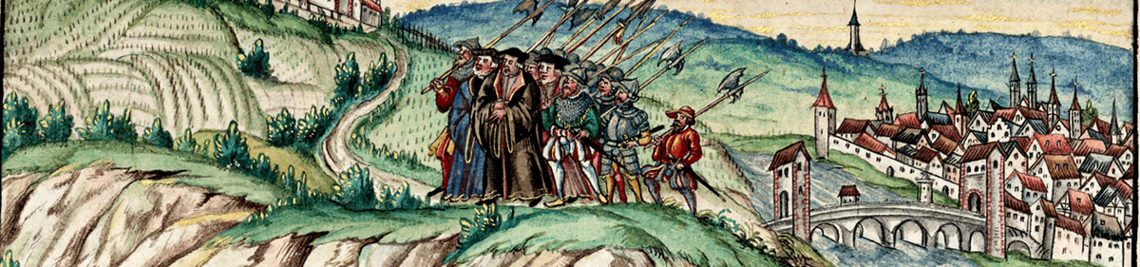
Proclamation by Magister Lorenz Fries on behalf of Bishop Johann von Egloffstein
The Papal Privilege
On 10 December 1402, Pope Boniface IX issued the charter of foundation, at the request of Johann von Egloffstein, for the establishment of a university in Würzburg.
For the bishopric and the town, the founding of the university had a number of welcome side effects: it enhanced not only Johann’s reputation, but also that of the bishopric and the town, as in the Middle Ages towns with a university were regarded as places of the very highest standing. The town’s location and circumstances were also highly favourable for establishing a university.
Würzburg as a university town
Particular praise was given to the ‘mild climate’ and the ‘abundance of food’. Würzburg generally boasted a large community of scholars, as Charlemagne had established the Würzburg Cathedral School in his time. The economic boom should also be borne in mind, as it attracted well-off professors and students to the city. Furthermore, the bishopric and the city were able to educate their own young people themselves and thus exert a certain influence over them.
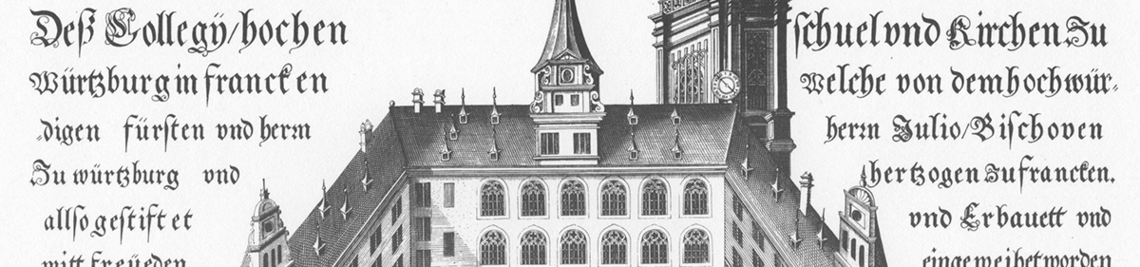
As for the premises of the university, Johann had already made arrangements for these even before the papal privilege was granted. He acquired the Hof zum Katzenwicker in 1402 and then the Großer Löwenhof in 1403. The university was subsequently housed in both properties.