

Insignia and historical awareness
From Seal, Sceptre & Robe to Corporate Identity
The History of the University of Würzburg from the Middle Ages to the Present Day
Embark on a journey of discovery through the history of the University and its insignia. Gain an insight into its traditions and customs, recall lost treasures and relive the past. Which symbols have remained in the University’s collective consciousness; and which has it moved away from?
Endowed with its own jurisdiction and extensive manorial rights, Alma Julia was far more than merely an educational institution. The university’s sense of self-importance is evidenced not only by accounts of lavish secular celebrations, but also by numerous symbolic objects such as the papal charter of foundation from 1402, seals, academic gowns and, not least, buildings such as the old university building. Much of what had, over time, faded from the consciousness of the universitas – the community of lecturers and students – is now being recalled.
Anniversaries reflect an awareness of history
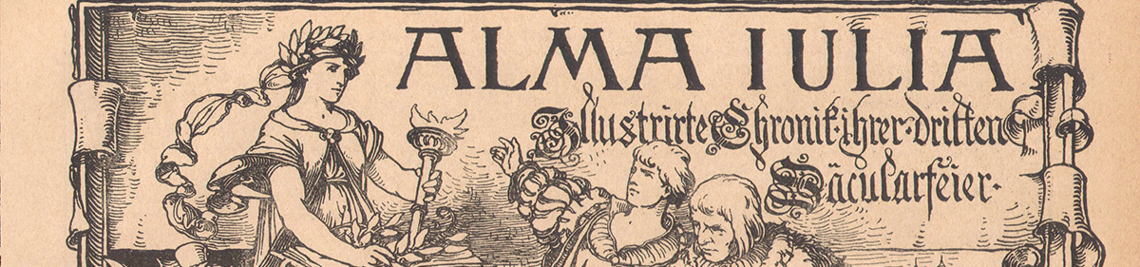
What began as a gathering of dignitaries for a select group of guests, featuring a service of honour, commemorative speeches and honorary doctorates, soon became a major representative event for the university, featuring demonstrations of the latest scientific achievements, and ultimately culminated in a wide-ranging public relations campaign to promote the university as an educational institution, attracting large crowds and taking on the character of a public festival. The last centenary celebration in honour of Julius Echter even took place over the course of a whole year, featuring smaller events and a major ceremony in May. Read more!
Foundation, reforms and upheavals
The circumstances surrounding the founding of the university in Würzburg are truly remarkable. Würzburg was in a precarious economic situation. Nevertheless, Prince-Bishop Johann von Egloffstein sought to persuade the cathedral chapter to support the establishment of a university. As one of the first prince-bishops, Egloffstein had himself received a university education and now brought these achievements and his wealth of experience to the city of Würzburg, becoming the first ecclesiastical ruler to found the first university in what is now Bavaria. Read more!
Corporations are becoming a microcosm
In the 11th and 12th centuries, the first universities developed in both Bologna and Paris. Bologna was distinguished above all by its Faculty of Law, whilst Paris was noted for its faculty of theology. Unfortunately, the exact dates and circumstances of their foundation can no longer be ascertained. The only certainty is that, from the 13th century onwards, the first structural forms of a sworn community became apparent. The formation of a ‘universitas magistrorum et scholarium’ (community of teachers and students) was intended to ensure security and self-determination. Read more!
Seals as identifying features
The practice of affixing a seal impression, which has been widespread since the Middle Ages, served two functions equivalent to those of a modern signature: the image of the seal-bearer served as a distinguishing feature, whilst the impression attested to the identity of the bearer and guaranteed the authenticity of a document. Furthermore, the seal was used to authenticate documents – a privilege that presupposed the seal-bearer’s own legal sphere, which was the case for universities. Read more!
university sceptre
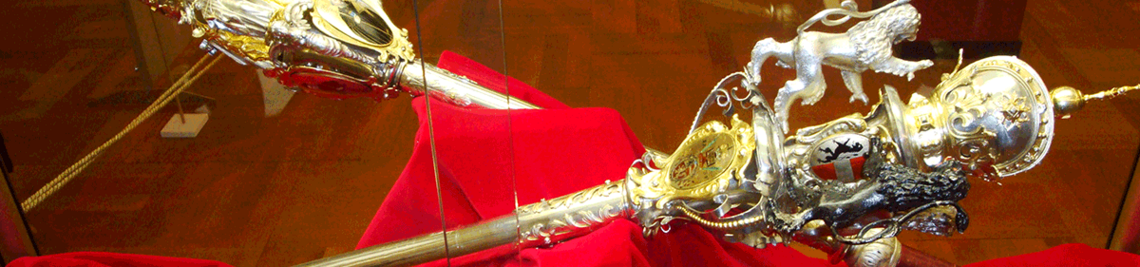
As an official insignia symbolising the office and dignity of its bearer, the sceptre was for a long time one of the indispensable items at the university. It was used during ceremonial processions, handover ceremonies for the Rector’s office, and the conferral of academic degrees. For example, when graduates were awarded their academic degrees, they were required to touch the tip of the sceptre whilst taking the oath. The sceptres were carried by the university ushers, who led the way ahead of the graduates during the procession. Read more!
"Gasthaus zur akademischen Freiheit" – University jurisdiction
In the Middle Ages, the administration of justice was a privilege granted to institutions by the respective sovereign. In 1587, Prince-Bishop Julius Echter granted the University of Würzburg precisely such a privilege. This academic jurisdiction recognised the University as an independent corporation within the Prince-Bishopric. In this way, it established its position in relation to the town’s citizens, the cathedral chapter and the sovereign himself. Read more!
Wine, interest and tax – property ownership and financing
The success of any university stands or falls on its funding. In the Middle Ages, estates and the income they generated, as well as revenue from bonds, were regarded as the most important sources of income. Unlike his predecessor, Johann von Egloffstein, Prince-Bishop Julius Echter von Mespelbrunn endowed the university with a substantial endowment. To this day, the University of Würzburg continues to receive income from some of these endowments. Read more!
From Farm to Campus – Buildings and Locations
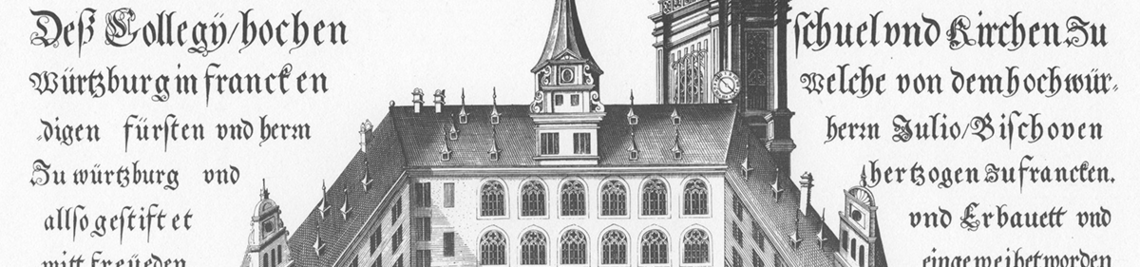
Ever since the university was founded in 1402, it has been the university’s buildings, as well as its insignia, that have shaped its public image. The university buildings embody the institution’s self-image. What was initially a religious orientation under the prince-bishops was replaced by a secular one in the 19th century. ‘Veritati’ – committed to truth – is the inscription affixed to the building of the New University. With this commitment, the University of Würzburg strives to fulfil its social responsibility. Read more!
Clothes make the academic
Even today, membership of certain groups can often be recognised by the way people dress. The same was true in the Middle Ages and the early modern period. University members were clearly recognisable as such in public by their clothing. Within the university, clothing distinguished the wearer’s position: the length of the gowns signified rank. Colours indicated membership of a faculty; much like a code, they ensured rapid communication. The same applied to the student body. Read more!