

Founding and Endowment
Foundation, reforms and upheavals
The circumstances surrounding the founding of the university in Würzburg are highly remarkable. Würzburg found itself in a precarious economic situation following the battle between the townspeople and the Prince-Bishop’s soldiers at Bergtheim on 11 January 1400. Nevertheless, Prince-Bishop Johann von Egloffstein sought to persuade the cathedral chapter to support the establishment of a university. Assessing the university’s foundation from a purely economic perspective is by no means sufficient. As one of the first prince-bishops, Egloffstein had himself received a university education and now brought these achievements and his wealth of experience to the city of Würzburg, becoming the first ecclesiastical ruler to found the first university in what is now Bavaria. The founder, Julius Echter von Mespelbrunn, was able to draw on this pioneering spirit and learn from the shortcomings of the initial establishment. Following extensive planning, meticulous consideration and many debates, he laid the foundation for a long period of prosperity for the Alma Julia.
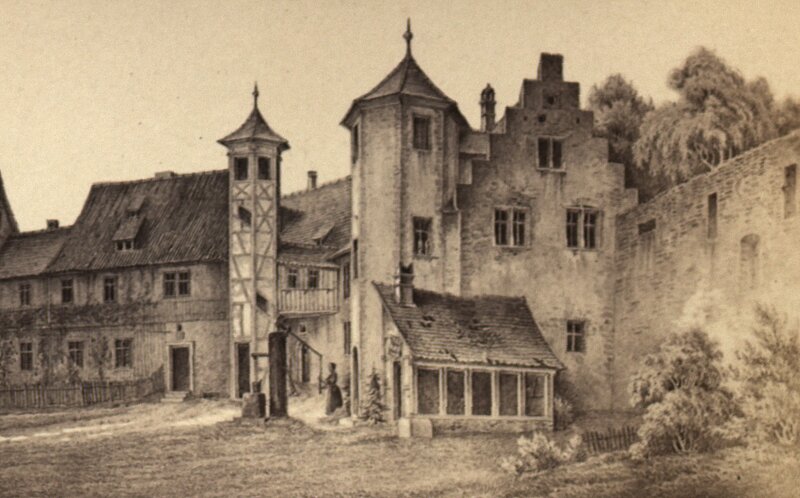
1402: The founding of the university by Johann von Egloffstein
For several years, the Prince-Bishopric of Würzburg had been suffering not only from chronic debt but also from considerable tensions between the citizens, who were striving for Würzburg to attain the status of a free imperial city, and the claims to power of the Prince-Bishop of Würzburg. The latter ultimately prevailed. Following his consecration as bishop in 1401, Johann von Egloffstein therefore had to contend not only with financial difficulties, but also with the recalcitrant canons, who rebelled against any tax levies, and with the resentful bourgeoisie, who still hoped for the city of Würzburg to be granted its independence.
Although both King Ruprecht of Wittelsbach and the Pope supported him, he thus had to overcome considerable resistance. Nevertheless, the Prince-Bishop founded a university in Würzburg as early as 1402. He acquired the necessary premises – the Hof zum Katzenwicker and the Großer Löwenhof – and on 10 December 1402, Pope Boniface IX issued the charter of foundation. However, due to a lack of financial resources and a lack of interest on the part of the city and the prince-bishopric, the new educational institution was not to prosper. Following the death of its founder and sole patron in 1411, it was not long before neglect gave way to gradual decay. Johannes Trithemius, abbot of the Schottenkloster in Würzburg, summed up his impressions of the University of Würzburg’s decline in the following verses: Balnea, census, amor, lis, alea, crapula, clamor, Impediunt multum Herbipoli studium, which roughly translates as ‘Bathing. Money and love, dice games, drunkenness and clamour soon brought an end to Würzburg’s great school.” Nevertheless, one cannot help but attach great significance to this foundation, as it was not only the first university in Bavaria but also the first to be founded by a spiritual sovereign. Thanks to the influx of high-ranking professors and fee-paying students, Würzburg enjoyed a brief golden age, which proved that the city was ideally suited as a centre of learning.
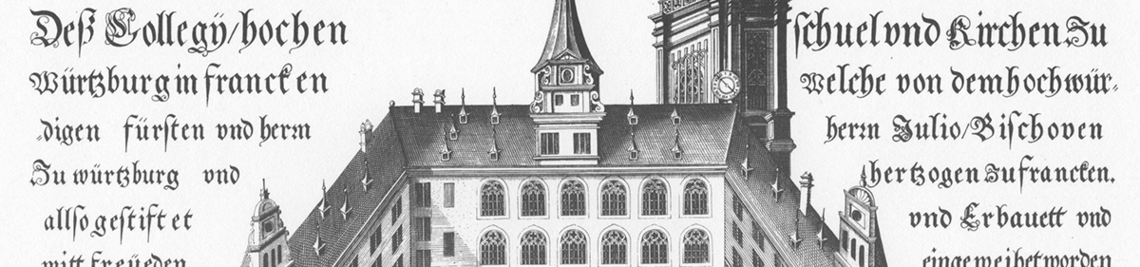
1582: The re-establishment of the university under Prince-Bishop Julius Echter von Mespelbrunn.
Julius Echter von Mespelbrunn – elected Prince-Bishop in 1573 – reopened the University of Würzburg in 1582 following many struggles against the cathedral chapter and the Jesuits’ dominance in the education sector. The Prince-Bishop, who was thoroughly educated in theology, the humanities and law, relentlessly asserted his will against the cathedral chapter and the Protestant nobility in order to emphasise and consolidate his sovereign authority in higher education policy as well. The canons accused him of wanting to ‘do everything as he saw fit’, but the Prince-Bishop threatened that, if necessary, he would achieve his aims with the help of papal and imperial support.
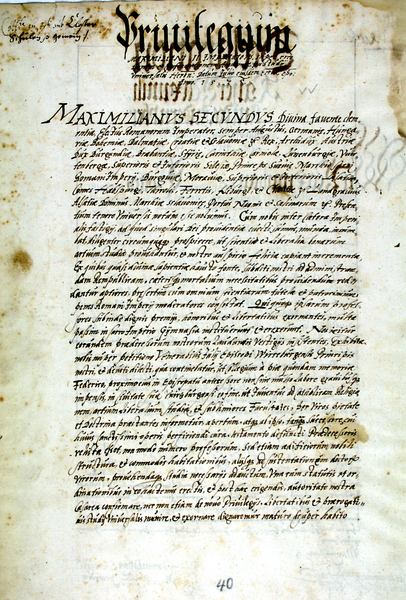
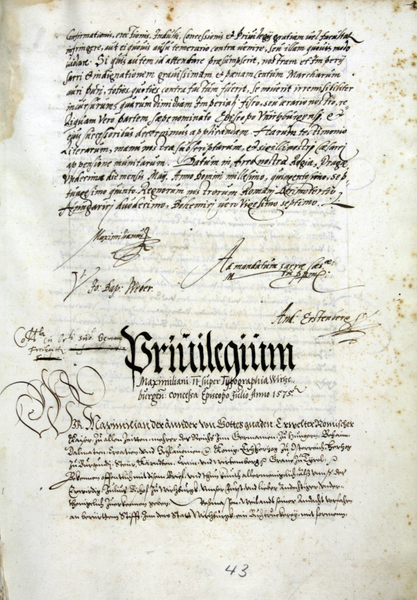
On 11 May 1575, Würzburg was granted a privilege by the Imperial Chancellery, and on 28 March 1576, Echter also received a privilege from Pope Gregory XIII, who, following the models of the universities in Bologna and Paris, granted the institution all the rights of a ‘universitas studii generalis’. In doing so, the Pope explicitly referred to the first foundation of the university under Johann I von Egloffstein; however, in contrast to the privilege granted at that time, he required all professors and doctoral candidates to take an oath to the Tridentine Creed. The university saw itself as an ‘academia catholica’, a denominationally oriented institution comprising four faculties: Philosophy, Catholic Theology, Law and Faculty of Medicine. To ensure stability and a secure future, the Prince-Bishop had endowed his university with extensive properties and estates. Thanks to this reliable financial foundation, neither drastic changes nor reorganisation measures were necessary for a long time. The university was able to develop positively and reach its first heyday.
Following the death of Julius Echter in 1617, his heart was interred in the university church as a special honour bestowed by the university, where it remains to this day, despite several interruptions caused by the turmoil of war and the reconstruction efforts of the 20th century.
1802–14: Reforms under Maximilian I Joseph of Bavaria
Following its incorporation into
Bavaria
, the University of Würzburg underwent comprehensive and far-reaching reforms for the first time since its foundation (the first Bavarian reform), which were almost equivalent to a complete re-establishment. Until then, changes to the academic regulations had mainly concerned day-to-day teaching, such as the introduction of German as the language of instruction in mathematics lectures by Prince-Bishop Friedrich Karl von Schönborn in 1731, or the opening of the university to students of non-Catholic denominations.
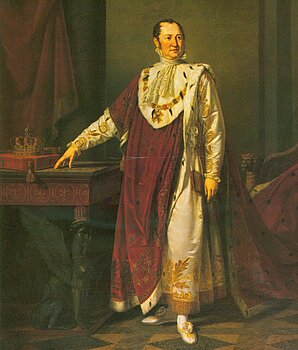
In the wake of secularisation, the principle of Catholicism was abolished and a state curator took over the running of the university in place of the rector. This brought to an end the existence of the Alma Julio-Fridericana as a Catholic institution of higher education and a university under the jurisdiction of the bishopric. Efforts were also made to modernise the teaching staff, though this far exceeded the financial means of the university’s budget. The bold restructuring of the curriculum gave the university a completely new character. The aim was to establish contact with and compete against the renowned universities of northern Germany, and indeed to surpass them; as a result, the Bavarian sovereign saw himself very much as the ‘second founder’ of the Julio-Maximilianea.
However, after an initial false dawn, student numbers dried up. Many professors left, and it became apparent that the new teaching staff could not be integrated without difficulty. Although the university’s incorporation into the Grand Duchy of Tuscany in February 1806 and its accession to the Confederation of the Rhine in September of the same year raised hopes of renewed independence from the authoritarian Bavarian policies of recent years under the white-and-blue royal rule, they were, however, forced to face the sobering reality of new financial and military obligations towards France, which robbed their regained independence of its appeal. The Grand Ducal Government’s organisational decree for the University of Würzburg, dated 7 September 1809, dashed all hopes of regaining lost rights. This was followed by a comprehensive re-Catholicisation and the definitive disenfranchisement of the university and its governing bodies. The teaching staff was reduced and the range of courses significantly curtailed. The decline of the once-flourishing university was also reflected in dwindling student numbers.
When Minister Montgelas toured Franconia in 1814, he noted that the once-renowned University of Würzburg had indeed ‘fallen into a state of great disrepair’. With somewhat diminished zeal, now more closely aligned with financial constraints, the Bavarian reforms were reinstated. However, the university did not regain its former splendour until state interference had also been removed.
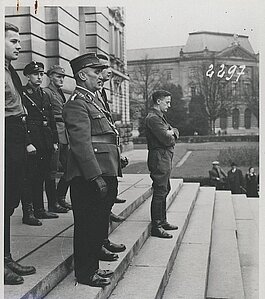
1933–45 The University of Würzburg during the Third Reich During
the
Third Reich
, the University lost not only all rights to self-governance and administration for the first time, but also its dignity and academic freedom. Through the reintroduction of the career civil service in April 1933 and the Act ‘on the Dismissal and Transfer of University Lecturers in Connection with the Reorganisation of the German Higher Education System’ of January 1935, leadership positions across the board were filled with party members loyal to the regime, whilst lecturers deemed politically undesirable were eliminated. German universities were restructured into an effective instrument of power for the National Socialist ideology, with the curricula also being radically reshaped in line with National Socialist ideology.
National Socialist ideology spread rapidly amongst large sections of the student body, with the result that, with a few exceptions, the University of Würzburg was soon regarded as a reliable pillar of the system. The natural sciences were exploited for political ends, with particularly disgraceful examples being the establishment of an ‘Institute for Hereditary Sciences and Racial Research’ in the ‘Welzhaus’ on Klinikstraße, whose director, Professor Ludwig Schmidt, published various works on National Socialist racial ideology. From 1938 onwards, the staunch National Socialist and SA Obersturmbannarzt Ernst Seifert ultimately led the university until the downfall of the Third Reich in 1945.
From 1945: Rising from the Ruins
The war had led to the decline of the universities, as many lecturers were called up for military service and students were conscripted into military, labour and auxiliary services. The devastating air raid on 16 March 1945 destroyed a large proportion of the university buildings, along with their contents, including four-fifths of the Old University’s library collection and large parts of the university archives.
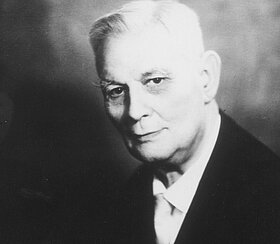
However, it was not only the acute shortage of buildings but also the consequences of National Socialism that caused the university serious difficulties after the end of the war. Most members of the teaching staff were deemed to have a ‘tainted past’, and as a result of the Denazification Act, the faculties and their staff had all but ceased to exist. In order to enable a fresh academic start, the first step was to address the shortage of all essential supplies.
Thanks to Julius Echter’s foresight, the university was able to draw on extensive woodland holdings, so that, through barter and ingenuity, around 82 per cent of the university’s buildings had been restored by 1952. By joining forces, the faculties – led by the Faculty of Theology – were able, under Josef Martin, the first rector to be freely elected after the end of the war, to resume teaching by 1947 in various undamaged premises throughout Würzburg. Over the years, the university organised itself according to customary law and was finally granted a new charter in 1968.