

Seal
Seals as identifying features
The practice of affixing a seal impression, which has been widespread since the Middle Ages, served two functions equivalent to those of a modern-day signature: the image of the seal-bearer served as a distinguishing feature, whilst the impression attested to the identity of the seal-bearer and guaranteed the authenticity of a document. Furthermore, the seal was used to authenticate documents – a privilege which presupposed that the seal-bearer possessed their own legal sphere, which was the case with universities.
Seals in the academic sphere
In the university sector, the use of seals began as early as the second half of the 13th century. The University of Paris is regarded as a pioneer in this regard; it derived the necessary rights from its corporate law and, following a dispute with church representatives, secured these rights from Pope Innocent IV. It also served as a model for Julius Echter, who, when securing privileges for his newly founded institution, sought to obtain the prerogatives enjoyed by all the major European universities.
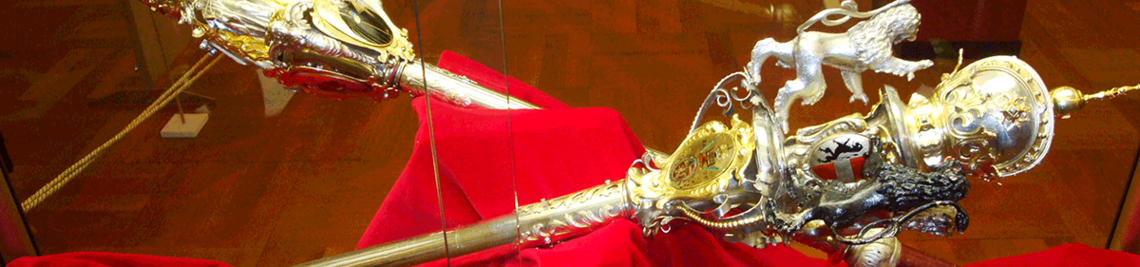
Alongside the sceptre and the register, a university’s seals were among the rector’s insignia, which were conferred upon him by his predecessor upon taking office. As a rule, three types of seals were found in the universities of the Holy Roman Empire, namely the university seal, the faculty seal and the rector’s seal. In the case of the university seal, a further distinction was usually made between large and small seals. Each seal was permitted to be used only on a specific type of document, so that the importance and significance of the document could be immediately inferred from this. The seal impression was intended to indicate both the owner and their function. The typical design of a university seal therefore usually included a motto (inscription) and an image – most often a depiction of a saint. This referred to the patronage of the university or the faculty.
Seal of the University of Würzburg from its early years
The only item to have survived from the time of theuniversity’sfounding by Johann von Egloffstein is the rector’s seal. The seal field depicts a magister seated on a lectern, holding a book, alongside the motto‘rectoratus studii Herbipolensis’in lapidary script. A double wreath of leaves surrounds the seal field itself. The impression appears on the charter issued on 2 October 1410, in which both teachers and students undertake to observe the privileges granted by Bishop Johann. It is not known whether a small seal existed at Egloffstein alongside the rector’s seal. It may, however, be assumed that, had it existed, both would have borne the same design.
Seal of the University of Würzburg from the period of its restoration
The statutes of 1587 reveal the decision to acquire one large and one small seal, as well as their intended uses, though not their design. It is known, however, that Julius Echter had ceded to his university the right, granted to him by the Emperor, to determine the content of the seals.
The large university seal
The large seal, crafted from silver, was more an object of prestige than one of practical use. The fact that its impression appears only rarely on university documents also suggests that it was seldom used in practice. Only the most significant matters, such as the granting of privileges, the sealing of revenues and annual income, were validated by its impression. The university archives served as the repository for the large seal. Over time, however, this ceremonial insignia ceased to be regarded as a symbolic object. The reasons for this, as well as the exact period, remain unclear.
The original silver seal die was so severely deformed by the heat during the air raid on Würzburg on 16 March 1945 that no images are any longer recognisable. Today, a lacquer impression dating from 1606 provides a record of its design. The inscription and the motif correspond to those of the University’s current large embossed seal.
The small university seal
The small university seal – also known as the ‘Sekret’ – was essentially similar in design to the large one and was also used as the Rector’s seal. The only visual differences from the main seal were its oval shape and the absence of a year date. The use of the ‘Sekret’ is documented from 1595. Two surviving documents from that year attest to its use as wax impressions, including a scholarship endowment by the cathedral dean Erasmus Neustetter.
The Faculty Seals
In addition to the two university seals, each of the four higher faculties also had its own seal, which was used, amongst other things, to authenticate doctoral degree certificates. These were kept together with the faculty funds and the statutes in the so-called ‘cista’.
Seals during the Royal Bavarian period
Immediately following Würzburg’s transfer to the Electorate of Bavaria in 1802, the University of Würzburg initially chose not to adapt the designs of its seals to reflect the new political circumstances. It was not until two years later that the designs were replaced with the Bavarian sovereign’s coat of arms, bearing the inscription ‘Sigillum Universitatis Julio Maximilianeae Würzburgensis’. The small seal was given the motto ‘Sigillum U. J. Maximilianeae’. The name of the Bavarian King Maximilian I – referred to by some as the ‘second founder’ – was now also incorporated into the university’s name and officially recognised. During the brief reign of the Habsburg Grand Duke Ferdinand III of Tuscany, Würzburg University was compelled by decree to cease using these seals and reverted to its original ones for a time.
With the transition in 1814 back to Bavaria, which had by then become a kingdom, it once again became necessary to acquire new seals. However, as the proposal submitted in this regard went unanswered, the university resumed use of its 1802 seals, a practice that was to remain unchanged until the onset of Nazi rule. It was not until 1936 that the order to use the Reich seal at all German universities was issued. Through a special application submitted to the Reich Ministry of Education, the University of Würzburg was able to circumvent the requirement to hand over the original seals to the Main Mint. Instead, they continued to be kept at the Museum of Art History, where many of them suffered severe damage in a fire on 16 March 1945. Even though some were not destroyed by the flames, the passage of time has nevertheless left traces of corrosion, which now make it considerably more difficult to recognise the images.
Seals today
Today, the University of Würzburg uses metal and rubber stamps alongside an embossing seal. In the case of the large embossing seal, it has chosen to honour tradition and still features the image and motto from the period of its revival and foundation. Unlike its predecessor from the Echter era, the small embossing seal is round and features only the founder’s coat of arms within an oval cartouche. The inscription on it reads ‘Bayer. Julius-Maximilians-Universität Würzburg’, even though the word ‘Bayerische’ was removed from the university’s name in 2006.
Read more about the University’s small embossing seal!
From the logo to the corporate identity
The role of creating a sense of identity, which for centuries was the preserve of seals, is now fulfilled by the corporate identity introduced in 2006. A consistent colour scheme and a shared logo are intended to convey a company’s personality, including its value system and corporate culture, through visual elements such as letterheads and its online presence. The impetus for developing a new identity design arose from the project to redesign the university’s website. In this context, a concept for print materials was also developed, adapted to the new look of the website, which ensures consistency across all materials and thus contributes to the standardisation and modernisation of the university’s public image. Two traditional elements were incorporated through the choice of the blue-and-white colour combination for the lettering and the highlighting of the Echter coat of arms from the large seal. To the outsider, however, the institution’s identity is primarily revealed through the lettering. The simplification of the seal’s design has clearly pushed the traditional element into the background in favour of the modern component as the distinguishing feature.