
Debt, tensions and conflicts
The capture of the cathedral chapter
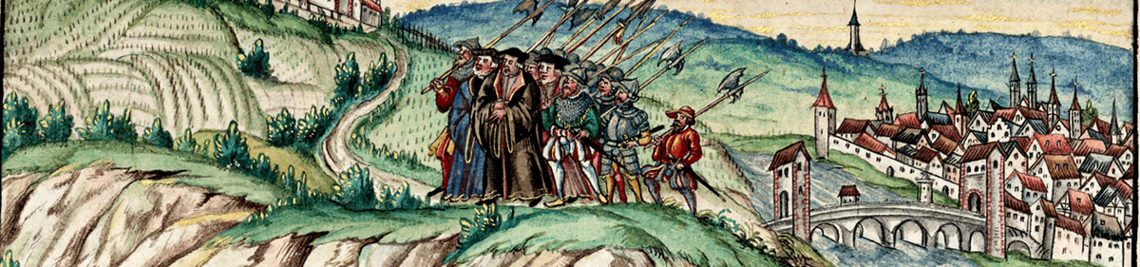
The Bishopric and the city of Würzburg experienced difficult times, particularly at the turn of the 14th to the 15th century. The political and social climate in Würzburg was characterised by conflicts between ‘three forces’. There were frequent conflicts, varying in scale and intensity, between the bishop, the cathedral chapter and the townspeople. After the Battle of Bergtheim, however, the townspeople made no further attempts to assert their freedoms for the time being, and Johann had to focus primarily on dealing with his cathedral chapter. Relations between Bishop Johann and the cathedral chapter had been very strained since his demands for tax payments in 1407, and when the canons refused to make the payments due, he had 18 of them arrested during a procession in the summer of 1408 and imprisoned at Marienberg Fortress. The remaining members of the cathedral chapter promptly fled to Ochsenfurt, where the canons allied themselves with the local nobility against Johann.
Pope Gregory XII subsequently issued a papal bull against the rebellious canons, whilst they, for their part, demanded that Johann be excommunicated. Next, Gregory XII sent an envoy to bring the conflict to an end. The consensus reached stipulated that the canons were to make the payments, but in return they were granted greater rights to participate in the prince-bishop’s rule.
Alliances and conflicts
Johann was able to forge alliances with the neighbouring towns and counties of the Bishopric – some of which were also at odds with one another – with the aim of protecting the Bishopric from further conflicts. In 1408, he reached an agreement with the Counts of Henneberg, Wertheim, Rieneck, Castell and Hohenlohe. However, despite all his efforts, the Würzburg District Court Regulations drafted by Johann were not voluntarily adopted by the Franconian imperial cities. In 1403, the Burgraves of Nuremberg in particular put up considerable resistance. Nor was the adoption of the title of Duke met with much favour by some of his contemporaries. Once the dispute with the Burgraves of Nuremberg had been settled, Johann allied himself in 1407 with Burgrave Frederick VI against the imperial city of Rothenburg ob der Tauber to settle a feud over the Würzburg Land Court Regulations. Following mediation by King Ruprecht, Bishop Johann and the neighbouring principalities did eventually reach an agreement on the jurisdiction of the Würzburg Land and Bridge Court, as well as on the ecclesiastical court.
Financial crisis in the Bishopric
For many years, the bishopric and the town had been suffering from chronic debt: upon becoming bishop, Johann von Egloffstein inherited debts totalling around 2.5 million guilders from his predecessor, Bishop Gerhard von Schwarzburg, alone.
Despite this enormous debt burden – Johann von Egloffstein was even briefly excommunicated by the Curia in 1406 for insolvency – he continued to acquire territories, castles and fiefs for the bishopric. However, even numerous pledges of property did little to alleviate the dire financial situation.
Due to the financial crisis, Johann sought an audience with the Pope and was in fact granted permission to levy additional taxes – these were borne by the clergy. The treasurer of the papal College of Cardinals, Bishop Heinrich of Tuskulum, lifted Johann’s excommunication in 1406 and once again extended the deadline for him to settle his debts. But the Franconian knight Johann von Kronberg was less lenient and had summoned the bishop, as a defaulting debtor, to appear before the ‘Freigericht zu den hunden ’. Once again, it was King Ruprecht who stood behind Johann von Egloffstein and intervened on his behalf.
To get his debts under control, Johann not only imposed further levies and taxes, but also introduced a completely new division of the town’s territory, designed to facilitate the collection of levies and the deployment of military troops. This division endured for centuries and can still be recognised in many places today – for example, in the districts of Sanderau and Pleich.