
Neubaukirche
The Neubaukirche
Formerly a place of worship, today a festival hall
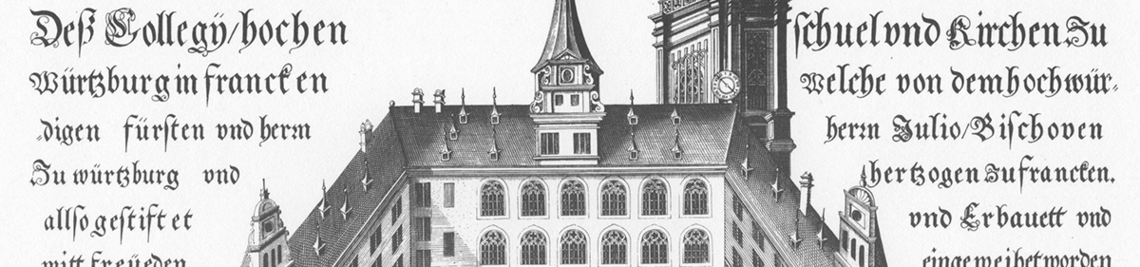
When the University of Würzburg was founded in 1582 by the Catholic Prince-Bishop Julius Echter von Mespelbrunn, it was also given its own church. Today, it is no longer used for church services, but as a festival hall for university celebrations, concerts and conferences. The Neubaukirche is said to have got its name from the fact that the newly erected university building complex in the 16th century was the new building par excellence in Würzburg.
The history of the church begins in 1583, one year after the university was founded. At that time, the prince-bishop commissioned the Mainz court architect Georg Robin, who had already planned the Juliusspital for him in 1576, to build the church. The east, north and west wings of the Echter University had already been erected when the workers began building the church in 1586. Two years later, Echter commissioned the construction of a tomb for himself in the church. He decreed that his heart should be buried there.
The university church was consecrated on 8 September 1591. The entire building complex comprising the church and university was completed the following year.
Swedish invasion halted restoration work
The building was thus completed very quickly - too quickly, as it turned out. Soon, considerable interventions were necessary to preserve the building fabric: in 1626, the church vault had to be removed and eventually it was even necessary to cover the tower. The restoration work was not yet well underway when it came to a standstill in 1631 due to the Swedish invasion. The church then remained without a roof and vault for almost 70 years - wind and weather were able to cause damage unhindered.
In 1696, Prince-Bishop Johann Gottfried von Guttenberg commissioned the artist Antonio Petrini to restore the church: the church was given a new vault and a new roof, the six buttresses on the south side were reinforced by three more, and the first floor of the tower and the octagon above it were built. This essentially gave the tower its current shape.
Altars and pulpit were sold
Prince-Bishop Johann Philipp Greiffenclau commissioned a new interior for the church in the 18th century. However, this did not remain for long; most of it was lost when the building was secularised at the beginning of the 19th century and subsequently used as a depository for files and books. Even the baroque high altar, the side altars and the pulpit were removed and sold.
The depot was closed in 1851. The church was given an organ and was used for church services again from 1867. In 1882, during the 300th anniversary celebrations of the university, it was decided to redesign the interior. By 1890, the church had been colourfully decorated by renowned artists of the time - including fresco paintings by the Munich painter Barthelme.
However, the church was not to last long: It only shaped the cityscape in all its splendour for just over half a century. During the bombing raid on Würzburg on 16 March 1945, the new church and most of the university library, which was housed in the Old University, were almost completely destroyed, as was the rest of the city.
A year of clearing rubble
It took around a year, until the end of 1946, just to clear the rubble, and even after that the restoration of the university's functioning teaching activities took priority. The church and tower were only given a makeshift roof in 1949. However, it was destroyed by a storm in the mid-1950s. After this, the fate of the church increasingly became the focus of those responsible: it quickly became clear that the university alone would not be able to shoulder the financing of a new building. For this reason, only the most important safety measures were initially carried out. These were completed by 1957.
At the end of the 1960s, the then Rector, Professor Werner Uhlmann, decided to take up the cause. Together with the Würzburg press, he launched a series of fundraising campaigns. In one of the first campaigns, you could buy an engraving by Högler and Salver for 50 marks. This was the beginning of a concerted campaign by artists, entrepreneurs, scientists, student associations, companies, clubs, journalists and many, many citizens of the city and the surrounding area, in which no stone was left unturned, from open days to concerts, exhibitions and much more, in order to raise as much money as possible for the reconstruction. Among other things, gold and silver medals were minted, the proceeds of which were used for the new church and for which the Würzburg Beautification Association provided the basic funding.
In 1970, the Senate passed a resolution to rebuild the church. It was decided that it would be used as a concert hall, banqueting hall, assembly hall, room for exhibitions etc. after its renovation. On 28 September 1977, the time had finally come: the topping-out ceremony for the tower of the new church was celebrated.
Five years later, in 1982, the university celebrated the 400th anniversary of its foundation by Julius Echter. To mark the occasion, the heart of the university founder - which had survived the night of the bombing in March 1945 intact in a tin capsule - was ceremoniously buried in a specially made memorial in the church on 13 September. The new church was finally reopened on 7 November 1985.
Lighting and carillon
Today, the church is in better shape than ever before: shortly after its completion in 1986, it was equipped with a Schuke organ (the second largest organ in the city after the one in the cathedral). Since 2003, the church tower has been illuminated after dark. This puts it on a par with other large buildings in the city in this respect too.
Finally, in 2005, on the initiative of the then university chancellor Bruno Forster, the church tower was fitted with a carillon, the likes of which can only be found at a few other European universities apart from Würzburg. The church also owes much of this additional equipment to a large number of donors.
More information
"Die Würzburger Universitätskirche 1583-1973. Zur Geschichte des Baues und seiner Ausstattung", Reinhardt Helm, in: "Quellen und Beiträge zur Geschichte der Universität Würzburg", Vol. 5, Neustadt a.d. Aisch 1976
Art in the Neubaukirche
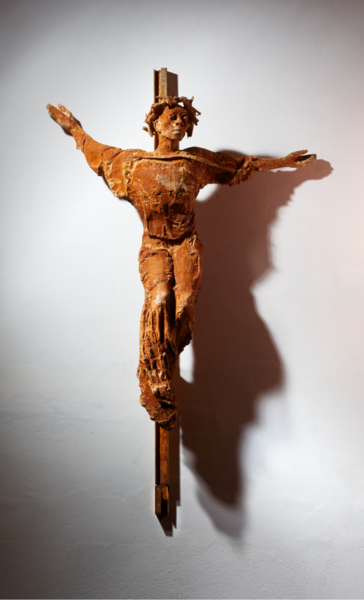
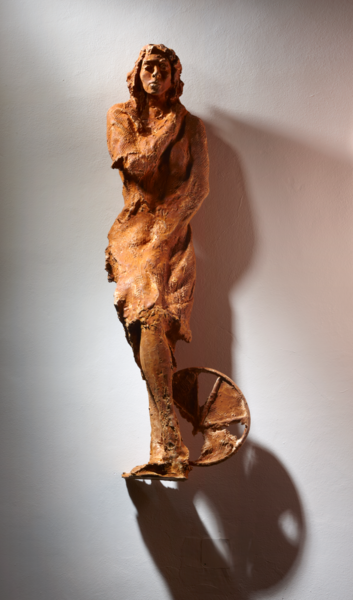
Since 10 December 2010, two works of art have adorned the fronts of the two side wings of the Neubaukirche. The sculptures - Christ and St Catherine - were created by the painter and sculptor Karlheinz Oswald. They are each 140 centimetres tall. Their surface has a special patina, which was achieved using wax, plaster and oxidisation.
Christ and St Catherine are intended to "symbolically refer to the original use of the new church as the church of the university refounded by Prince-Bishop Julius Echter and to its current use as the festive auditorium of Alma Julia", as the art consultant of the Diocese of Würzburg, Canon Dr Jürgen Lenssen, put it.
The former chairman of the University Association, Prince Albrecht zu Castell-Castell, had made the suggestion to decorate the new church artistically. The university management under President Alfred Forchel took up this suggestion and implemented it together with the art department of the Diocese of Würzburg. The purchase was financed by funds from the diocese and donations, which Forchel and the honorary senator of the university, Professor Dieter Salch, had jointly appealed for.