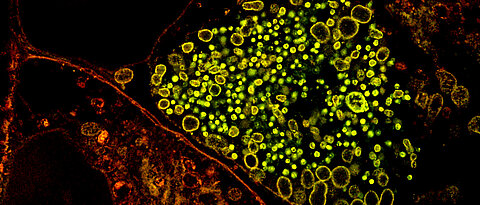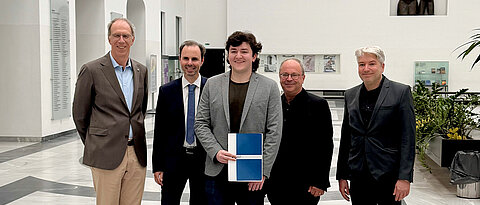

The cancer gene MYC camouflages tumours by suppressing alarm signals that normally activate the immune system. This finding from a new study offers a promising way to improve existing cancer therapies as well as develop new ones.
more
The cancer gene MYC camouflages tumours by suppressing alarm signals that normally activate the immune system. This finding from a new study offers a promising way to improve existing cancer therapies as well as develop new ones.
more
According to a new study by the University of Würzburg, Bavarian meadows are the most monotonous insect habitats. Surprisingly, fields and settlements often offer more diversity than grassland.
more
Gandhi, Putin, Trump: when people become messianic figures, similar mechanisms are always at work. The new Käte Hamburger International Centre at the University of Würzburg aims to uncover them.
more
Magnetic particle imaging: New center at JMU – Würzburg urologist honored for study – InnoCube: Würzburg small satellite spends a year in space – Quantum computing: Junior research group works on key technology
more
Researchers from the Universities of Würzburg and Braunschweig have provided empirical evidence for the first time: Maths lessons are a suitable place to promote skills for sustainable development.
more
Children from less privileged families are less likely to attend grammar school after primary school, despite achieving the same results. Targeted mentoring can reduce this gap.
more
A research team at the University of Würzburg has, for the first time, uncovered how E. coli bacteria sneak into the prostate. The discovery opens the door to potential new treatments for bacterial prostatitis.
more
Increased use of organoids in cancer research: The Würzburg lighthouse project "Preclinical Models" is working towards this goal. The Bavarian Centre for Cancer Research is funding it with almost one million euros.
more
Researchers from Würzburg, Braunschweig, and the US identifiy Cas12a3 nuclease showing precise activity. Their study is published in Nature.
more
Experts are increasingly turning to machine learning to predict antibiotic resistance. The results should be treated with caution, as a new study by HIRI shows.
more
For several years, researchers in Würzburg have been using state-of-the-art single-cell analysis to study individual cells. The new “in situ RNA imaging analyzer” now also enables the visualization of complex disease processes.
more
Würzburg economist Peter Bofinger is a member of the pension commission appointed by the German government. The commission is tasked with drawing up proposals for pension reforms.
more
Major international investment in a Würzburg start-up: The company aims to develop more effective and more readily available CAR-T therapies against cancer.
more
The Würzburg-led research unit “Relativistic Jets in Active Galaxies” has been investigating the powerful plasma beams emitted by supermassive black holes since 2021. Now the DFG has extended its funding.
more
A new study from the University of Würzburg's Chair of Mathematics Education shows that AI research for STEM education focuses too much on technology and neglects the holistic development of students.
more