Candida auris, a fungus that is life-threatening to humans, has spread rapidly across the globe. Researchers at the University of Würzburg suspect this may be due to rising temperatures.
more


Candida auris, a fungus that is life-threatening to humans, has spread rapidly across the globe. Researchers at the University of Würzburg suspect this may be due to rising temperatures.
more
Nobel Laureate Georg Nagel: Cycling to a TV Appearance — Parisian Modernism: Researchers Analyze Nadar’s Guest Book — Smartphones: A Game Aims to Prevent Cannabis Use Among Teens
more
The guest book of the French photography pioneer Nadar (1820-1910) is the focus of a new DFG project involving the Universities of Würzburg, Konstanz and Tübingen.
more
JMU Professor Carolin Wienrich, as a member of the Advisory Council for Consumer Affairs, has co-authored a report. It deals with consumer protection in online retail involving AI agents.
more
In companies in Mainfranken, AI has become part of everyday working life, but not in automated processes. This is shown by an online survey conducted by the Würzburg-Schweinfurt Chamber of Industry and Commerce and the University of Würzburg.
more
A new logo, new colours and typefaces: The University of Würzburg has modernised its visual identity. The aim is to strengthen its profile in the competition for students, researchers and funding.
more
Lectures for the winter semester 2026/27 begin at the University of Würzburg on 12 October. At the annual press conference marking the start of the semester, President Paul Pauli provided updates on current developments at the university.
more
Julius-Maximilians-Universität Würzburg (JMU) achieves an excellent position in the international comparison. It performs particularly strongly in research quality and knowledge transfer.
more
Würzburg Professor Georg Nagel (73) has been awarded the 2026 Nobel Prize in Physiology or Medicine for his discoveries in optogenetics. He conducted research at JMU for more than 20 years.
more
The University of Würzburg does not receive funding as a University of Excellence. Nevertheless, the university intends to continue pursuing its strategy developed during the application process.
more
The Faculty of Chemistry and Pharmacy has awarded an honorary doctorate to Jarugu Narasimha Moorthy, Professor at the Indian Institute of Technology Kanpur, in recognition of his achievements.
more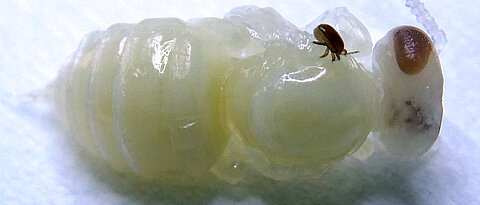
The Tropilaelaps mite has reached Turkey, thereby crossing the border into Europe. Experts have now been discussing in North Macedonia how this dangerous bee mite can be contained.
more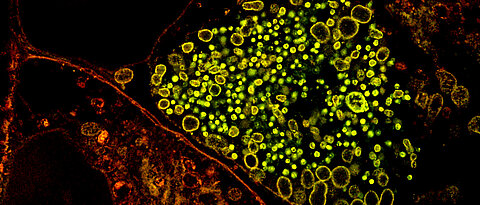
Chlamydia organise their genetic material with the help of lipids. This is shown by a new study from the University of Würzburg. This unexpected alliance could change our current understanding of how bacterial DNA is organised.
more
From North America to Patagonia: Researchers at the University of Würzburg have reconstructed how New World blackbirds spread across the Americas over millions of years.
more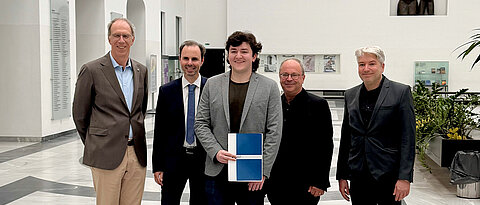
During his Frühstudium at the University of Würzburg, Veit Lang achieved something quite remarkable: he completed all the requirements for a Bachelor’s degree in Mathematics before he was even eligible to enrol as a regular student.
more