
Candida auris: A harbinger of further dangerous fungal species?
10/21/2026Candida auris, a fungus that is life-threatening to humans, has spread rapidly across the globe. Researchers at the University of Würzburg suspect this may be due to rising temperatures.
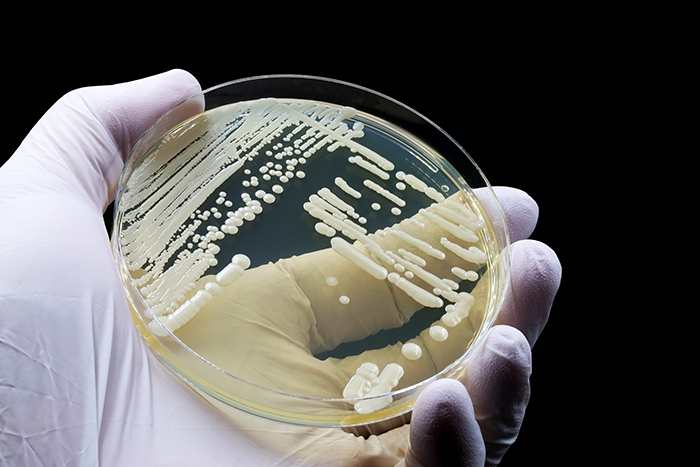
Why has the yeast Candida auris become a dangerous pathogen worldwide in just a few years? This question is on the minds of many researchers. Carla Schuh and Chaitanya Gokhale from the Biocentre at the University of Würzburg have now summarised the current state of knowledge in a review article in the journal mSphere. To that end, they analysed around 180 studies by other researchers.
The two researchers have a theory: in their view, it could be that climate change is what made the fungus infectious in the first place.
Why do they think this? Of the estimated three to five million species of fungi on Earth, only a few hundred are capable of infecting humans. “This is partly because most fungi cannot grow at a body temperature of 37 degrees Celsius,” says Carla Schuh. However, climate change could lead to many fungi adapting to higher temperatures – and thus being able to colonise the human body.
Original habitat of the fungus unknown
Important: The Würzburg study does not prove that climate change has actually caused the increased infectivity of Candida auris. However, the researchers have found numerous indications in the studies reviewed that support this explanation.
They emphasise that the original habitat of Candida auris remains unknown to this day. Possible habitats include coastal areas, wetlands or other saline environments. “This is another reason why there are several possible explanations for why the fungus appeared so suddenly and spread so rapidly,” says Chaitanya Gokhale. In addition to climate change, other man-made environmental changes are also being discussed, such as the use of fungicides in agriculture.
High mortality rate in cases of blood infection
Candida auris was first discovered in 2009 in Japan, in a patient’s ear. This is where its name comes from, which literally translates as ‘yeast of the ear’. Within a few years, the fungus was then found simultaneously on several continents in different genetic lineages. In evolutionary biology, this is an indication of a globally active selective factor such as climate change.
The fungus grows readily at 37 degrees Celsius and can even withstand temperatures of up to 47 degrees Celsius. Its closest relatives cannot do this. Furthermore, it manages to survive on surfaces in hospitals for extended periods. And it is often resistant to several antifungal drugs at the same time.
All of this combined makes Candida auris life-threatening for immunocompromised people such as hospital patients or care home residents. If it enters the bloodstream, the mortality rate – depending on the study – ranges between 20 and 67 per cent. For many countries, the figure is around 52 per cent. During an outbreak in Europe with 140 confirmed cases, 41 per cent of those affected died within a month.
Fungal infections on the rise worldwide
The review article from Würzburg also examines global research findings on how environmental changes influence the spread of fungal diseases. The examples range from Cryptococcus gattii and Aspergillus fumigatus to other fungal species that are colonising new regions or frequently developing resistance.
“The research community agrees that fungal infections are becoming increasingly significant worldwide. However, the exact causes and the role of individual factors remain the subject of heated debate,” reports Carla Schuh.
Early-warning systems for new pathogens
Many researchers conclude from their findings, above all, that there is a need for better surveillance – to detect new pathogens as early as possible, before major outbreaks occur.
They propose systematically monitoring fungi in soil, water, the air and hospitals. This, they say, requires close integration of environmental monitoring, climate research, evolutionary biology and medicine.
Developing such early warning systems and preventive measures would require substantial investment in diagnostics, laboratory infrastructure and drug development. As a first pass, theoretical models could then help predict which species might become problematic in a cost-effective way.
“Given the shift in Candida infection dynamics, investing in and developing such predictive frameworks is imperative, as we expect other closely related species to follow this trajectory”, say the Würzburg researchers.
Candida auris is also a focus of the National Reference Centre for Invasive Fungal Infections, which is based at the Institute of Hygiene and Microbiology at Würzburg University Hospital. The centre is headed by Professor Oliver Kurzai.
Publication
Carla E. Schuh, Chaitanya S. Gokhale: Candidozyma auris (Candida auris) as a harbinger of novel fungal pathogens. mSphere, 2 October 2026. DOI: 10.1128/msphere.00109-26
Contact
Prof. Dr Chaitanya Gokhale, Chair of Computational and Theoretical Biology, University of Würzburg, chaitanya.gokhale@uni-wuerzburg.de