A new special exhibition at the Martin von Wagner Museum at the University of Würzburg shows how people in ancient times used magical practices to combat their fears and worries.
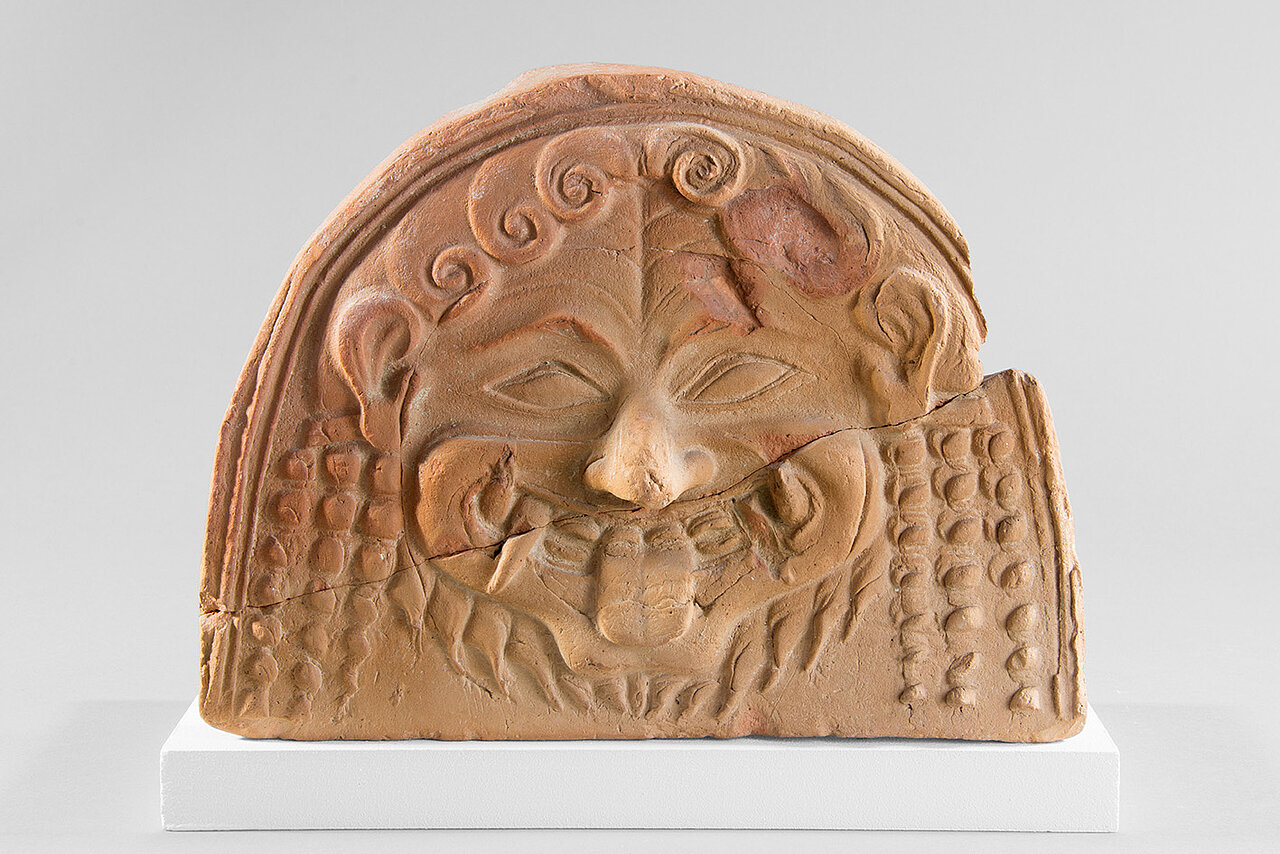
People have always tended to alleviate their personal fears and worries with the help of special objects and rituals. Such ‘magical’ practices were very popular in antiquity and show similarities across different cultures: for example, evil is combated with ugly grimaces, whilst wordplay and letter patterns are believed to help incantations take effect.
Anyone wishing to gain an overview of the common magical methods practised in the cultures of the Ancient Near East, Egypt, Greece and Rome should visit the new special exhibition at the Martin von Wagner Museum at the University of Würzburg.
On display are around 150 objects, written and pictorial records, as well as modern replicas – including numerous items on loan from ten museums and private collections across Germany. Visitors can look forward to a journey through the entire ‘life cycle’ of human fears, from birth to death. This is not always solely about self-protection, but also about securing personal advantages, be it in sport, in court or in love.
The exhibition highlights how the applied magic of antiquity often blended seamlessly with medicine. Nor were the rituals always confined to the realm of private superstition: at times, they were even part of the officially prescribed ritual practices of the state religion.
DFG MagEIA Research Group
The exhibition has emerged from the work of the DFG Research Group ‘MagEIA’ at the University of Würzburg. MagEIA investigates the abundant ‘magical texts’ from the ancient cultures of Egypt, West Asia and the eastern Mediterranean. These include, amongst other things, ritual instructions, recipes or written documents that were themselves part of magical practices. The research group is led by Professors Daniel Schwemer (Ancient Oriental Studies), Martin Stadler (Egyptology) and Daniel Kölligan (Comparative Linguistics). The German Research Foundation (DFG) is funding MagEIA with 3.5 million euros from 2023 to 2027.
Visitor information
Special exhibition ‘Fear! Magic, Healing and Protection in Antiquity’
14 November 2026 to 16 May 2027
Martin von Wagner Museum of the University of Würzburg, antiquities collection, Residenzplatz 2
Tue – Sat 10.00 – 13.30
Sun 10.00 – 13.30 (from 15 November, Sundays every other week)
Free admission! The venue is accessible to all.
Museum website
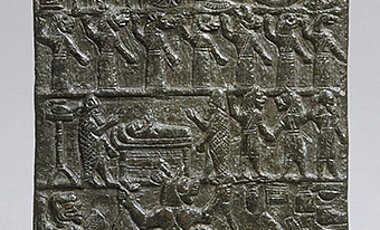
Amulet against infant mortality:
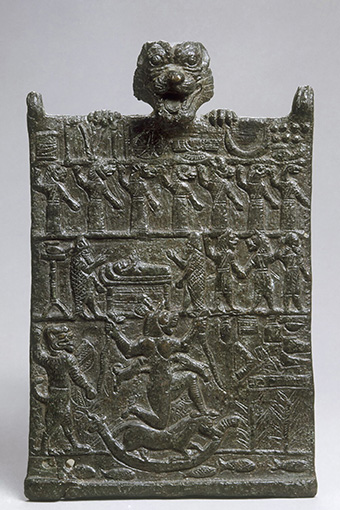
The Assyrian amulet depicts the demoness Lamaštu at the bottom. She was notorious for killing and devouring newborns and young children. As such, she was the symbolic figure of infant mortality in the Ancient Near East. She has the head of a lion with donkey’s ears, a hairy female body and the talons of a bird of prey in place of her feet. Here she is riding a donkey in a boat, suckling a dog and a pig, and holding snakes and centipedes in her hands. Her adversary is Pazuzu, the king of the wind demons. His facial features were generally intended to ward off evil demons. With his hideous grimace, he puts the child-eater at the bottom of the image to flight; at the same time, he peeks out vividly over the edge of the amulet at the top. The MagEIA exhibition displays a replica of the amulet from the collection of Near Eastern Archaeology at Goethe University Frankfurt. The original bronze amulet is approximately 14 cm tall, is housed in the Louvre in Paris and dates from Assyria in the 9th to 7th centuries BC. (Image: Hervé Lewandowski / Musée du Louvre)
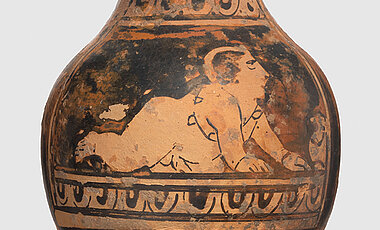
Wine jug for small children:
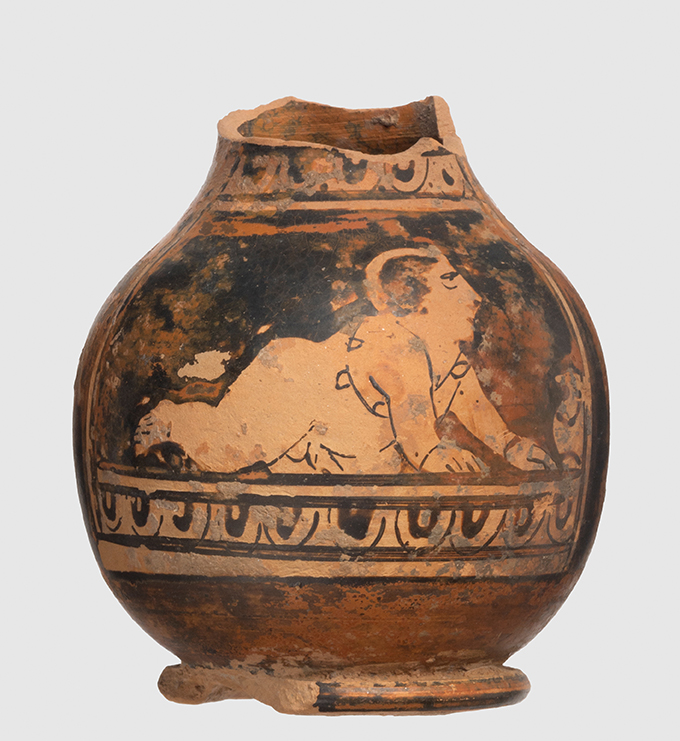
This ancient Greek jug depicts a toddler who is still crawling, wearing an amulet around his or her torso. Children were considered particularly vulnerable until they reached school age, which is why they were often given amulets for protection, to which all manner of rattling or jingling objects were attached as good-luck charms. The jug is only seven centimetres tall, and there is a reason for this: it was intended as a drinking vessel for children aged three and above. In ancient Greece, during the spring festival of Anthesteria in Athens, these children were given their own small ration of diluted wine to welcome them as new members of the city’s community. The jug comes from the collection of the Martin von Wagner Museum at the University of Würzburg and dates from the 5th century BC. (Image: Christina Kiefer / Universität Würzburg)
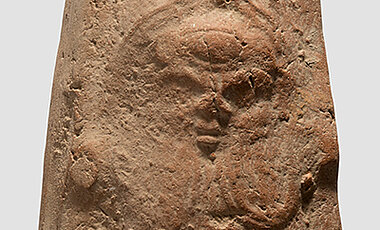
An indecent gnome to protect the family:
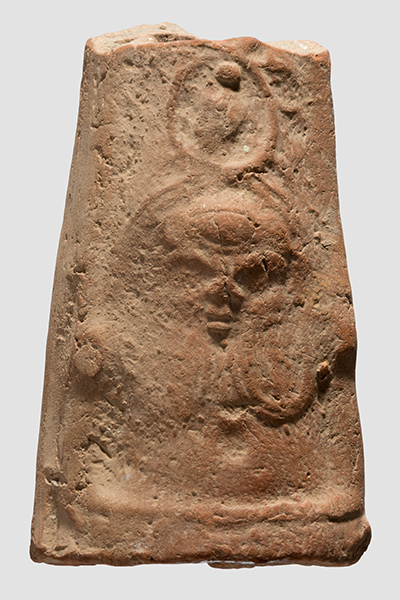
The ancient Egyptian god Bes, depicted here in silhouette on a pinewood candleholder, was believed to protect the family within the home and, above all, to watch over women and their babies during childbirth. His dwarfish figure is characterised by short legs, a pot-bellied stomach and broad shoulders. His face, usually depicted in full profile, is framed by a lion-like mane and a shaggy beard. He often sticks his tongue out – an eccentric, fun-loving gnome with indecent manners. Of this object, only one of several medallions originally attached above the head has survived; it depicts grapes. The terracotta object forms part of the collection of the Martin von Wagner Museum at the University of Würzburg. It dates from the 2nd/3rd century AD. (Image: Christina Kiefer / Universität Würzburg)