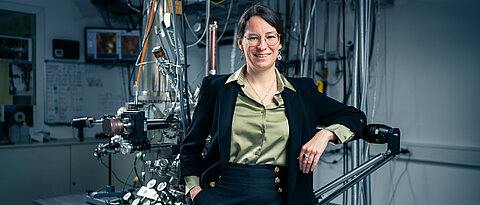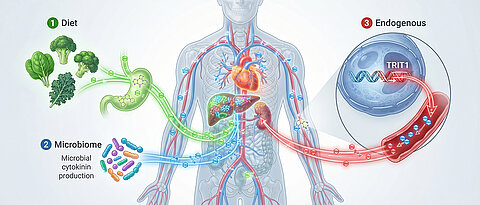

A lack of vitamin B2 makes tumour cells more susceptible to a unique form of cell death. This was discovered by researchers at the Rudolf Virchow Centre at the University of Würzburg.
more
A lack of vitamin B2 makes tumour cells more susceptible to a unique form of cell death. This was discovered by researchers at the Rudolf Virchow Centre at the University of Würzburg.
more
The University and University Hospital of Würzburg have demonstrated magnetic particle imaging on humans for the first time. The new procedure enables radiation-free visualisation of blood vessels in real time.
more
The spread of a particular genre of music reflects the borders between medieval empires in Europe. This is shown by a study conducted by a musicologist at the University of Würzburg.
more
The EO4CAM web portal supports authorities and local authorities in Bavaria with issues relating to climate-adapted urban development, forestry and agriculture.
more
Bavarian Centre for Cancer Research (BZKF) funds its own clinical trials for the first time - Lower Franconian maths whizzes puzzle over problems at the University of Würzburg - Women interested in starting their own businesses can now apply for scholarships
more
Researchers at the University of Würzburg have identified a considerable number of wild bee species on the Hubland Campus. Some of the university's measures provide suitable habitats and thus promote biodiversity.
more
The Cluster of Excellence "Cross-Cultural Philology" at LMU Munich, which was launched at the beginning of 2026, takes a global look at 5,000 years of written culture. Among them is Würzburg-based Egyptologist Martin A. Stadler.
more
Villages can provide important habitats for insects. A new study by the University of Würzburg shows which areas in rural settlements are particularly rich in species – and where there is still room for improvement.
more
A new study by the University of Würzburg shows that undamped climate change will radically change German agriculture by 2100 and could bring Mediterranean crops to Franconia.
more
Around 100 years ago, Ljuba Metzl translated a famous Baroque drama from Latin into German. But her achievement has been suppressed from history.
more
Up to half of the insects in the Amazon region could be exposed to life-threatening heat levels due to progressive, anthropogenic global warming. This is shown by a recent study by the universities of Würzburg and Bremen.
more
The small satellite SONATE-2 from Würzburg has been in orbit for two years. It completed its mission a year ago; it is still valuable for science.
more
To improve their chances of survival, animals must learn – and that can be dangerous. A new study from the University of Würzburg shows how gradual learning under parental supervision can reduce these risks.
more
The Model United Nations (WüMUN) will take place at the University of Würzburg on 8 and 9 May 2026. In this format, young people can get into the role of UN delegates and experience simulated international negotiations.
more
When searching for food, most insects specifically head for flowers that promise them the best yield. Researchers from the Universities of Konstanz and Würzburg have now shown how bumblebees orientate themselves.
more