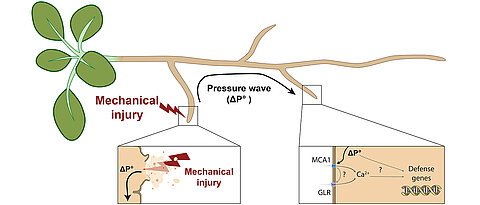
Researchers at the University of Würzburg have shown that plants communicate root injuries in milliseconds via mechanical signals. A drop in hydraulic pressure serves as a rapid alarm system for neighboring roots.
more


Researchers at the University of Würzburg have shown that plants communicate root injuries in milliseconds via mechanical signals. A drop in hydraulic pressure serves as a rapid alarm system for neighboring roots.
more
How do speech and language development disorders manifest in children, and what can help those affected? To explore these questions, JMU is organising hands-on activities and discussions in the city centre on 16 October.
more
In the subject rankings compiled by ShanghaiRanking Consultancy, Würzburg’s research has achieved top positions in nine subject areas. Three areas have performed exceptionally well.
more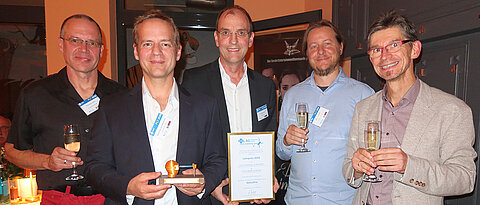
For the development of the virtual laser laboratory simulator ‘femtoPro’, three Würzburg researchers have been awarded the 2026 Teaching Prize by the German Physical Society.
more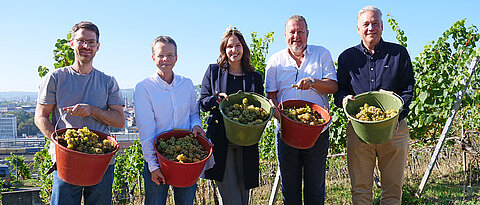
The new UniWein is on its way: to mark the end of the grape harvest, representatives from the University of Würzburg and the Staatlicher Hofkeller, along with the Franconian Wine Queen, gathered at the Würzburger Stein.
more
There are still a few places available on several degree programmes with restricted intake at the University of Würzburg.
more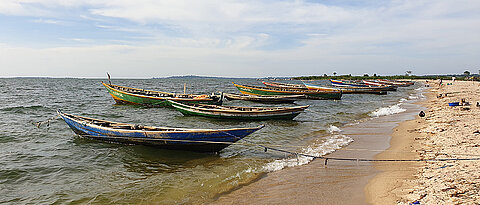
The successful work of the Else Kröner Centre Würzburg-Mwanza can continue: the Else Kröner-Fresenius-Stiftung is funding the collaborative project to improve healthcare for a further 2.5 years.
more
With funding of 1.5 million euros, Dr Karl Petri from Würzburg University Hospital is developing a new technology for safe and long-lasting CAR-T cell therapy.
more
Tom Beneke, a researcher from Würzburg, has received an ERC Starting Grant for his work on the tropical disease leishmaniasis. This prestigious European research award is worth 1.5 million euros.
more
A new observatory is set to detect sources of cosmic rays, dark matter and other relics of the Big Bang in a few years’ time. Astrophysicists from the University of Würzburg are involved in the project.
more
Würzburg physicist Dr. Kajetan Fijalkowski conducts research into the high-precision measurement of electrical resistance. For its work on this novel quantum resistance standard, he was presented with the Helmholtz Prize.
more
The latest ShanghaiRanking confirms JMU’s strong international research profile. In the global ranking, the University of Würzburg is placed 202nd, ranking 12th in Germany and 3rd in Bavaria.
more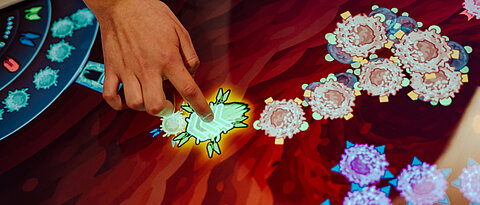
From 8 to 11 September, the MS Wissenschaft will be moored near the Mainkuh in Würzburg. On board the exhibition ship is a digital research game from Würzburg that explains a special form of cancer treatment in an accessible way.
more
FIFA President Gianni Infantino is a highly controversial figure – yet his position appears remarkably secure. Würzburg sports scientist Tobias Thune Jacobsen identifies three reasons why Infantino seems to survive every crisis.
more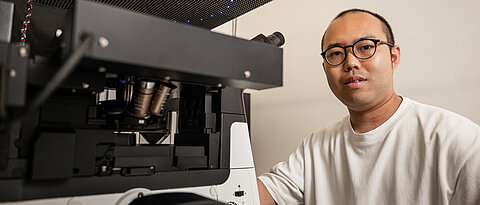
Shoma Kataoka's goal is to accelerate the analysis of large volumes of samples, such as those involved in drug discovery. He will receive close to 220,000 euros in funding for his research in Würzburg.
more