
Can the emergence of definite quantum measurement outcomes be explained mechanistically?
Physikalisches Kolloquium
| Datum: | 02.02.2026, 14:15 - 16:45 Uhr |
| Kategorie: | Kolloquium |
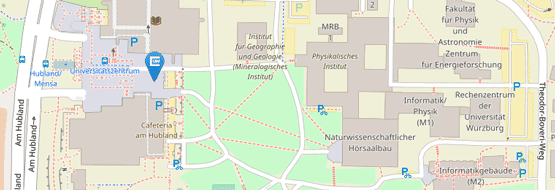
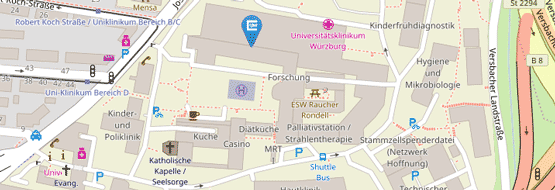
| Ort: | Hubland Süd, Geb. P1 (Physik), Röntgen-Hörsaal, Online |
| Veranstalter: | Fakultät für Physik und Astronomie |
| Vortragende: | Prof. Dr. Meinard Kuhlmann (Johannes Gutenberg-Universität Mainz, Fachbereich Philosophie und Philologie) |
Am 2. Februar 2026 um 14:15 Uhr findet das nächste Physikalische Kolloquium zum Thema "Can the emergence of definite quantum measurement outcomes be explained mechanistically?" im Röntgen-Hörsaal des Physikalischen Instituts und online via Zoom statt.

The linearity of the Schrödinger equation together with the assumption that the wave function of Quantum Mechanics is complete (i.e. no hidden variables) are in conflict with the expectation that measurements yield definite outcomes. We do observe definite outcomes, however. In fact, our everyday world appears surprisingly classical with no superpositions of dead and alive cats. This is commonly referred to as the quantum measurement problem. In the last decades primarily three proposals for a solution of this problem survived (de-Broglie-Bohm, Ghirardi-Rimini-Weber and Everettian many worlds). On the one hand all three proposals are more amenable to a realistic reading than the Copenhagen interpretation, which has an instrumentalist inclination. On the other hand, it is not so obvious to which extent they supply mechanistic explanations for the emergence of definite quantum measurement outcomes in terms of real spatiotemporal processes. I will argue that although all three accounts allow, albeit in very different ways, for a mechanistic reading, this comes at costs which may be unexpected and in some cases intolerable.
Teilnahme
Präsenz im Röntgen-Hörsaal und online.