LivingLABs

The latest research findings are always passed on directly to students at JMU, whether in lectures or laboratory practicals. Via ESF-PROMPTNET, new knowledge will also be made available to the employees of partner companies in the future, for example online in the form of modularised qualification content and podcasts - or in "real life" through LivingLABs.
LivingLABs are experiential laboratories in which employees of the partner companies can engage with research knowledge, familiarise themselves with it in simulations and try out many things for themselves. This takes place in constant dialogue with JMU researchers. This enables them to better assess the potential of an innovation for their own company.
02.03.21, 17.00 hrs
In many areas, small and medium-sized enterprises (SMEs) are among the pioneers of technological progress. In this presentation we would like to show you the possibilities of support for your research and development through federal funding. The support provided by the federal government, the EU and the state of Bavaria in the form of project funding within the framework of specialist programmes, special funding programmes, funding for technology transfer, business start-ups or research infrastructure will be presented and explained.
Please register by e-mail at alessandra.bierwagen@uni-wuerzburg.de. The registration deadline is 01.03.2021.
The symptoms and course of COVID-19 couldn't be more different between patients - some don't even notice their infection and others need intensive care. What role do gender and age play in this? In this lecture, PD Dr Christine Krempl will explain the current state of knowledge on infections caused by SARS-CoV-2 and the pathogenesis of the disease involved. Particular emphasis will be placed on the gender- and age-specific differences in patient reactions.
The event is part of the ESF-PromptNET Gender Medicine project and is free of charge for cooperation partners thanks to EU funding. This event will take place online on 18.02.21 at 12 noon . Please register by the day before at laura-sofia.colon@uni-wuerzburg.de until the day before.
We look forward to seeing you there!
Your PromptNET Team
We are currently experiencing a very different way of working together than we could have imagined a year ago. Work and interpersonal dialogue often take place online. Contact restrictions are preventing us from meeting up with friends, colleagues and family as usual. All of this can be stressful.
Mindfulness-based stress reduction offers various formal and informal exercises for focussing on the present moment. Staying in the here and now, remembering that it is always the present moment in which life takes place, can slow things down, especially in these turbulent times. In her online offer, Prof Kübler presents exercises that everyone can do on their own or together.
The event is part of the ESF-PromptNET Gender Medicine project and is free of charge for cooperation partners thanks to EU funding. This event will take place online on 10.02.21 at 5 pm . Please register by the day before at laura-sofia.colon@uni-wuerzburg.de until the day before.
We look forward to seeing you there!
Your PromptNET Team
Many of us have been working from home a lot since the coronavirus pandemic began. As a result, we move less - we don't get to go to work, but we also don't get to go to the next meeting, visit colleagues in the office next door or take a short walk to lunch. This makes it all the more important to incorporate exercise breaks into our home office routine.
In his presentation, Dr Andreas Petko will combine theory and live online exercise sessions - join in and use this event as an incentive to get moving regularly, even when working from home.
The event is part of the ESF-PromptNET Gender Medicine project and is free of charge for cooperation partners thanks to EU funding. This event will take place online on 27.01.21 at 5 pm . Please register by the day before at laura-sofia.colon@uni-wuerzburg.de until the day before.
We look forward to seeing you there!
Your PromptNET Team
Evidence-based practice for healthcare professionals and other interested parties
Nowadays, help with health problems is just a mouse click away. The internet is full of testimonials, tips and recommendations. And therapists, doctors and pharmacists can also research a wide range of study results, reviews and case reports online. Drug manufacturers substantiate their advertising promises with risk reduction, event-free courses and significance values.
In this jungle of information, therapists and patients can quickly lose the overview. It is often difficult to reliably recognise the difference between good and bad information. Basic knowledge of statistical evidence can help here.
In this presentation, which will be followed by a discussion, we would like to give you a brief introduction to the necessary basic statistical terms, and then in the main part give you practical tips on how to apply evidence-based practice in your own everyday life and present helpful research options.
If you have any questions or suggestions regarding the event, please contact our email address prompt.net@uni-wuerzburg.de
Please register here by 11.12.20.

In addition to an exclusive tour of the university's exhibition stand, ESF-PROMPTNET will be presenting itself to its cooperation partners with a number of exciting workshops.
Among other things, the JMU Business Informatics sub-network Digitalisation offers the opportunity to test a completely new purchase-sales programme using an ERP demonstrator.
In the "Honeycloud", you can use the example of bee welfare to find out how state-of-the-art sensor technology can be used optimally in sensitive areas to conveniently read valuable data via an app. A central field for Industry 4.0.
The ESF-PROMPTNET Lounge on the stand offers the opportunity to network and exchange ideas.
On Tuesday, 1.10.Gender Medicine and the LivingLABs experimental network will also be holding a barefoot trail on the topic of "Walking correctly" for you.
Free guest tickets to these events are available for co-operation partners.
Please register briefly by e-mail: prompt.net@uni-wuerzburg.de
We look forward to welcoming you to our stand.
In addition to our exclusive event for cooperation partners on 2 October from 11 a.m. to 1 p.m.on Tuesday, 1 October, Gender Medicine and the LivingLABs experimental network will be offering a barefoot trail on the subject of "Walking the right way" at the university stand at the Mainfranken Messe .
In four workshops throughout the day (11:00, 13:00, 15:00 and 17:00) you will learn more about the importance of feet for our health, the role of walking in the prevention of diseases and the benefits of walking barefoot. Afterwards, you can have your feet and movement analysed and get practical tips for walking barefoot while walking along the barefoot path.
Free guest tickets to this event are available for co-operation partners.
Please register briefly by e-mail: corinna.frank@uni-wuerzburg.de
The workshop series "Promoting physical activity in old age" focussed on various aspects of physical activity and ageing. In the first part, the participants dealt with the theoretical basics. Prof Billy Sperlich explained the biological processes of ageing and their consequences for movement sequences and ability. The relevance of the topic became clear from the many questions asked by the participants.
In the second part, the participants were able to experience age for themselves: using the GERT simulation suit, they were able to try out how well they can still move with 30-40 additional years of life and which everyday movements cause problems. Under the guidance of sports scientist Philip Kunz, the participants learnt specific exercises to prevent movement problems in old age and to promote movement in old age.
The last part of the series was specifically geared towards the needs of SMEs, which were identified in the first and second parts. The SMEs' main areas of interest can be summarised under the keywords "prevention" and "everyday practice". The participants worked with fictitious people for whom strategies to promote physical activity were to be found and, under the guidance of Dr Birgit Sperlich, developed solutions for more physical activity in everyday life. They also discussed ways of creating state-funded programmes to promote physical activity and offering courses.
Thursday, 16.05.2019
18:00-20:00
Focus: state of research
Thursday, 23 May 2019
17:00-20:00
Focus: Simulation & Practice
Tuesday, 28 May 2019
17:00-20:00
Focus: Development (R&D)
Subnetwork | Gender Medicine |
Speakers | Prof Dr Billy Sperlich |
Date | 16.05.2019 18:00-20:00 |
Venue | Sports Centre of the University, Mergentheimer Str. 76, 9782 Würzburg |
Craftsmen are often faced with the following problem: customers want a quotation, they have to write invoices and want to process the orders on hand. This is not always easy to organise in terms of time. But there is a support solution: modern business software, such as ERP systems for the office.
Participants learn how to use the human factor when introducing new, digital solutions in the company and how to involve and integrate employees in the digitalisation process. The aim is to organise change in company processes in a harmonious and effective way. This session will focus on emotions and processes in particular. Participants will learn ways to utilise them productively.
Please register for the event by emailing tanja.granzow@uni-wuerzburg.de
Subnetwork | |
Speakers | Prof Frank Schwab, Dr Astrid Carolus |
Date | 14.05.2019 16:00-19:00 |
Venue | New University (seminar room 411/4th floor), Sanderring 2, 97070 Würzburg |
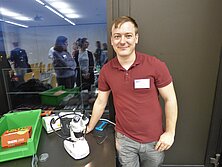
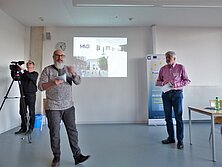
Business meets science
The ability to act flexibly and purposefully in our rapidly changing society is a decisive factor for the success of small and medium-sized enterprises (SMEs). Science offers important insights and impulses, for example on the utilisation of resources, the tailored training of foreign skilled workers, the use of technology in old age, STEM didactics in the context of training, customer acquisition, the transfer of experience in the company and much more. In an informal atmosphere, companies can enter into dialogue with scientists from the university and develop new ideas and concepts together.
Programme
From 16:00 to 18:00, scientists from the university will present aspects of their research that are relevant to companies in a kind of science slam, each lasting seven minutes.
This will be followed by a dialogue forum from 18:00 to 19:00, where participants will have the opportunity to exchange ideas and present further interaction formats. Representatives of companies will have the opportunity to talk directly to the scientists over a small snack, address topics relevant to their company and agree on further dialogue and cooperation beyond the event.
16:15 | Literacies (Prof. Michaela Fenske, European Ethnology and Folklore)Skills such as reading and writing have become rarer in the societies of the Global North. Experts even speak of a crisis of classical literacies. At the same time, new literacies are increasingly needed, for example in the area of mastering new media. What this means for society and the economy, what place plural literacies have in the everyday lives of people today, is one of the many research topics of European ethnology. |
16:25 | The smallest antennas in the world (Enno Kraus, Physics)The miniaturisation of components has changed our world forever. The latest digital revolution is only possible because basic electronic components such as the transistor have become smaller and smaller. In his current research, Enno Kraus is working on the miniaturisation of another classic component, the antenna. Antennas in the nanometre range no longer work with radio waves, but with light. They can amplify the signals of individual molecules, realise new types of light sources and form the basis for ultra-small optical circuits. |
16:40 | Narrative interviews and knowledge transfer in companies (Prof. Elke Wagner, Special Sociology and Qualitative Methods of Empirical Social Research)How can communication be established between employees and company management? How can knowledge be synchronised between former and new employees? Elke Wagner will present methods from the field of qualitative social research that can contribute to establishing communication between different perspectives. She will focus in particular on the narrative interview. |
16:50 | How DAX and badgers are connected - commitment to biodiversity as a success factor for companies (Dr Frauke Fischer, Animal Ecology and Tropical Biology)Biodiversity has always been the basis of all economic activity. While the links to the production of food or the development of new medicines are obvious, the connection between biodiversity and global financial markets or the digital economy is not immediately apparent. Frauke Fischer explains what DAX and badgers have to do with each other and how system boundaries that are too narrow without taking ecological aspects into account have a negative impact on the core business of many companies. But it is also about entrepreneurial opportunities and the right - because goal-orientated - commitment. |
17:05 | Digitalisation, mathematics, professional context - what can mathematics didactics contribute to this (Prof. Hans-Stefan Siller, Didactics of Mathematics)Mathematics didactics initially appears to be a (research) field that exclusively develops or provides concepts, results, methods and the like for the educational sector, in particular mathematics teaching. The lens of mathematics didactics allows different perspectives with different, also combinable focusses. In the context of a short presentation, different perspectives will be taken and possibilities for (innovative) co-operation will be shown. |
17:15 | Lifeworld effects of design - How do designers think and do everyday things? (Isabella Kölz, European Ethnology and Folklore)As commonplace as mass-produced everyday objects such as the office chair or the smartphone may seem to us, they have a major impact on our living environment. Work and action processes are mechanised, automated and digitalised through and with everyday objects. "Everyday objects" are always something designed and moulded: Society materialises in them - at the same time they have an effect on it. In order to understand the socio-cultural effects of our "product environment", production and appropriation processes must be analysed qualitatively. On the production side, product designers have a key role to play here. In the practical design of "everyday things", they contribute to the formation of people and society. In order to find out which ideas of and for society materialise in designed products, the process of their "becoming" (i.e. designing, planning and producing) must be ethnographed. |
17:30 | Customer communication / tapping into new target groups (Prof. Guido Fackler & Michael Koller, Museology & Museum am Dom)Even if museums and business seem to have little in common at first glance, they are dependent on visitors and customers. Consequently, the Museum am Dom, with the support of museology/museum science, is trying to learn more about its audience in order to better tailor its own offers to their expectations and needs. This change from an institution-centred offer orientation to a service-centred customer orientation begins in-house and should also be of interest to entrepreneurs in terms of more sustainable customer loyalty. |
17:40 | Designing and testing technology with and for people of all generations (Stephan Huber, Psychological Ergonomics)The ability to use current technology (or not) divides generations. Yet technology even has the potential to connect generations - we just need to listen better to all potential users. This presentation shows ways to design inclusive systems and explains how the experiences of people with dementia can also be incorporated into the development. |
17:55 | Inclusion! - People with disabilities - handicaps with potential! (Prof Roland Stein, Special Education)The debate about inclusion has also reached the world of work. The topic is proving to be highly emotionalised. It is helpful to take a sober view, which, based on disabilities, impairments and handicaps, also opens up serious potential for the world of work and for vocational training. How can companies and people with disabilities be brought together constructively? The current state of research provides a variety of starting points that will be outlined in this article. Different forms of disability, individual support needs on both sides - the companies and the people - as well as helpful approaches in this regard must be taken into account. |
18:00-19:00 | Dialogue forumCome and talk to the scientists in a relaxed atmosphere. |
Subnetwork | |
Speakers | Prof. Michaela Fenske, Enno Kraus, Prof. Elke Wagner, Dr Frauke Fischer, Prof. Hans-Stefan Siller, Isabella Kölz, Prof. Guido Fackler, Michael Koller, Stephan Huber, Prof. Roland Stein, |
Date | 19.02.2019, 16:00-19:00 (followed by a closing event) |
Venue | Central Lecture Hall and Seminar Centre "Z6", Am Hubland, 97074 Würzburg |
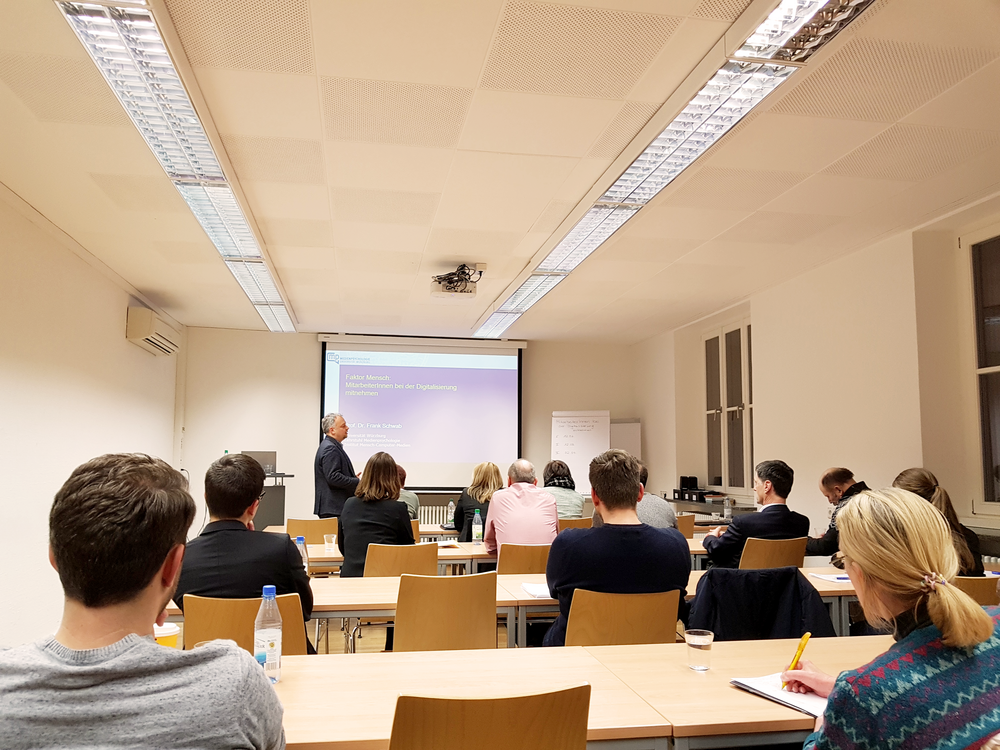
As part of the event series "Craftsmanship meets science" - 12 February / 2 April 2019 - you will learn how to successfully introduce new business software in your company and who could support you in the process. Interactive sessions will show you how you can get employees on board with digitalisation in your company and which psychological and gender-specific aspects need to be taken into account.
Subnetwork | |
Speakers | Prof Frank Schwab |
Date | 12 February 2019, 15:45 - 18:00 |
Venue | Peking Hall, Josef-Stangl-Platz 2 |
In the first discussion group of this series, representatives of the Würzburg business sciences department discussed the significance of product mentions in social media for their sales success with representatives of the Prompt@NET cooperation companies. Together, they planned the conceptualisation of further training measures for small and medium-sized enterprises and cooperation with various JMU chairs (such as Information Systems or Marketing) in this field. Among other things, the chairs have extensive experience and new findings in the procedure for programming corresponding software forecasting tools. Knowledge that should also be made available to companies in appropriate formats!
Subnetwork | |
Speakers | Dr Tanja Granzow, JMU scientist, company representatives |
Date | 21.12.2019 |
As part of the Mainfranken Innovation Forum, interested small and medium-sized companies from the region were able to find out more about the ESF project Prompt@NET
Subnetworks | |
Speakers | Dr Tanja Granzow |
Date | 05.11.-07.11.2018 |
Venue | Turing lecture theatre, Hubland South Campus |
Facts about the European Social Fund. The European Social Fund (ESF) provides funding for education, training and qualification programmes to improve the employment opportunities of people in Europe. In the higher education sector, funding is focussed on improving networking between business and science.