
Supplementary area IMIB
Further information on the supplementary area can be found here
The Institute of Molecular Infection Biology (IMIB) is an interdisciplinary research institute of the Faculty of Medicine at the University of Würzburg with close links to the Faculty of Biology. The working groups are concerned with diverse molecular aspects of infections caused by bacteria, parasites and fungi. Fundamental aspects of gene regulation in pathogens are investigated. Some research groups analyse metabolic and gene regulatory processes in the interaction of microbes with host organisms. Another focus is RNA biology and the function of small RNAs and other non-coding RNA molecules.
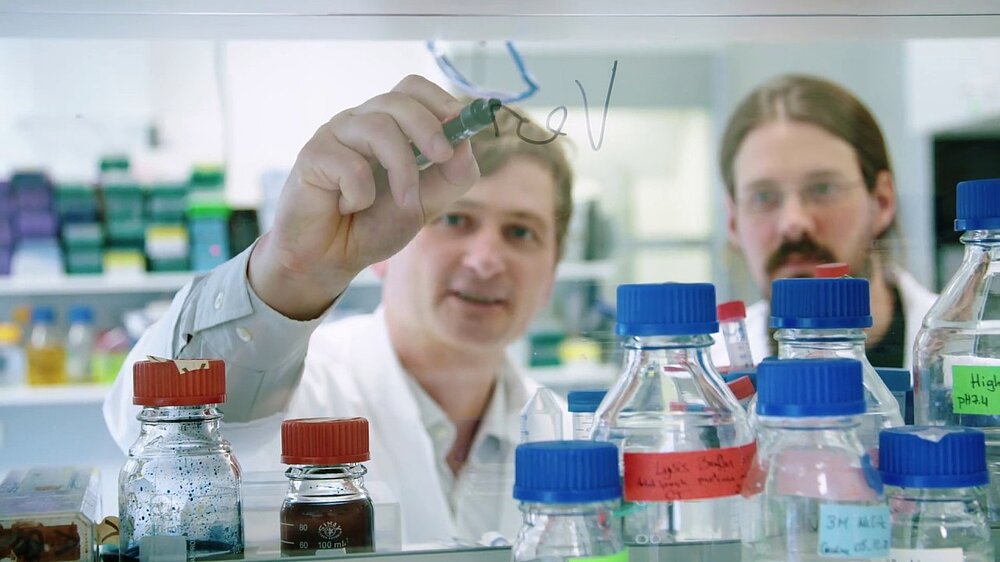
Head of supplementary area Prof Dr Jörg Vogel

Prof Jörg Vogel has been Director of the Helmholtz Institute for RNA-based Infection Research (HIRI) in Würzburg since 2017, where he has also been Professor and Director of the Institute of Molecular Infection Biology (IMIB) since 2009. As a globally recognised scientist in the field of RNA biology, awarded the Leibniz Prize in 2017, he is considered a pioneer in the application and development of high-throughput sequencing methods for the analysis of individual infected cells and of interactions between pathogenic bacteria and their hosts.
He studied biochemistry at the Humboldt University in Berlin and at Imperial College, London (UK). He received his doctorate from the Humboldt University of Berlin in 1999. He conducted research at the University of Uppsala (Sweden) in 2000/2001 and as an EMBO Fellow at the Hebrew University, Jerusalem (Israel) in 2002/2003, before founding an independent junior research group at the Max Planck Institute for Infection Biology in Berlin in 2004.
Research assistants in the supplementary area IMIB
Dr Milan Gerovac

In molecular infection biology, we analyse the regulatory mechanisms of pathogens. Efficient adaptation of pathogens to their environment or the human (host) is essential for infection. This adaptation is made possible within a pathogen by around 10,000 genetic elements and 4,000 proteins that interact with each other and form a complex network. This is countered by a further complexity in the way the host responds to the pathogen. In addition, we now know that humans are largely superorganisms with over 1,000 different bacterial species, each with their own regulatory networks. The aim of my research is to understand these relationships and uncover their basic principles.
To this end, I use state-of-the-art molecular high-throughput methods to obtain a global overview of the networks, clustering and relationships.
Dr Chandradhish Ghosh

Chandradhish Ghosh has worked at the interface of chemistry, nanotechnology and infectious diseases during his research career. As part of his PhD (at JNCASR, India), he introduced a new class of membrane-active molecules targeting various pathogens. Before joining IMIB/HIRI, he worked at the Max Planck Institute of Colloids and Interfaces (Potsdam, Germany) on the development of glyconanomaterials and nanobody-drug conjugates as anti-infectives and immunotherapeutics. At the IMIB, he is planning the further development of antisense oligomers for clinical use.
Dr Linda Popella

Linda Popella's PhD thesis and her subsequent PostDoc period focussed on immunomodulation mechanisms of herpes simplex virus type 1 and human cytomegalovirus during infection of human monocyte-generated dendritic cells (Immunomodulatory Department, University Hospital Erlangen). Since June 2020, she has been working as a PostDoc at the Institute of Molecular Infection Biology (University of Würzburg) on the development of programmable antimicrobials based on the platform of RNA-targeted antisense oligonucleotides (ASOs).