Gender medicine

For a long time, gender was not recognised in medicine as a factor that could influence health or illness. Only the male body served as a medical model - and for a long time it was assumed that biological processes were the same in women. A rethink only took place in the 1980s and resulted in the founding of gender medicine at the end of 1990. It sees itself as the science that researches medical differences between the sexes.
Our range of events focuses on
- biological gender differences when dealing with medically relevant topics.
- Evidence-based and innovative design of knowledge transfer by specialists from the University Hospital, the Faculties of Medicine and Biology and Media Psychology.
- Health communication from a media psychology perspective.
More information on gender-specific medicine can be found on the website of the Biocentre.
Date: 24 March, 5 - 7 p.m.; online via GoToMeeting
Speakers: Prof Doreen Reifegerste, Prof Frank Schwab
Doreen Reifegerste is Professor of Health Communication at the University of Bielefeld and focuses, among other things, on how health promotion can be communicated in a gender-sensitive way. To this end, she will first clarify a few terms and then use historical and current practical examples to show which DOS and DON'TS need to be considered in the field.
In the second part of the event, Frank Schwab will provide information on the psychological foundations of emotions and stress in the workplace and explore the question of whether stress reactions are being intensified, particularly as a result of advancing digitalisation, and whether they are also being transferred to the private environment as a result of increasing home working.
Registration up to and including 22.03.2021 via the registration form on our homepage.
The symptoms and course of COVID-19 couldn't be more different between patients - some don't even notice their infection and others need intensive care. What role do gender and age play in this? In this lecture, PD Dr Christine Krempl will explain the current state of knowledge on infections caused by SARS-CoV-2 and the pathogenesis of the disease involved. Particular emphasis will be placed on the gender- and age-specific differences in patient reactions.
The event is part of the ESF-PromptNET Gender Medicine project and is free of charge for cooperation partners thanks to EU funding. This event will take place online on 18.02.21 at 12 noon . Please register by the day before at laura-sofia.colon@uni-wuerzburg.de until the day before.
We look forward to seeing you there!
Your PromptNET Team
We are currently experiencing a very different way of working together than we could have imagined a year ago. Work and interpersonal dialogue often take place online. Contact restrictions are preventing us from meeting up with friends, colleagues and family as usual. All of this can be stressful.
Mindfulness-based stress reduction offers various formal and informal exercises for focussing on the present moment. Staying in the here and now, remembering that it is always the present moment in which life takes place, can slow things down, especially in these turbulent times. In her online offer, Prof Kübler presents exercises that everyone can do on their own or together.
The event is part of the ESF-PromptNET Gender Medicine project and is free of charge for cooperation partners thanks to EU funding. This event will take place online on 10.02.21 at 5 pm . Please register by the day before at laura-sofia.colon@uni-wuerzburg.de until the day before.
We look forward to seeing you there!
Your PromptNET Team
When? Wednesday, 03.02.2021, 5 pm
Where? Online via GoToMeeting
Lecturer: Prof. Dr Frank Schwab, Chair of Media Psychology, Julius-Maximilians-Universität Würzburg
Digital media and digital communication are very popular. It is impossible to imagine both the workplace and private life without them. Digital information, digital entertainment, websites, intranet, Zoom and Microsoft Teams, messengers and smartphones...
How and why are they used? What are the special features of media use in companies? Are there gender-specific differences in usage behaviour? Isn't it all a waste of time and what needs do we bring to these digital worlds? From a psychological perspective, we look at everything we do as people with the media we create. At first glance, many things seem illogical, but at second glance they seem understandable and explainable.
Registrations are possible until 01.02.2021 at ricardo.muench@uni-wuerzburg.de You will receive the access data for the meeting room the day before the event.
Many of us have been working from home a lot since the coronavirus pandemic began. As a result, we move less - we don't get to go to work, but we also don't get to go to the next meeting, visit colleagues in the office next door or take a short walk to lunch. This makes it all the more important to incorporate exercise breaks into our home office routine.
In his presentation, Dr Andreas Petko will combine theory and live online exercise sessions - join in and use this event as an incentive to get moving regularly, even when working from home.
The event is being organised as part of the ESF-PromptNET Gender Medicine project and is free of charge for cooperation partners thanks to EU funding. This event will take place online on 27.01.21 at 5 pm . Please register by the day before at laura-sofia.colon@uni-wuerzburg.de until the day before.
We look forward to seeing you there!
Your PromptNET Team
21 January 2021, 5 pm
Stately vs pixie-like, pastel-coloured recipe ideas vs lumberjack steaks for "real blokes". The differences in the generally accepted ideal image of a male or female body are immense, and this also determines how overweight and obesity are perceived and dealt with by the sexes In addition, there are actual gender-specific differences in fat distribution and energy balance caused by sex hormones Type 2 diabetes mellitus is not only closely associated with obesity, but here too gender-specific differences influence screening, treatment and complications.
Dr Ann Cathrin Koschker, specialist in internal medicine with a focus on endocrinology and diabetology, heads the Diabetes and Metabolism Outpatient Clinic and the Internal Obesity Outpatient Clinic at Würzburg University Hospital.
The event is part of the ESF-PromptNET Gender Medicine project and is free of charge thanks to EU funding. This event will take place online on 21.01.21 at 5 p.m. Please register by 20.01.21 at laura-sofia.colon@uni-wuerzburg.de.
We look forward to seeing you there!
Your PromptNET Team
In recent years, more and more girls and women have been diagnosed with autism spectrum disorders, even though there is still little information about the "typical characteristics" of women.
This lecture will provide basic knowledge about the various terms used to describe ASD and the special features of the behaviour and perception of girls and women on the autism spectrum. Understanding these particularities forms the basis for autism-specific support and encouragement for autistic people. The external view in this lecture will be presented by Daniela Ursel, employee at the Autismus Kompetenzzentrum Unterfranken e.V. (Autism Competence Centre Lower Franconia).
Nadine Amend will present the very personal inside view of a young woman on the autism spectrum. With a lively presentation, she will give an insight into her very personal and not only professional everyday life.
Both speakers will be happy to answer questions after the talk.
Please register by 22.09.20 at laura-sofia.colon@uni-wuerzburg.de
We look forward to seeing you there!
Speakers | Daniela Ursel Nadine Amend - Autism Competence Centre Lower Franconia e.V. |
Date | 23.09.2020 18.00 - 20.00 hrs |
Place | tba |
It has been proven that good leadership behaviour has a positive effect on the health of employees in a company, resulting in fewer sick days. The new conditions of the increasingly digitalised world of work in Industry 4.0 in particular pose new challenges for companies when it comes to employee health, satisfaction and loyalty to the company. Health management that is customised to the needs of companies and their employees is becoming increasingly important. This is more than just the opportunity to exercise during the lunch break and fruit in the coffee kitchen. Through efficient and strategic health management, every company can develop the right measures to maintain the health and performance of its employees.
We want to talk to you about occupational health management and shed light on the gender-specific, psychological and physiological advantages and disadvantages of good and bad health management.
Date 1: Workshop, 09.07.2020, 6 pm
Good health management adapts to the everyday working lives of employees and the structures of a company.
Together with researchers from JMU, we would like to familiarise ourselves with your company's health management and discuss it with you. The resulting questions and discussion points will be dealt with in greater depth in our online seminar (27 July): Our experts will present options for expanding and optimising your BGM concept.
Please register by (07.07.2020) to(prompt.net@uni-wuerzburg.de)!
Attention, the number of participants is limited!
Date 2: Dialogue: Presentation of the university concept with a focus on the gender aspect, 16.07.2020, 6 pm
Lecturer: Prof.'in Dr Marie-Christine Dabauvalle (University Women's Representative, Cell Biologist)
Prof Dr Marie-Christine Dabauvalle is a member of the Health Management Steering Committee at JMU and will give you an insight into the university's best-practice example. The "physical working environment" - the laboratory, the lecture theatres, the office, the workshop, etc. - is part of the "health" complex. - is one part of the "health management" complex. The other part is the "psychological working environment": the relationships between managers and employees, the tone of everyday working life and conflicts.
In both parts, the needs of women and men often differ greatly. Recognising these differences and acting accordingly makes it possible for employees to grow together with the company.
Get to know diversified and gender-equitable health management from the perspective of the university and ask your questions to our expert.
Registration until 16.07.2020 at 14:00 (extended!) via our registration form on our website
Date 3: Online seminar ,27.07.2020, 5 pm
Lecturers:
Prof. Dr Marie-Christine Dabauvalle (University Women's Representative, Chair of Electron Microscopy)
Prof Dr Frank Schwab (Chair of Media Psychology)
Dr Birgit Sperlich (Institute of Sports Science)
Sebastian Seibel (Institute of Work, Industrial and Organisational Psychology)
Katja Beck-Doßler (Head of the JMU Conflict Counselling Centre)
Julius-Maximilians-Universität has a great deal of expertise in the field of occupational health management, both in research and in practice. Our researchers from the fields of psychology, biology and sports science, together with members of the university's health management steering committee, will discuss aspects of good health management in various companies with you. In short presentations and case studies, a number of different application scenarios will be dealt with in which the participating companies can find themselves in order to obtain helpful and profitable starting points for their own health management.
Registration by (27.07.2020 at 14:00) via our registration form on our website

In addition to an exclusive tour of the university's exhibition stand, ESF-PROMPTNET will be presenting itself to its cooperation partners with a number of exciting workshops.
Among other things, the JMU Business Informatics sub-network Digitalisation offers the opportunity to test a completely new purchase-sales programme using an ERP demonstrator.
In the "Honeycloud", you can use the example of bee welfare to find out how state-of-the-art sensor technology can be used optimally in sensitive areas to conveniently read valuable data via an app. A central field for Industry 4.0.
The ESF-PROMPTNET Lounge on the stand offers the opportunity to network and exchange ideas.
On Tuesday, 1.10.Gender Medicine and the LivingLABs experimental network will also be holding a barefoot trail on the topic of "Walking correctly" for you.
Free guest tickets to these events are available for co-operation partners.
Please register briefly by e-mail: prompt.net@uni-wuerzburg.de
We look forward to welcoming you to our stand.
In addition to our exclusive event for cooperation partners on 2 October from 11 a.m. to 1 p.m.on Tuesday, 1 October, Gender Medicine and the LivingLABs experimental network will be offering a barefoot trail on the subject of "Walking the right way" at the university stand at the Mainfranken Messe .
In four workshops throughout the day (11:00, 13:00, 15:00 and 17:00) you will learn more about the importance of feet for our health, the role of walking in the prevention of diseases and the benefits of walking barefoot. Afterwards, you can have your feet and movement analysed and get practical tips for walking barefoot while walking along the barefoot path.
Free guest tickets to this event are available for co-operation partners.
Please register briefly by e-mail: corinna.frank@uni-wuerzburg.de
Dr Löffler is a senior physician at the Interdisciplinary Day Therapy Centre at the University Hospital of Würzburg and heads the consultation hours for complementary oncology and integrative medicine at the Comprehensive Cancer Centre Mainfranken.
What's the story behind the famous man's cold? What role does this small difference play in (complementary) oncology and what does it mean for our daily work with patients?
Together, we looked at the current state of studies on the topic and explored ideas for integrating gender aspects into patient care using the example of complementary medicine.
Subnetwork | |
Speakers | Dr Claudia Löffler, Senior Physician at the Interdisciplinary Day Therapy Centre at Würzburg University Hospital |
Date | 07.08.2019, 17:00-20:00 hrs |
Venue | Seminar room 205, Building 46, University of Würzburg |
A special lecture event took place on Wednesday, 24 July 2019. Under the title "Broken Heart", cardiologist Prof Dr Christiane Angermann looked at this topic with regard to sex and gender differences. Although suicide, Takotsubo cardiomyopathy and depression occur differently in men and women, pathophysiologically there are common roots...
Interesting insights are provided and some aspects are placed in a medical and literary context. An exciting exchange of different perspectives on the human organ that leaves no one untouched: the heart.
We ask for binding registrations with the names of all participants by 19 July 2019 to corinna.frank@uni-wuerzburg.de.
Subnetwork | |
Speakers | Prof Dr Christiane Angermann |
Date | 24 July 2019, 18:00 hrs |
Venue | At Hubland, University of Würzburg |
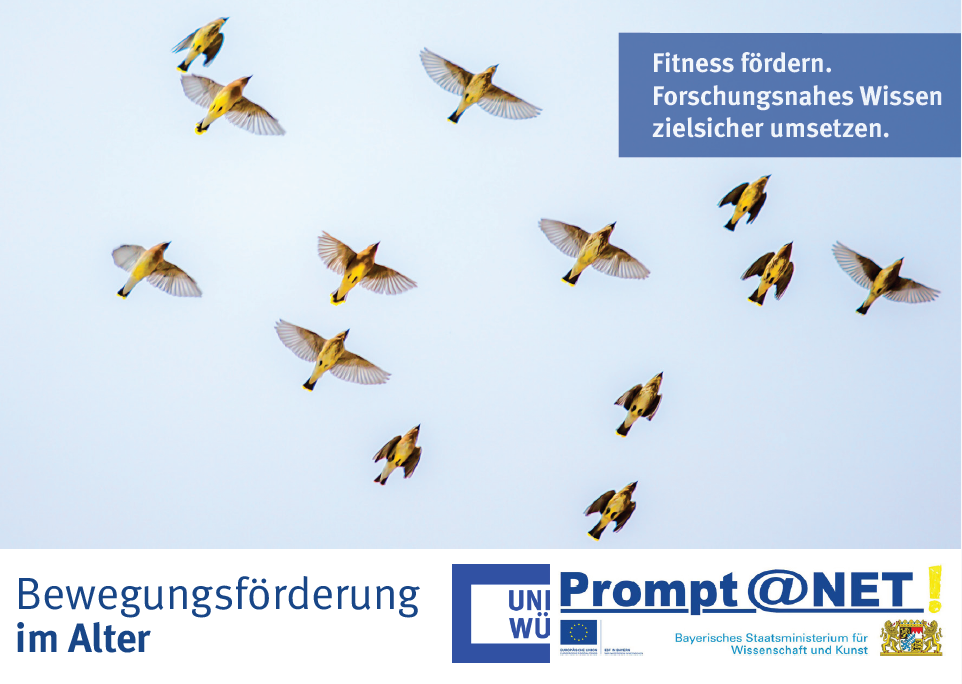
The workshop series "Promoting physical activity in old age" focussed on various aspects of physical activity and ageing. In the first part, the participants dealt with the theoretical basics. Prof Billy Sperlich explained the biological processes of ageing and their consequences for movement sequences and ability. The relevance of the topic became clear from the many questions asked by the participants.
In the second part, the participants were able to experience age for themselves: using the GERT simulation suit, they were able to try out how well they can still move with 30-40 additional years of life and which everyday movements cause problems. Under the guidance of sports scientist Philip Kunz, the participants learnt specific exercises to prevent movement problems in old age and to promote movement in old age.
The last part of the series was specifically geared towards the needs of SMEs, which were identified in the first and second parts. The SMEs' main areas of interest can be summarised under the keywords "prevention" and "everyday practice". The participants worked with fictitious people for whom strategies to promote physical activity were to be found and, under the guidance of Dr Birgit Sperlich, developed solutions for more physical activity in everyday life. They also discussed ways of creating state-funded programmes to promote physical activity and offering courses.
Thursday, 16.05.2019
18:00-20:00
Focus: state of research
Thursday, 23 May 2019
17:00-20:00
Focus: Simulation & Practice
Tuesday, 28 May 2019
17:00-20:00
Focus: Development (R&D)
Subnetwork | Gender Medicine |
Speakers | Prof Dr Billy Sperlich |
Date | 16.05.2019 18:00-20:00 |
Venue | Sports Centre of the University, Mergentheimer Str. 76, 9782 Würzburg |
Coaching on gender-typical communication situations in the
healthcare sector
This event looks at the connections between gender and sex
and communication. This will be explained and
reflected on in role plays and commentaries. We consider communication as a process that takes place on a non-verbal,
paraverbal and verbal level. Empirical studies show that men and
women communicate quite similarly in some cases, but also very
differently in others. Gender-typical communicative patterns are worked out and described
and made tangible and reflected upon in the role-playing games.
Sub-network | |
Speakers | Prof Frank Schwab |
Date | 25.04.2019 |
Venue | Centre for Media Didactics (Room 005), Theodor-Boveri-Weg |
Craftsmen are often faced with the following problem: customers want a quotation, they have to write invoices and want to process the orders on hand. This is not always easy to organise in terms of time. But there is a support solution: modern business software, such as ERP systems for the office.
Participants learn how to use the human factor when introducing new, digital solutions in the company and how to involve and integrate employees in the digitalisation process. The aim is to organise change in company processes in a harmonious and effective way. This session will focus on emotions and processes in particular. Participants will learn ways to utilise them productively.
Please register for the event by emailing tanja.granzow@uni-wuerzburg.de
Subnetwork | |
Speakers | Prof Frank Schwab, Dr Astrid Carolus |
Date | 14.05.2019 16:00-19:00 |
Venue | New University (seminar room 411/4th floor), Sanderring 2, 97070 Würzburg |
The "Gender Medicine in Practice" format was launched on 13 March 2019. In this series of events, SMEs have the opportunity to present themselves and their company. Of course, the focus here is also on gender-specific differences and the relevance of these differences in practice.
Mr Kemmelmeyer from Sports Activities kicked things off. He spoke about our most important leg, the foot.
Feet are one of our most complex body parts, are one of our central sensory organs and have a holistic effect. Mr Kemmelmeyer explained how complex our feet are and why they are one of our central sensory organs, the importance of feet for our health and the role that running plays in preventing illness. Although the foot plays an important role in our health, the differences between men and women when it comes to walking, for example, have hardly been researched. Nevertheless, well over a third of all adults complain of foot problems. During the stimulating discussion, it became clear how important education and research on gender-specific medicine is and that there is still a great need for action.
Subnetwork | |
Speakers | Karlheinz Kemmelmeyer, Prof Dr Marie- Christine Dabauvalle |
Date | 14 March 2019, 5:00 pm |
Venue | Seminar room 205, Gerda-Laufer-Str. 46, 97074 Würzburg |
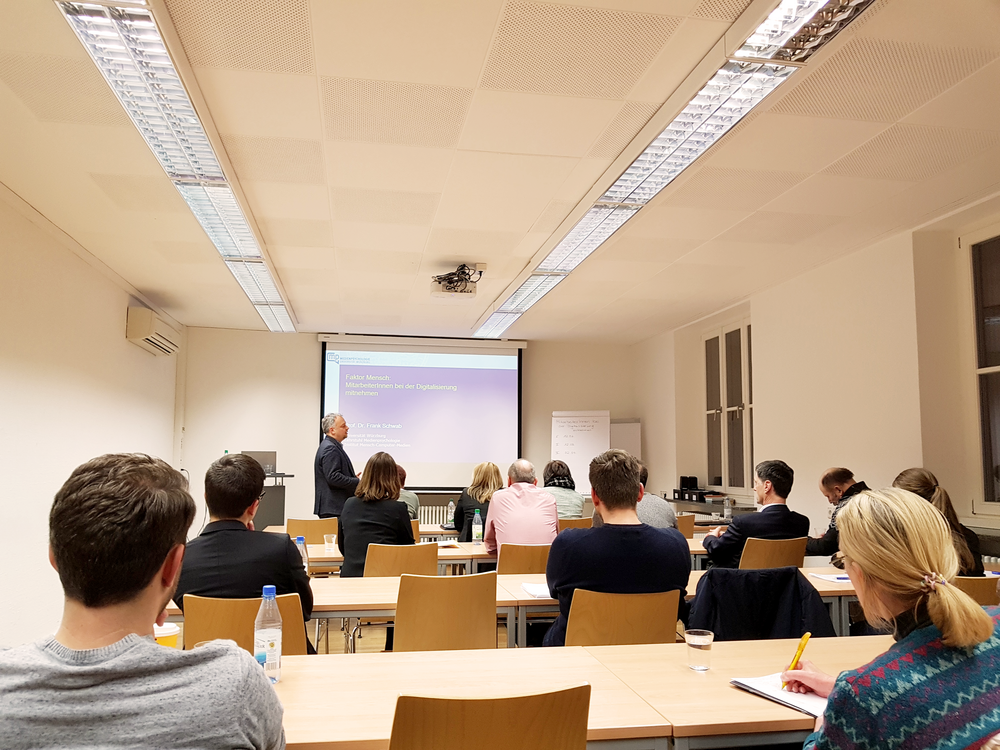
As part of the event series "Craftsmanship meets science" - 12 February / 2 April 2019 - you will learn how to successfully introduce new business software in your company and who could support you in the process. Interactive sessions will show you how you can get employees on board with digitalisation in your company and which psychological and gender-specific aspects need to be taken into account.
Subnetwork | |
Speakers | Prof Frank Schwab |
Date | 12 February 2019, 15:45 - 18:00 |
Venue | Peking Hall, Josef-Stangl-Platz 2 |
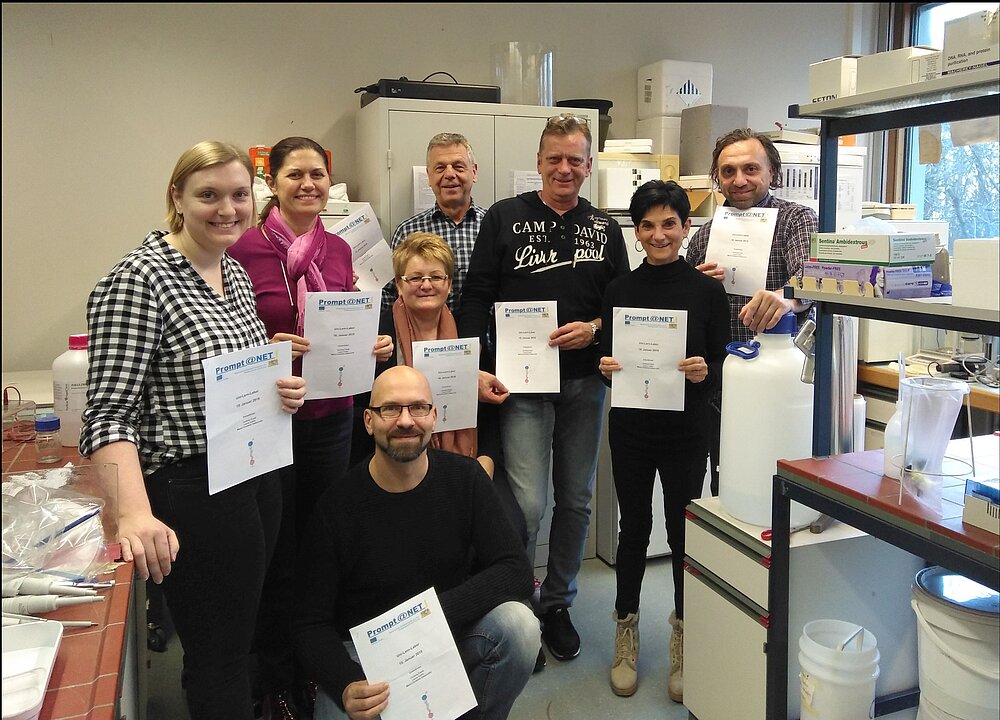
The compact series "Uni-Lern-Labor - Theory & Practice" on the topic of "Gender-specific differences in the rare disease facioscapulohumeral muscular dystrophy" (FSHD) took place for the first time at the University of Würzburg's Biocentre.
FSHD is the third most common hereditary muscular dystrophy - one in 25,000 people in Europe is affected. The differences between the sexes in this disease are reflected in the course of the disease as well as in the therapy.
The second practical part of the compact series followed in the afternoon. In Ms Dabauvalle's laboratory, the participants conducted experiments under the guidance of companies from the regional healthcare sector and learnt about important approaches and ways of thinking in research.
Subnetwork | |
Speakers | Prof Marie-Christine Dabauvalle |
Date | 19.01.2019, 13:00-17:00 |
Venue | A104, Biocentre |
The compact series "Uni-Lern-Labor - Theory & Practice" on the topic of "Gender-specific differences in the rare disease facioscapulohumeral muscular dystrophy" (FSHD) took place for the first time at the University of Würzburg's Biocentre.
FSHD is the third most common hereditary muscular dystrophy - one in 25,000 people in Europe is affected. The differences between the sexes in this disease are reflected in the course of the disease as well as in the therapy.
In Part I of the compact series, the participants learnt about the theoretical background of this disease: development, causes, progression and therapy, as well as the research approaches: Prof. Dr Marie-Christine Dabauvalle explained which questions can be answered with which methods and how gender-specific differences can be investigated. Prof. Dabauvalle is Professor of Cell Biology in the Central Department of Microscopy at the Hubland University Biocentre. She is researching the cellular mechanisms of the development of this disease.
Subnetwork | |
Speakers | Prof Marie-Christine Dabauvalle |
Date | 19.01.2019, 9:00-12:00 |
Venue | A104, Biocentre |
Gender medicine deals with gender-specific medical differences, such as the different symptoms of a heart attack in men and women. A great deal of research is still needed in the field of gender medicine, and the findings should be quickly transferred to the healthcare system. At the network meeting, co-operation partners were given an initial overview and worked out their interests and interfaces in the field of gender-specific medicine together.
Subnetwork | |
Speakers | Laura-Sofia Colón |
Date | 13.12.2018, 17:00-20:00 hrs |
Venue | Seminar room 205, Gerda-Laufer-Str. 46, Hubland North Campus |
Presentation of the knowledge transfer project "Prompt@NET" at the 4th specialist event for employers in Mainfranken.
Subnetwork | |
Speakers | Prof Marie-Christine Dabauvalle, Prof Frank Schwab |
Date | 18.10.2018, 12:30-17:00 |
Following the Prompt@NET kick-off event, Prof Dr Marie-Christine Dabauvalle presented her field of research, the rare disease FSHD, to the workshop participants. Afterwards, there was the opportunity to visit Prof. Dabauvalle's laboratory at the Biozentrum and gain an insight into the everyday life of a scientist. As part of Prof Schwab's workshop, the participants worked on questionnaires on exemplary topics (stress, coping, etc.) under guidance and received information on triggers in the world of work and digital media, as well as how to deal with them.
Sub-network | |
Speakers | Prof Marie-Christine Dabauvalle |
Date | 10 October 2018, 13:30 - 15:30 |
Venue | Central lecture theatre and seminar building 6 - Z6, Hubland South Campus |
Presentation of the knowledge transfer project "Prompt@NET" during the poster sessions of the 40th International Meeting of the German Society for Cell Biology (DGZ).
Subnetwork | |
Speakers | Corinna Frank |
Date | 17.-19.09.2018 |
Place |
Presentation of the knowledge transfer project "Prompt@NET" during the poster sessions of the conference "Life at the edge: The nuclear envelope in nucleocytoplasmic transport and genome organisation" of the German Society for Cell Biology (DGZ).
Subnetwork | |
Speakers | Corinna Frank |
Date | 25.-28.07.2018 |
Facts about the European Social Fund. The European Social Fund (ESF) provides funding for education, training and qualification programmes to improve the employment opportunities of people in Europe. In the higher education sector, funding is focussed on improving networking between business and science.