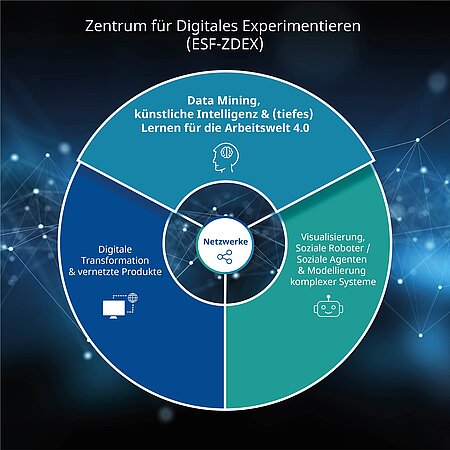
New data mining, AI and (deep) learning for the world of work 4.0
Our ESF-ZDEX network for data mining, artificial intelligence and (deep) learning for the world of work 4.0 offers you advice on the application of these techniques to your problems and, in promising scenarios, also the development of prototypes. Take the opportunity of a free consultation if you are a company based in Northern Bavaria!
Network Manager Prof Dr Christoph Flath

Professor Christoph Flath has held the Chair of Information Systems and Information Management at JMU Würzburg since 2018. He studied industrial engineering at the University of Karlsruhe and the University of Toronto (2003-2008). In 2013, he completed his doctorate in Information Systems at the Karlsruhe Institute of Technology. He was a visiting scholar at the Kellogg School of Management and worked as a research assistant at the WHU - Otto Beisheim School of Management and at the FZI - Research Centre for Information Technology. Before joining the University of Würzburg as a junior professor (2014), he headed the research group "Smart Grids and Energy Markets" at the Karlsruhe Institute of Technology.
Research focus in Business Analytics & Data Mining:
- Optimisation and machine learning
- Data visualisation
- Applications in the fields of energy, industry, mobility and e-commerce
Network Manager Prof Dr Fotis Jannidis

Prof Dr Fotis Jannidis has held the Chair of Digital Humanities and Modern German Literature since the 2009 summer semester and supports the ESF-ZDEX project as network manager.
Network Manager Prof Dr Frank Puppe

Frank Puppe has held the Chair of Artificial Intelligence and Knowledge Systems at the University of Würzburg since 1992. His research areas include the further development and adaptation of AI techniques in the fields of machine learning, knowledge-based systems, language processing, image processing, e-learning, data preparation and data mining in industrial, medical, legal, philological, technical and administrative application projects.
Research associates in the Data Mining, AI and (deep) learning for the world of work 4.0 network
Michael Banck (M. Sc.)

Michael Banck completed his bachelor's and master's degree in computer science in Würzburg, where he worked on the processing and analysis of medical image data in cooperation with the University Hospital of Würzburg for his master's thesis in 2017. At the same time, he worked as a software developer from 2015 and, after completing his master's degree, as a software architect on a project for Schaeffler until mid-2020. In July 2020, he restarted his collaboration with the University Hospital of Würzburg and the Chair of Artificial Intelligence and Knowledge Systems, headed by Prof Dr Puppe. His research focuses on the computer-aided improvement of medical examinations in the field of gastroenterology.
Nico Elbert

Nico Elbert is a research assistant at the Chair of Information Systems and Business Analytics at the Faculty of Management and Economics. He has been working here since autumn 2021 - on application-oriented methods for operations management: the aim is to further improve various decision support systems for logistics processes with the help of data-supported methods. Parallel to his work at the Chair of Information Systems and Business Analytics, he is completing his Master's degree in Information Systems. With this background and his professional experience from 5 years in SAP BI consulting, he supports the ZDEX project with his strong methodological and analytical expertise.
Toni Greif (M. Sc.)

Toni Greif is a research assistant at the Chair of Information Systems and Information Management at the Faculty of Management and Economics. He has been working here since autumn 2018 - on application-oriented methods for operations management: the aim is to further improve various decision support systems for logistical processes with the help of data-based methods. Before joining the Chair of Information Systems and Information Management, he completed his degree in mathematics and business mathematics in summer 2018. With his background in business informatics, mathematics and business administration as well as his professional experience from various internships, he supports the ZDEX project with his strong methodological and analytical expertise.
Matthias Griebel (M. Sc.)

Matthias Griebel completed his bachelor's degree in economics and his master's degree in business informatics at the University of Würzburg. He has been working as a research assistant at the Chair of Information Systems and Information Management since June 2017. He supports the ZDEX project with his expertise in machine learning. In particular, he deals with the objectivity, reliability and validity of deep learning and Bayesian deep learning approaches.
Amar Hekalo (M. Sc.)

Amar Hekalo completed his master's degree in physics in 2018. He has been working on his doctorate at the Chair of Artificial Intelligence and Knowledge Systems at the University of Würzburg since November 2018. There, he is working on making central processes in clinical practice, specifically in the creation of diagnostic reports, faster and more reliable. To this end, he is researching various machine learning methods in the context of text and speech processing as well as the automatic recognition of diseases in medical images. He is therefore supporting the ZDEX project with his expertise in the field of deep learning, in particular image processing, as well as the procurement and processing of the associated data material.
Lennart Keller
Lennart Keller has been working as a research assistant in the ZDEX network "Natural Language Processing" since 2020 and is also studying for a Master's degree in Digital Humanities. At the same time, he teaches in basic areas of digital humanities and programming. During his bachelor's degree, he worked as a research assistant for various projects analysing literary texts using digital methods.
Leon Liman (M. Sc.)

Leon Liman completed his bachelor's and master's degree in computer science at the University of Würzburg, where he already worked on the data warehouse of the University Hospital of Würzburg in his bachelor's and master's thesis. Since April 2017, he has been working as a research assistant at the Chair of Artificial Intelligence and Knowledge Systems at the University of Würzburg. There he is involved in the development of a data warehouse and conducts research in the areas of exploration, processing and generation of data with a focus on medical applications.
David Schmidt (M. Sc.)

David Schmidt has been working at the Chair of Artificial Intelligence and Knowledge Systems since March 2018. He works on natural language processing, including the recognition of characters and their relationships in novels using named entity recognition, coreference resolution and relation recognition methods.
Dr Nikolai Stein

Dr Nikolai Stein completed his bachelor's degree in economics and his master's degree in business informatics at JMU Würzburg. He has been working at the Chair of Information Systems and Information Management since 2015 and completed his doctorate on the use of intelligent systems in business planning in 2019. His research investigates the paradigm shift from model-driven planning to data-driven prescriptive decision support. Based on company, sensor and web data, he uses methods from the fields of machine learning and operations research to improve the planning and control of operational processes. Through his interdisciplinary research at the interface between business, technology and society, Dr Nikolai Stein brings expertise from various fields to the ZDEX project.
Thorsten Vitt

Thorsten Vitt has been working as a computer scientist since 2006 in various digital humanities projects (e.g. Fausteditition, TextGrid, DARIAH) on different forms of modelling, analysis and processing of text data. His research and teaching interests include graph technologies in digital editions and the use of word embeddings on literary texts.