Helmholtz Institute for RNA-based Infection Research (HIRI) and JMU jointly develop new diagnostic approaches
The detection of pathogens such as SARS-CoV-2, the recognition of tumour cells or the diagnosis of rare diseases could become significantly more efficient and possibly more cost-effective in the future. Würzburg scientists have developed a diagnostics platform that has the potential to revolutionise everyday medical practice.
The newly developed technology has already won several awards. Most recently, Cynthia Sharma (JMU) and Chase Beisel (HIRI) were among the winners in the Life Science category of the Science Breakthrough of the Year 2021. The Federal Ministry of Education and Research (BMBF) is now funding HIRI with €733,000. This will support the development of LEOPARD to market maturity.
CRISPR-Cas: The system behind the new technology
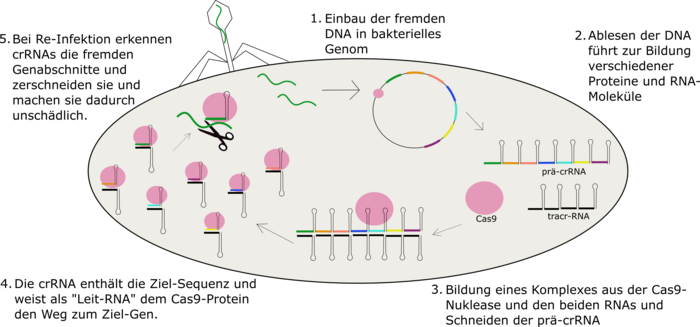
The CRISPR-Cas9 system is an immune system of various bacteria. This system gives the immune system a kind of memory: if foreign genetic material enters, a short section of it is incorporated into the CRISPR area of the DNA. Reading the CRISPR section leads to the formation of various proteins and RNA molecules:
- (pre) crispr RNA (crRNA) contains the various sequences of foreign genomes as "guide RNA"
- trans-activating crRNA (tracrRNA) activates the pre-crRNA
- Cas9 is the protein that cuts the target DNA
The pre-crRNA is a long chain that contains sequences of foreign genes. When the tracrRNA binds to it, the pre-crRNA is cut into small pieces, each of which contains a foreign gene sequence.
RNA strands can be produced that carry part of the target gene as a sequence. With Cas9, the DNA can be cut at this point and, depending on the further procedure, genes can be switched off or inserted. This makes it possible, for example, to analyse gene functions and treat genetic diseases.
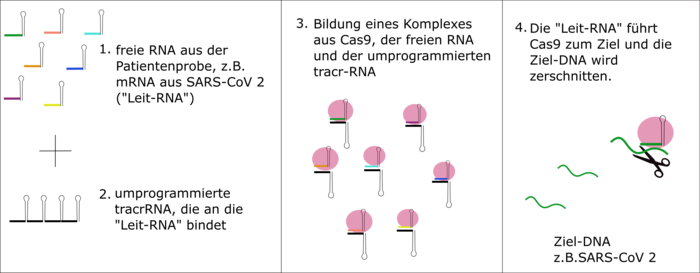
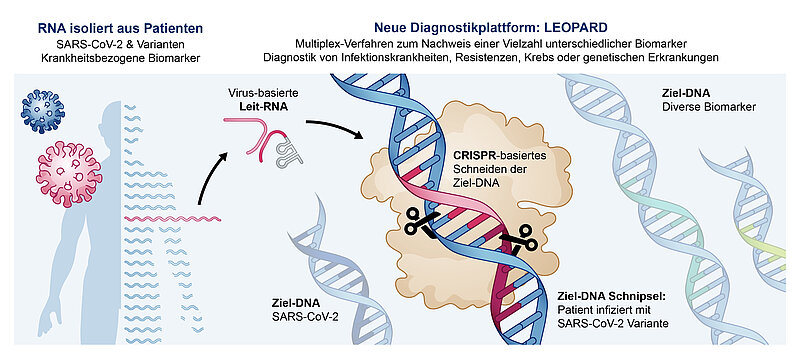
In early 2021, scientists at JMU and the Helmholtz Institute for RNA-based Infection Research (HIRI) discovered that other immune system-independent RNA molecules can also be bound by Cas9. They developed a diagnostic platform called LEOPARD - Leveraging EngineeredtracrRNAs and On-targetDNAs for PArallel RNA Detection.
They found a way to reprogramme the tracrRNA in such a way that it is possible to determine which RNA becomes a "guide RNA" in order to control the Cas9 nuclease.
The new diagnostic platform enables a multiplex diagnostic procedure: Instead of just the detection of one specific pathogen, the detection of several factors is possible here. In laboratory tests, the scientists were able to detect RNA fragments from 9 different viruses. This opens up new possibilities in diagnostics: a patient sample could be tested for several variants of SARS-CoV-2, influenza or other respiratory viruses in a single test. The detection of cancer markers or rare diseases could also be possible.
Contact us
Prof Dr Chase Beisel, Helmholtz Institute for RNA-based Infection Research (HIRI). Email: chase.beisel@helmholtz-hiri.de;https://www.helmholtz-hiri.de
Prof Dr Cynthia Sharma, Chair of Molecular Infection Biology II, Institute of Molecular Infection Biology (IMIB), JMU Würzburg. E-mail:cynthia.sharma@uni-wuerzburg.de, www.uni-wuerzburg.de/en/imib
Original article:
Non-canonical crRNAs derived from host transcripts enable multiplexable RNA detection by Cas9. Chunlei Jiao, Sahil Sharma†, Gaurav Dugar†, Natalia L. Peeck, Thorsten Bischler, Franziska Wimmer, Yanying Yu, Lars Barquist, Christoph Schoen, Oliver Kurzai, Cynthia M. Sharma*, Chase L. Beisel*. Science, 27.04.2021
https://www.science.org/doi/10.1126/science.abe7106
Video Falling Walls:
Video LEOPARD:
https://www.youtube.com/watch?v=giRmYzbqJKk
Press release:
https://www.uni-wuerzburg.de/aktuelles/einblick/single/news/mit-crispr-zu-besseren-coronatests-1/