
The Heartbeat of the Nucleus: The Dawn of Nuclear Timekeeping
Physikalisches Kolloquium
| Datum: | 23.11.2026, 14:15 - 16:45 Uhr |
| Kategorie: | Kolloquium |
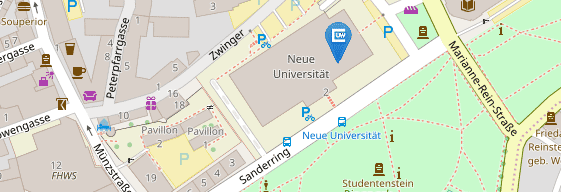
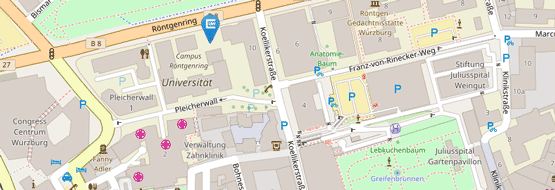
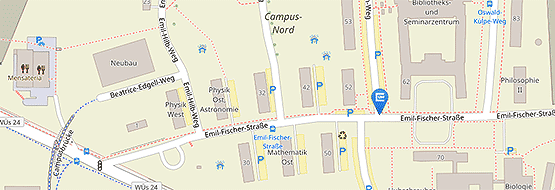
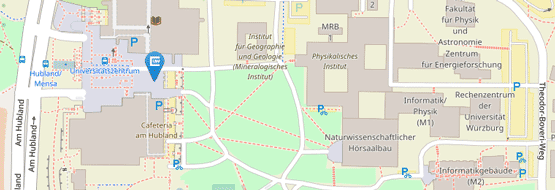
| Ort: | Hubland Süd, Geb. P1 (Physik), Röntgen-Hörsaal, Online |
| Veranstalter: | Fakultät für Physik und Astronomie, Theoretische Physik I, Prof. Dr. Ronny Thomale |
| Vortragende: | Prof. Dr. Peter Thirolf |
Am 23. November 2026 findet um 14:15 Uhr im Röntgen-Hörsaal des Physikalischen Instituts und onlina via Zoom das nächste Physikalische Kolloquium mit einem Vortrag zum Thema „The Heartbeat of the Nucleus: The Dawn of Nuclear Timekeeping“ von Prof. Dr. Peter Thirolf (Ludwig-Maximilians-Universität München, Fakultät für Physik) statt.

Abstract
The quest for an optical nuclear frequency standard, the ‘nuclear clock’ based on the elusive and uniquely low-energetic ‘thorium isomer’ 229mTh, has increasingly triggered experimental and theoretical research activities in numerous groups worldwide in the last decade. Today’s most precise timekeeping is based on optical atomic clocks. However, those could potentially be outperformed by a nuclear clock, based on a nuclear transition instead of an atomic shell transition. Only one nuclear state is known so far that could drive a nuclear clock: the ‘Thorium Isomer 229mTh’, i.e. the isomeric first excited state of 229Th, representing the lowest nuclear excitation so far reported. Such a nuclear clock promises intriguing applications in applied as well as fundamental physics, ranging from geodesy and seismology to the investigation of possible time variations of fundamental constants and the search for Dark Matter [1].
After years of nuclear-spectroscopy driven identification and characterization activities of 229mTh, recently seminal breakthroughs with first laser-driven excitations of the isomeric nuclear resonance in 229Th could be achieved, both using intense broad-band [2,3] and VUV frequency-comb based narrow-band lasers [4], respectively. Hardly any physical observable experienced an improvement by 11 orders of magnitude within only 5 years, as it was reached for the excitation energy of the thorium isomer.
The obvious expectation of a nuclear clock prototype to appear soon was indeed realized recently, when almost simultaneously 2 groups reported on a breakthrough of realizing first working nuclear clocks based on optical excitation of 229mTh and fluorescence detection in a solid-state approach using doped large-bandgap crystals [5,6], followed very recently by a third device [7].
Alternative approaches based on thin films [8] and laser-driven conversion-electron Mössbauer spectroscopy of the thorium isomer [9] also succeeded in isomer excitation, while the complementary approach using individual laser-cooled trapped ions in vacuum is still under study. The talk will review the status and perspectives of ongoing activities on realizing a high-precision nuclear frequency standard based on the thorium isomer both in the solid-state and trapped 229mTh3+ ion approach.
Teilnahme
Präsenz im Röntgen-Hörsaal und online.
Bereits ab 13:45 Uhr können Sie sich im Foyer vor dem Röntgen-Hörsaal auf eine Tasse Kaffee oder Tee treffen.