

Physikalisches Kolloquium
Magnetism at the atomic scale
| Datum: | 22.06.2026, 14:15 - 16:45 Uhr |
| Kategorie: | Kolloquium |
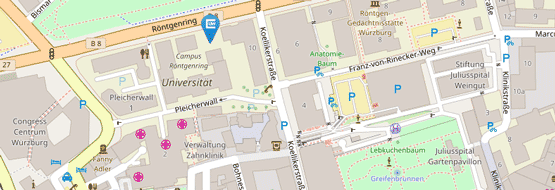
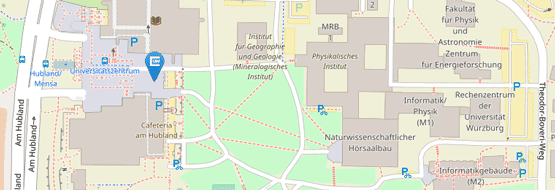
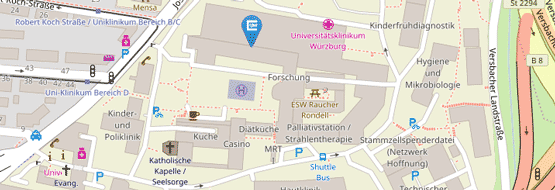
| Ort: | Hubland Süd, Geb. P1 (Physik), Röntgen-Hörsaal, Online |
| Veranstalter: | Fakultät für Physik und Astronomie, Theoretische Physik I, Prof. Dr. Ronny Thomale |
| Vortragende: | Prof.in Dr. Laëtitia Farinacci |
Am 22. Juni 2026 um 14:15 Uhr findet das nächste Physikalische Kolloquium mit einer Antrittsvorlesung zu Professur für Festkörperphysik von Prof.in Dr. Laëtitia Farinacci zum Thema "Magnetism at the atomic scale" statt. Bereits ab 13:45 Uhr können Sie sich im Foyer vor dem Röntgen-Hörsaal auf eine Tasse Kaffee oder Tee treffen.

Magnetism lies at the heart of many of today’s most transformative technologies, from information storage to the rapidly evolving field of quantum computing. As we push toward ever smaller, faster, and more energy-efficient devices, a fundamental question emerges: how can magnetic phenomena be understood, controlled, and ultimately designed at the level of single atoms?
In this lecture, I will explore how scanning tunnelling microscopy (STM) provides a powerful platform to address this challenge. By enabling the imaging, manipulation, and spectroscopic investigation of individual atoms and molecules, STM allows us to construct and probe magnetic systems with unprecedented precision. Combined with advanced techniques such as pump–probe methods, stochastic resonance, and electron spin resonance spectroscopy, it opens the door to accessing magnetic dynamics and interactions across a wide range of energy and time scales.
A central theme of this work is the controlled creation of emergent quantum states. Magnetic centres on superconductors, for instance, give rise to bound states within the superconducting gap with remarkable properties. These states offer a route toward engineering topological phases that are highly relevant for fault-tolerant quantum computing.
Looking forward, the key challenge is to move from observation to control. One direction we pursue is to harness the coupling of these states to electromagnetic fields in order to tune their properties and dynamics at the atomic scale. A complementary and technologically motivated approach is to exploit electric fields as a means of control: unlike magnetic fields, they can be generated, localized, and integrated with relative ease. Establishing electric-field control of magnetism at the atomic scale thus represents an important step toward translating fundamental insights into functional quantum devices.
Teilnahme
Präsenz im Röntgen-Hörsaal und online.