


Physikalisches Kolloquium
Listening to the ultrafast chat of 2 electrons, and asking them about their physics life in intense laser fields
| Datum: | 06.07.2026, 14:15 - 16:45 Uhr |
| Kategorie: | Kolloquium |
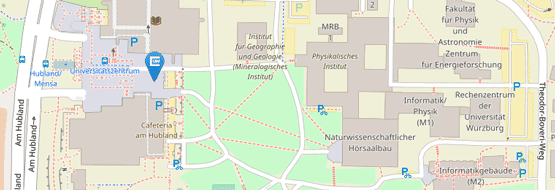
| Ort: | Hubland Süd, Geb. P1 (Physik), Röntgen-Hörsaal, Online |
| Veranstalter: | Fakultät für Physik und Astronomie, Theoretische Physik I, Prof. Dr. Ronny Thomale |
| Vortragende: | Prof. Dr. Thomas Pfeifer |
Am 6. Juli 2026 findet um 14:15 Uhr im Röntgen-Hörsaal des Physikalischen Instituts und onlina via Zoom das nächste Physikalische Kolloquium mit einem Vortrag zum Thema "Listening to the ultrafast chat of 2 electrons, and asking them about their physics life in intense laser fields" von Prof. Dr. Thomas Pfeifer (Max-Planck-Institut für Kernphysik, Heidelberg) statt.

Abstract
Electrons already taught us many physics lessons. To list only a few examples: Spectral analysis of flames, uncovering their discrete atomic energy levels, and the photoelectric effect, leading to the discovery of quantum mechanics, all the way to the laser principle along with its multitude of applications, among them quantum-optics science and technology. The Nobel Prize in Physics 2023 honored the making of extremely short, attosecond-duration flashes of light, opening a portal to exploring electrons in motion within atoms and molecules.
This talk focuses on some of our experiments using tools to measure (listen to), understand, and control/change (asking questions) fundamental electronic processes in atoms and molecules on ultrafast time scales. Employing intense short laser pulses (flashes) of light, the electronic levels within matter can be strongly modified, but then returned to their natural state within a few femtoseconds. These changes manifest in the electronic response and can be read out by spectroscopy, similar to Fraunhofer's approach of observing dark absorption lines in the solar spectrum. Our approach expands on this principle in the analysis of time-, and intensity-dependent spectral structures (line shapes), thus gaining access to the full quantum information, amplitude and phase, of quantum-dynamical modifications and thus changes of the electronic wavefunction. Starting our journey from two electrons in Helium, giving rise to Fano resonances, we extract the fundamental physical mechanisms and afterwards apply them in quantum systems of increasing complexity. These experiments point towards a potential future vision: An ultrafast quantum computer based on atomic states as central (or even neural) processing units (CPUs/NPUs), programmed by intense fields of light.
Teilnahme
Präsenz im Röntgen-Hörsaal und online.
Bereits ab 13:45 Uhr können Sie sich im Foyer vor dem Röntgen-Hörsaal auf eine Tasse Kaffee oder Tee treffen.