
Käte Hamburger Center for Messianic Studies (CEMES)
About Us

Messianic ideas of a more just society and the belief in their realization through chosen figures are rooted in traditions dating back more than two and a half millennia. Throughout this time, messianism has profoundly shaped social, political, cultural, and religious dynamics, and it continues to exert a powerful influence on contemporary thought. Its enduring historical presence is mirrored by a remarkable cross-cultural diffusion that extends far beyond the boundaries of Jewish and Christian traditions, encompassing regional, national, and global constellations. Messianic discourses increasingly appear in economic and ecological contexts, especially in times of crisis. These conceptual patterns play a critical role in addressing major political challenges and shaping future developments.
The universal dimension of messianism forms the academic core of the questions addressed by the Käte Hamburger Center for Messianic Studies and also influences its broader societal mission. As an anthropological constant, messianism requires comparative methodologies that are transhistorical, transcultural, and interdisciplinary. Contemporary messianic movements draw on a traditional repertoire of narratives and imagery, the analysis of which requires the expertise of historical and hermeneutic disciplines. The humanities are uniquely positioned to explore the potential, promises, risks, and dangers of messianic dynamics, particularly via collaboration with the social and political sciences.
Fellowships

The directors of CEMES will invite eight to ten outstanding scholars from around the world to Würzburg. Fellows will have the opportunity to pursue individual research projects and engage in collaborative work on messianism during a residency of six to twelve months. Applications are welcome from scholars across all disciplines whose work focuses on messianism, including both early-career researchers and established senior academics.
Fellow Application 2026-2027
We invite applications for international fellowships commencing in November 2026. Each year, we welcome up to eight to ten senior and junior fellows from around the world—scholars whose research engages critically and creatively with messianic figures, narratives, and practices, examining them as potent forms of cultural, political, religious, and social power.

Directors
“We are committed to examining and comparing the functionalization of messianic narratives across history and cultures, not least in order to gain a more nuanced understanding of contemporary political appropriations of these narratives.”
Barbara Schmitz holds the Chair of Old Testament and conducts research on messianic concepts and power structures in the history of Judaism, from antiquity to the present.
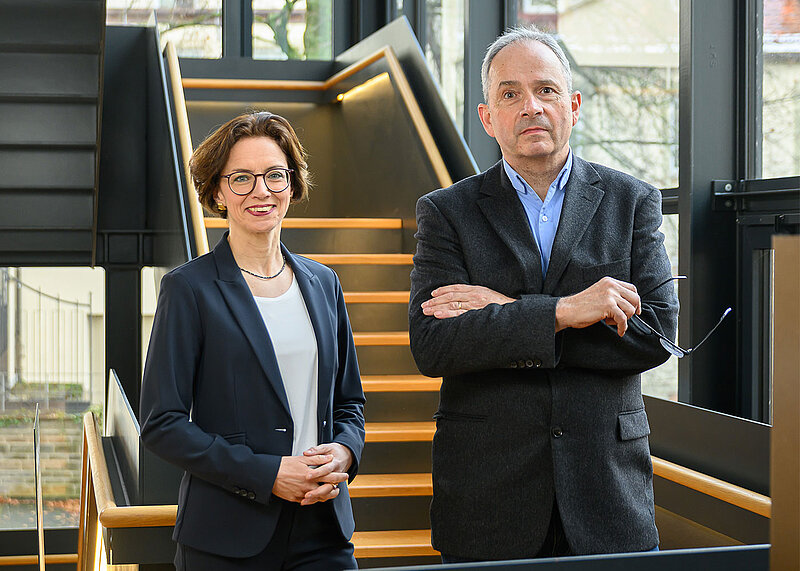
“Messianic discourses repeatedly draw on the same narratives and images, yet they adapt to very different historical and cultural contexts. This offers scholars working on texts and images a valuable opportunity to apply their analytical tools beyond their traditional domains, including politics, society, and religion.”
Christian Wehr, Chair of Spanish and French Literature, previously led a Volkswagen Foundation Opus Magnum project on messianism in Latin America from the colonial period to today.
Käte Hamburger International Centers
Since 2008, the Federal Ministry of Research, Technology and Space (BMFTR) has supported outstanding scholars with the freedom to pursue world‑class research in the humanities and social sciences through the Käte Hamburger Centers. This program is the Federal Ministry’s principal funding line for these academic fields and was evaluated as excellent in 2017. It is named after the Germanist, literary scholar, and philosopher Käte Hamburger (1896–1992).