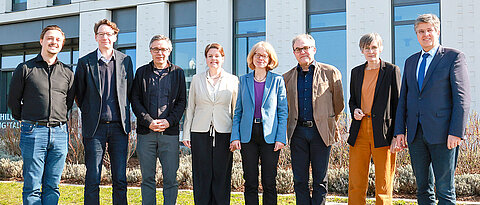
The German Research Foundation is providing funding of around four million euros for a new research group at the University of Würzburg. The group is investigating how ‘alternative facts’ were dealt with as far back as 500 years ago.
more

The German Research Foundation is providing funding of around four million euros for a new research group at the University of Würzburg. The group is investigating how ‘alternative facts’ were dealt with as far back as 500 years ago.
more
In the subject rankings compiled by ShanghaiRanking Consultancy, Würzburg’s research has achieved top positions in nine subject areas. Three areas have performed exceptionally well.
more
Read about new appointments, job anniversaries, research sabbaticals and more.
more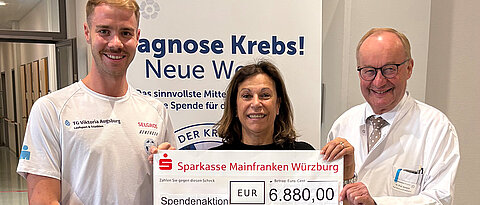
Amateur triathlete Niklas Karl has raised 6,880 euros for cancer research at the University Hospital through a fundraising campaign – an initiative in memory of a close friend.
more
Alexander Meining’s new charity crime novel was published a few days ago. The doctor, who works at Würzburg University Hospital, is donating his royalties to the charity ‘Hilfe im Kampf gegen Krebs’ (Help in the Fight against Cancer) for a specific project.
more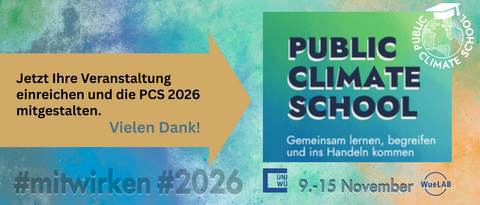
All JMU lecturers are invited to highlight the topic of sustainability in their courses during the Public Climate School, which will take place from 9 to 15 November 2026.
more
Through two different mentoring programmes, the Faculty of Medicine and the University Hospital support early-career academics in their career development. A new round of one of these programmes will begin in January 2027.
more
The Office of the University Women’s Representative has announced two scholarship schemes. Female researchers and students who are interested can apply by 30 September.
more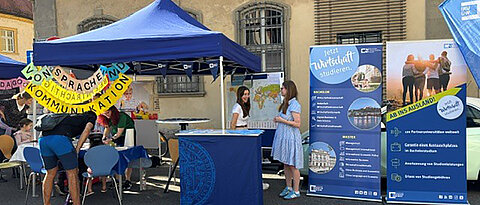
The University will once again be taking part in the Würzburg City Festival on 19 September: this time, the Science Mile will be located in front of TK Maxx on Schönbornstraße.
more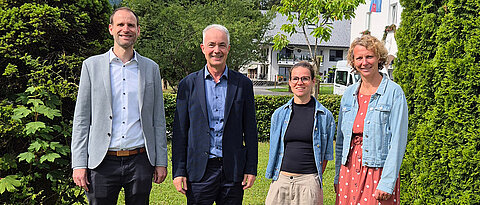
How do caregiving responsibilities and bringing up children affect health in the long term? A Würzburg-Bischofswiesen study follows those affected over a two-year period.
more
The Institute of History is looking for eyewitnesses who can tell about the Leighton Barracks in Hubland. Photographs of the former US barracks are also welcome.
more
Rheumatologist Dr Patrick-Pascal Strunz from the University Hospital has been awarded the Rudolf Schoen Prize – for his research into the therapeutic efficacy of an app developed in Würzburg.
more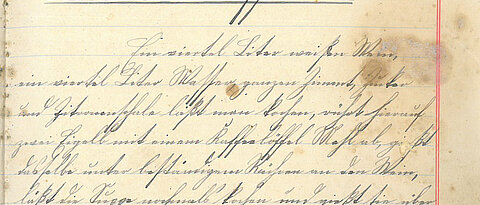
In the course ‘Erlesenes Franken’, members of the public learn to decipher Old German manuscripts alongside students. Anyone outside the university who is interested can register by 1 October.
more
As an interdisciplinary field, Geolingual Studies combines linguistics with remote sensing. A new anthology highlights the research opportunities this opens up.
more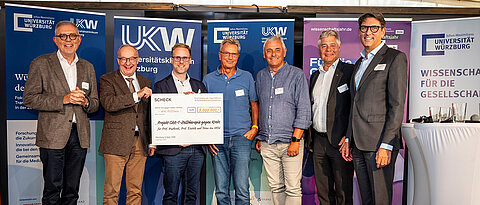
The “Würzburg Future Medicine Day” also focused on the future of the region as a centre for research. The Vogel Foundation sent a strong signal with its multi-million funding for CAR-T cell research.
more