
New DFG Research Group: ‘Alternative Facts’ in the 16th century
09/22/2026The German Research Foundation is providing funding of around four million euros for a new research group at the University of Würzburg. The group is investigating how ‘alternative facts’ were dealt with as far back as 500 years ago.
When discussions today turn to ‘alternative facts’, disinformation or competing claims to truth, attention is usually focused on social media and current political debates. Researchers at the Julius-Maximilians-Universität Würzburg (JMU) are now investigating a different aspect: they are examining how people in the early modern period dealt with provocative claims to truth and what parallels can be drawn with today’s social conflicts.
The German Research Foundation (DFG) is funding the new Würzburg research group “‘Alternative Facts’ in the 16th Century” with four million euros over the next four years. Seven professors will work together to get to the bottom of the origins and effects of “alternative facts”. The group will commence its work in early 2027.
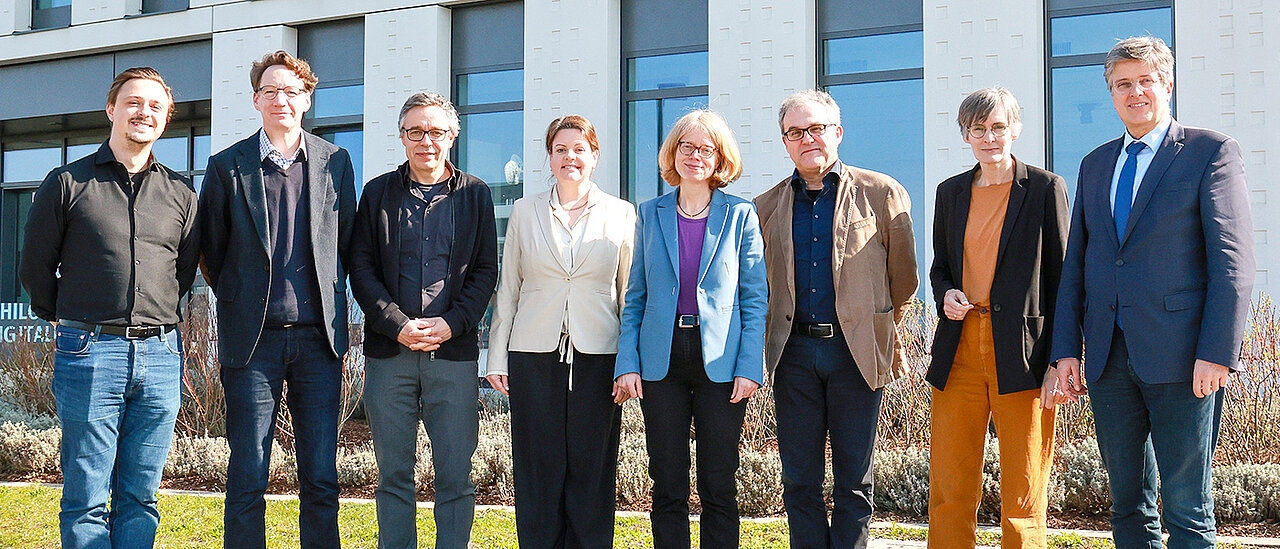
The spokesperson for the new DFG research group is Professor Regina Toepfer from the Chair of German Philology. Also involved are Professor Thomas Baier (Classical Philology / Latin Studies), Professor Maximilian Bergengruen (Modern German Literary and Cultural History), Professor Christine Büchner (Catholic Theology / Dogmatics), Professor Joachim Hamm (Literary History of the Late Middle Ages and Early Modern Period), Professor Dag Nikolaus Hasse (History of Philosophy) and, from the University of Bonn, Professor Birgit Ulrike Münch (Art History).
Media change as a driver of social conflicts
‘Alternative facts’ are not a phenomenon of the present day. ‘As early as the 16th century, established bodies of knowledge were being called into question, provocative interpretations were being disseminated, and public debates were becoming increasingly polarised,’ says Regina Toepfer. The period of upheaval in the 16th century, when a media revolution took place, is of particular interest: the printing press made it possible for the first time to disseminate information rapidly and on a massive scale – the researchers see parallels here with today’s digital media.
In the early modern period, contradictory facts were generated, passed down and discussed with particular intensity. People drew on knowledge from classical antiquity as well as from the Arab and Christian Middle Ages, embedded it in new narratives and worldviews, and supplemented it with subjective experiences and interpretations guided by self-interest.
Humanism proclaimed a renaissance of ancient authors and employed imagery of light to herald the overcoming of the ‘dark’ Middle Ages. At the same time, this seemingly progressive era had aspects that appear highly problematic today: these include colonisation and discrimination, ideology-based conflicts and religious wars.
The early modern period offers numerous parallels to today’s debates. At that time, fears of a ‘Turkish threat’ were stoked; there was misogyny and the persecution of witches, the defamation of unpopular individuals or entire ethnic groups, the exploitation and oppression of peasants and other social groups, and the marginalisation of those of other faiths, whether from Judaism or the Arab world.
Objective: Understanding patterns of communication
In their sub-projects, the researchers in the new DFG research group are using historical sources from various spheres of life to investigate how knowledge was conveyed, disputed or deliberately called into question. In doing so, they focus on topics from politics, religion, education, medicine and culture. Their aim is to understand the patterns of communication through which people sought to assert their own views or to undermine the credibility of other positions.
The researchers do not simply wish to determine whether a claim was true or false. Rather, they aim to understand why certain interpretations were persuasive, what social functions they fulfilled, and how they influenced public debate. To this end, they are investigating, amongst other things, strategies of sowing doubt, the emergence of competing narratives and the role of emotions in debates about knowledge and truth.
Through its work, the DFG Research Group aims to contribute to our understanding of a topic that could scarcely be more topical in light of growing disinformation and dwindling trust in knowledge.
Contact
Prof. Dr Regina Toepfer, Chair of German Philology, University of Würzburg, regina.toepfer@uni-wuerzburg.de