
University Medicine focuses on translation and transfer
09/15/2026The “Würzburg Future Medicine Day” also focused on the future of the region as a centre for research. The Vogel Foundation sent a strong signal with its multi-million funding for CAR-T cell research.
To raise the profile of Würzburg as a leading centre for medical science and to promote discussion on current research and innovative developments: that was the aim of the ‘Würzburg Day of Future Medicine’.
Around 150 guests from the worlds of politics, science and society gathered on 9 September 2026 on board the MS Wissenschaft. The floating science centre – an initiative of the Federal Ministry of Research, Technology and Space, as well as the ‘Science in Dialogue’ initiative – has been touring Germany since May under the motto ‘Medicine of the Future’ and stopped off in Würzburg before sailing on to Vienna.
CAR-T cell therapy is a flagship of the region
Also on board the MS Wissenschaft is an exhibit on CAR-T cell therapy developed by the University Hospital and the University of Würzburg. Immunotherapy using genetically modified T-cells is a flagship of the centre. Würzburg was the first centre in Germany to use this therapy in the treatment of blood cancer, and is now one of the centres with the highest number of patients treated.
To further strengthen this position and bring new research findings into clinical practice as quickly as possible, investment is needed across the entire innovation chain, as was agreed by the high-profile panel.
Three million euros invested in CAR-T cell research
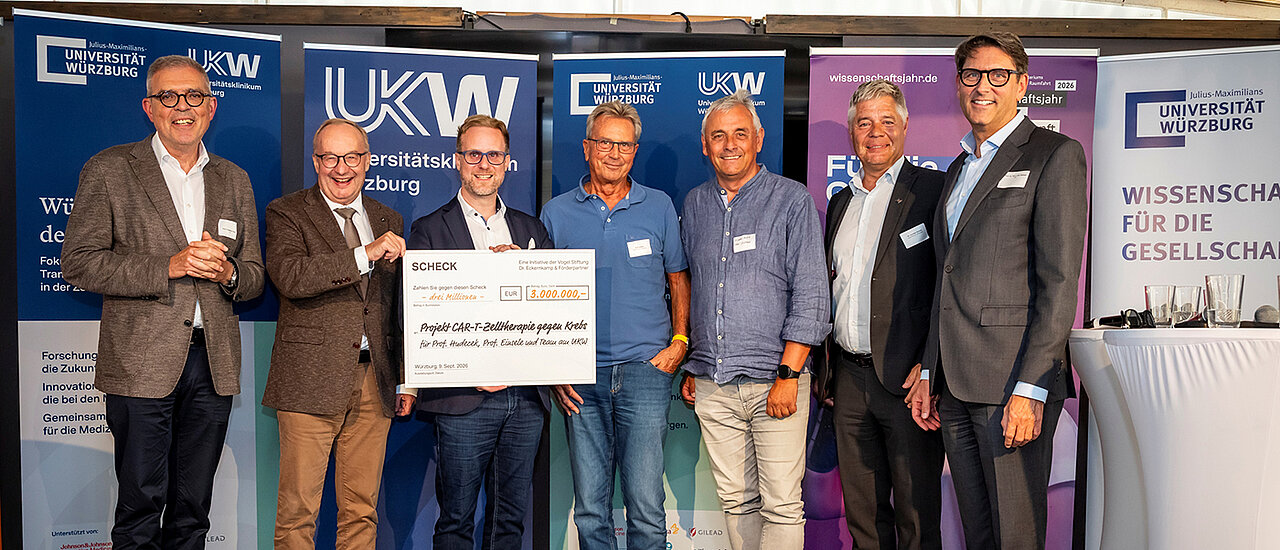
A symbolic cheque presentation by the Vogel Stiftung Dr Eckernkamp therefore sent a strong signal: The foundation has been supporting the work of Professor Hermann Einsele and Professor Michael Hudecek at Würzburg University Hospital (UKW) for several years now, and this research funding has now grown to a total of three million, according to a joint press release from Würzburg University Medical Centre and the Vogel Foundation Dr Eckernkamp.
The foundation’s commitment strengthens the overall CAR-T cell research project whilst also placing a particular emphasis on supporting early-career researchers in the field of protein engineering and in the use of artificial intelligence in the fight against cancer.
“With our support, we aim to strengthen the important research into CAR-T cell therapy at the University Hospital. We have the opportunity here to invest specifically in the momentum and growth of a cutting-edge field, thereby reinforcing Würzburg’s role as a beacon of excellence,” said Dr Gunther Schunk, Chairman of the Board of the Vogel Stiftung Dr Eckernkamp, explaining the ongoing funding. “We wish Professor Hudecek and his entire team every success and, above all, hope that the results of their research will reach patients as quickly as possible.”
Consistently translating research into clinical practice
Prof. Dr Michael Hudecek, holder of the UKW Chair of Cellular Immunotherapy and Head of the Würzburg branch of the Fraunhofer Institute for Cell Therapy and Immunology (IZI), said: “We are very grateful to the Vogel Foundation for this generous support. CAR-T cell therapy is already demonstrating the difference that innovative research can make for patients. Our aim in Würzburg is to consistently translate and transfer research, thereby bringing it into clinical practice as quickly as possible.”
The Dean of the Faculty of Medicine at Würzburg University, Prof. Dr Matthias Frosch, added: “The three million euros from the Vogel Foundation are of great value to the University Hospital and its research. New and innovative research in particular needs scope – especially when a topic is not yet covered by established funding structures. Foundations create this scope and drive forward research projects that would otherwise not be possible.”
Developing Würzburg as a centre for gene and cell therapy
The two panel discussions moderated by Johannes Keppner at the ‘Würzburg Day of Future Medicine’ focused on the question of how scientific findings can be successfully translated into clinical application and what conditions are needed for innovation in Würzburg to achieve this.
Leading researchers from Würzburg University Hospital and the University of Würzburg, as well as from the non-university research organisations Fraunhofer, Helmholtz and Max Planck, discussed the path from basic research to clinical application and the structures and infrastructure required to achieve this.
It became clear that Würzburg is very well positioned internationally in the field of gene and cell therapy and has achieved significant successes in both research and clinical application. Würzburg aims to further expand this leading position, in particular through additional research infrastructure that strengthens translation and transfer, both directly at the hospital and within the non-university research organisations and local biotechnology companies.
It should be possible to carry out the entire spectrum of activities in Würzburg, from basic research through clinical trials and suitable infrastructure right through to the manufacture of cell-based products. Collaborations with biotech and pharmaceutical companies, as well as the promotion of spin-offs, also play an important role in this regard.
“Würzburg is in an excellent position in the field of gene and cell therapy. The task now is to further build on this strength through targeted investment and strong partnerships, in order to bring research into clinical application quickly,” summarised Prof. Dr Tim J. von Oertzen, Medical Director of Würzburg University Hospital.
‘Medicine of the Future’ exhibition met with great interest
The ‘Medicine of the Future’ exhibition, which was on display in Würzburg on board the MS Wissenschaft from 8 to 11 September, also attracted a great deal of interest. According to the organisers, the exhibition received an excellent response: the ship was consistently very well attended on all four days.
Vogel Stiftung Dr Eckernkamp
The Vogel Stiftung Dr Eckernkamp was founded in 2000 by the Würzburg-based publisher Dr Kurt Eckernkamp and his wife Nina Eckernkamp-Vogel. The foundation focuses its funding on four areas of activity: education, science, healthcare and culture. Participation in life – across all generations – is at the heart of the foundation’s work. In 2020, the foundation was awarded the ‘Innovative through Research’ seal of quality by the Stifterverband für die Deutsche Wissenschaft in recognition of its support for research projects. The foundation pursues exclusively charitable objectives and is affiliated with the company Vogel Communications Group as a co-shareholder.