
Slammer:innen 2025
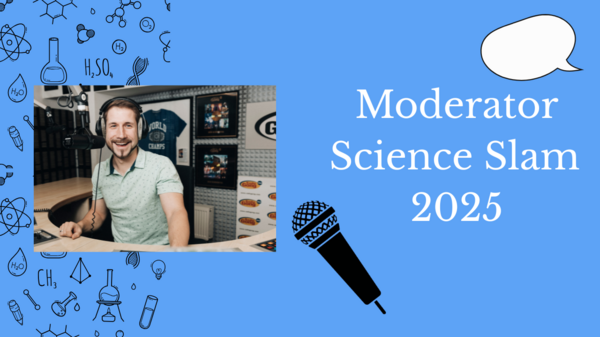
Presented by Johannes Keppner
Presenter at Radio Gong
How would you sum up 10 years of Science Slam? What do you particularly like about it?
The sheer breadth and variety of the talks! However diverse the fields of research and topics may be – there’s one thing the Science Slam has never been in its 10 years: boring! And, of course, the fantastic audience, who reward the speakers’ courage in stepping out of their comfort zone with thunderous applause – and also smile kindly at the presenter’s occasional corny jokes! ;)
What was the biggest blunder?
When organiser Michaela Thiel and I both wanted to have the last word at the same time. The audience thought it was rehearsed and laughed – so here too, the end justified the means!
Why do you think the Science Slam is still important today?
Because the format demonstrates in an entertaining and compelling way what research is being carried out in Würzburg’s ‘study rooms’ – and why it is important for humanity...or at least could become important – even if we might not have fully understood it even after a 7-minute explanation! ;)
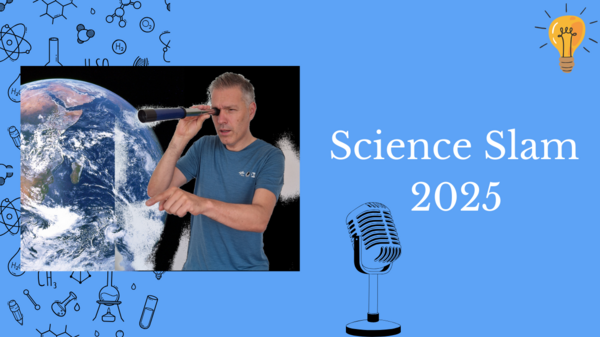
The evening will be opened by Hannes Taubenböck
JMU Geography Department, winners of the last Science Slam in 2024
What motivated you to take part?
The unequivocal statement from Michaela Thiel – the organiser – that, as last year’s winner, I simply had to open the Science Slam the following year! How could I possibly have refused?
What will you be talking about?
About how sometimes you have to change your perspective to understand the world in a new or different way. Remote sensing from space does exactly that. I’ll be showing how surprisingly people sometimes shape the Earth’s surface, what ideas they’re pursuing in doing so, and how these insights might help us make better use of the limited space on our planet.
What particularly fascinates you about your topic?
Satellite imagery is ubiquitous in today’s world. We use it in our daily lives to find our way around or to find out about places. And yet there is so much more information about how we live together hidden within this data, which isn’t immediately obvious. I’m fascinated by deriving surprising insights from spatial structures and trying to use them to better understand how we live together as a society.
Jessica Ruck
Psychologist and psychological psychotherapist, Institute of General Medicine at Würzburg University Hospital
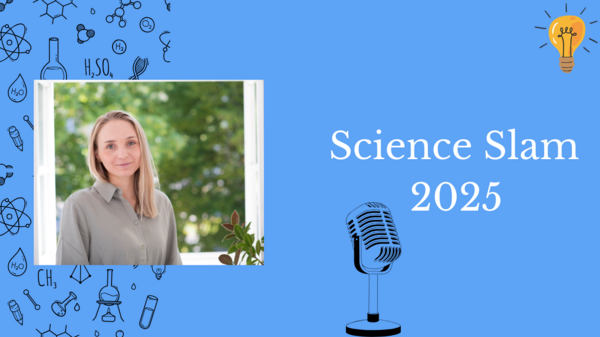
Slam title: Lost in prevention – Unintended effects of health communication, using the example of the Federal Ministry of Health’s ‘Legal but...’ prevention campaign
What motivated you to take part?
The Science Slam format brings together many of my passions: science, humour and PowerPoint! I’d like to share the knowledge and enjoyment I get from it with other people.
What will you be talking about?
How can I help people adopt “healthier” behaviours? When it comes to prevention – that is, preventing or reducing the burden of disease – well-meaning advice or fear-inducing messages can often backfire. The way health information is communicated has a decisive influence on health behaviour, such as the consumption of psychoactive substances like alcohol, nicotine and cannabis. Using an example from cannabis prevention, I’ll explain what needs to be considered in health communication and what can go wrong.
What particularly inspires you about your topic?
At our Institute of General Practice, we focus, among other things, on prevention and the teaching of communication skills to encourage motivation for lifestyle changes (e.g. regarding smoking and alcohol) in general practice. I am fascinated by the impact that the conscious use of language and the attitude with which I approach patients can have. Raising awareness of patients’ perspectives and their lived reality is particularly important to me in this regard.
Carsten Büchner
PhD student in physics at the Fraunhofer Institute for Silicate Research ISC in Würzburg
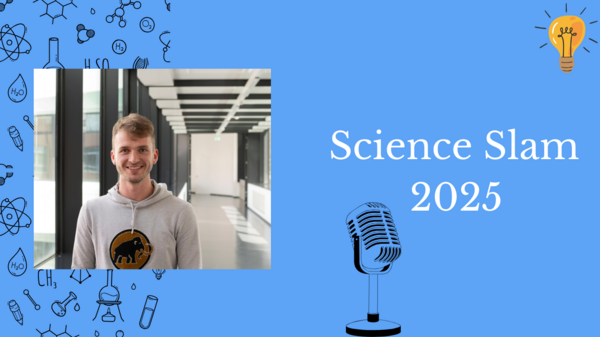
Slam title: Listening and understanding: How are our batteries actually doing?
What motivated you to take part?
I’ve been sitting in the audience at the Science Slam for many years and am amazed every time at how excitingly and vividly scientific topics can be presented. For me, that’s science communication in action – and I’d like to play my part in it.
What will you be talking about?
Batteries have become an integral part of our everyday lives: they power our mobile phones, our laptops – and, increasingly, our cars too. They are key to the energy transition. But how are the batteries actually doing? How fully charged are they? How healthy? These questions aren’t that easy to answer. I will demonstrate how, at Fraunhofer ISC, we can use ultrasound to listen inside batteries and thereby give them a health check.
What particularly fascinates you about your research topic?
Climate change is the greatest challenge of our time. Without high-performance, long-lasting batteries, the energy transition will not succeed. With the help of ultrasound examinations, we can better understand the internal processes in batteries and thus improve their lifespan and performance. Being part of this drives me forward.
Dr Volker Latussek
Physicist, member of staff in the University central administration’s Planning and Reporting Department
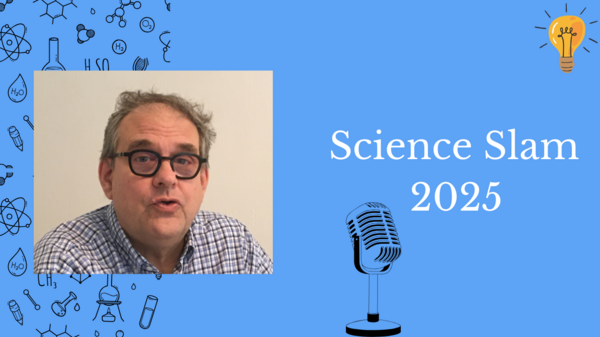
Slam title: Why isn’t external funding indecent?
What motivated you to take part?
The Science Slam captures the University of Würzburg’s guiding principle – ‘Science for Society’ – very well. The central administration supports research with its own motto: ‘Support for Science’. I’d like to give an example of this.
What will you be talking about?
The University of Würzburg is very successful in securing so-called third-party funding. Why does it do this? I would like to illustrate this type of funding in particular using the example of funding from the German Research Foundation (DFG).
What particularly excites you about your topic?
The fact that external funding brings me into conversation with many professors.
Dr Isabell Ramming
Microbiologist, Chair of Hospital Hygiene, University of Würzburg

Slam title: ESKAPE – (How) do we escape hospital germs?
What motivated you to take part?
Science slams make research visible, because they bring science out of the laboratory and right into the audience. Even topics that are often overlooked or uncomfortable – such as hospital infections. That’s exactly why I’m bringing my enterococci to the stage this time: to show just how exciting and important science can be.
What will you be talking about?
About round bacteria that are with us every day: enterococci. In the gut, they are useful co-inhabitants – in hospital, they can become life-threatening. And they challenge us: they are incredibly adaptable and have many resistances. I’m researching how these bacteria ‘communicate’ with each other via tiny membrane vesicles and exchange information. Hopefully, this will help us find new ways to control them.
What particularly inspires you about your research topic?
I’m excited that my research can have a direct benefit for patients. I’m fascinated by bacteria because they are so incredibly diverse. And although they seem so simple, we still haven’t fully understood them. My research allows me to combine my fascination with bacteria with the well-being of patients. What could be better than that?
Prof. Dr Peter Bofinger
Emeritus Professor of Economics, Monetary Policy and International Economic Relations / Chair of the University’s Central Alumni Association
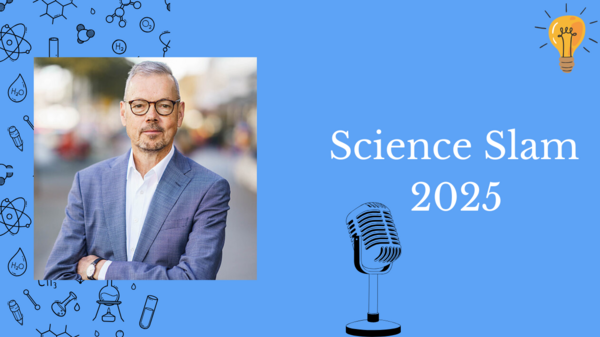
Slam title: Getting rich with cryptocurrencies?
What motivated you to take part?
The great atmosphere at the 2024 Slam.
What will you be talking about?
Cryptocurrencies, particularly Bitcoin.
What excites you most about your topic?
How you can get rich or go broke with cryptocurrencies.
Dr Gunther Schunk
Alumnus, linguist and Director of Public Relations at Vogel Communications Group, Chairman of the Board of the Vogel Foundation, Dr Eckernkamp, Chairman of the University Association
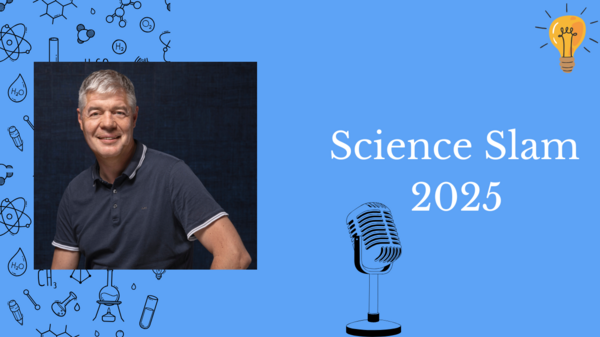
Slam title: Meefränggisch – linguistic identity-building as a superpower
What motivated you to take part?
As someone who loves communication, I celebrate every form of communication and enjoy trying them out. After coming second in my first Science Slam, it’s time to face the competition again.
What will you be talking about?
In a world increasingly permeated by digitalisation and artificial intelligence, there is a clear need for more humanity. Dialect, or at least dialectal and regional linguistic colouring, is a profoundly human form of expression. This gives dialect a new social function. In general, we should be exploring how individual, personal language use will emerge and function in the future, and how it can distinguish itself from language generated by AI.
What particularly inspires you about your topic?
The world of language is wonderful and can permeate everything. It can create new worlds and build the future. Perhaps right now, in an era caught between fake news and rapid-fire research, this is a particularly important role for language to play.
Prof. Martin Naumann, MSc (Eng)
THWS Professor of Design and Architectural Theory at the Faculty of Architecture and Civil Engineering, Vice-President for Sustainability and Infrastructure
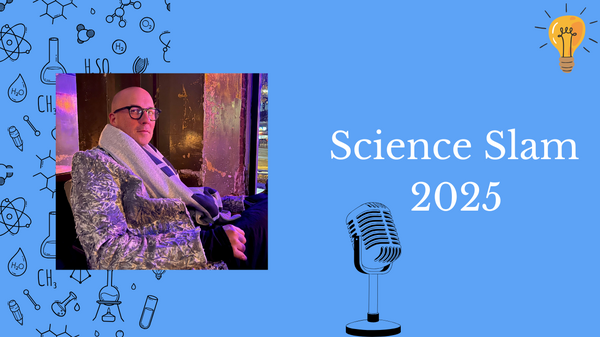
Slam title: A few thoughts on sustainability
What motivated you to take part?
I’ve been toying with the idea of taking part for ages – it seems like quite a cool format – then someone asked me directly, so I’m satisfying my curiosity :).
What will you be talking about?
Sustainability, dreams and reality
What particularly inspires you about your topic?
What excites me is that sustainability isn’t about sacrifice, but about opportunities. About innovation, collaboration and the ability to shape change, rather than just enduring it.