Best Of Slammer:innen 2025
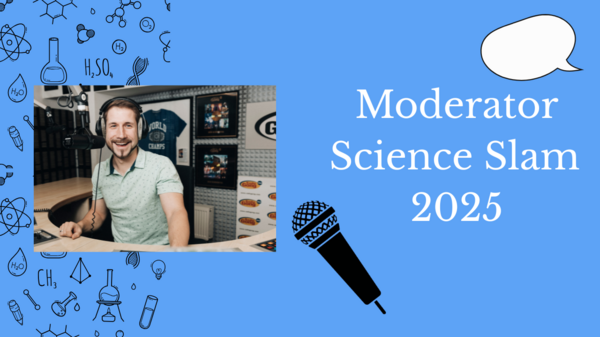
Presented by Johannes Keppner
Presenter at Radio Gong
How would you sum up 10 years of Science Slam? What do you particularly like about it?
The sheer breadth and variety of the talks! However diverse the fields of research and topics may be – there’s one thing the Science Slam has never been in its 10 years: boring! And, of course, the fantastic audience, who reward the speakers’ courage in stepping out of their comfort zone with thunderous applause – and also smile kindly at the presenter’s occasional corny jokes! ;)
What was the biggest blunder?
When organiser Michaela Thiel and I both wanted to have the last word at the same time. The audience thought it was rehearsed and laughed – so here too, the end justified the means!
Why do you think the Science Slam is still important today?
Because the format demonstrates in an entertaining and compelling way what research is being carried out in Würzburg’s ‘study rooms’ – and why it is important for humanity...or at least could become important – even if we might not have fully understood it even after a 7-minute explanation! ;)
Dr Julien Bobineau
Journalist and member of the management team at the Diversity Think Tank
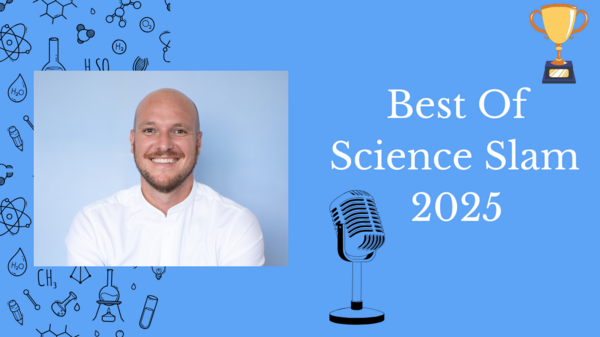
Slam title: Racism in the police force?! How colonial perceptions of Africa shape our everyday lives – and what Horst Seehofer has to do with it.
What motivated you to take part?
Over the last 10 years, I’ve had the chance to take to the stage at the Würzburg Science Slam with various slam performances. Now I’m really looking forward to being part of the Best Of
What will you be talking about?
I’ll be speaking on a very sensitive topic: racism in the police force. However, my study – which I’m conducting in collaboration with the Bavarian Police – isn’t about pointing fingers, but rather about how the police can position themselves to recognise and actively combat racism.
What particularly inspires you about your topic?
…that through my research I can make a small contribution to making our diverse society a little fairer
Prof. Dr Daniel Kulesz
Department of Engineering, Computer Science and Economics, Bingen University of Applied Sciences
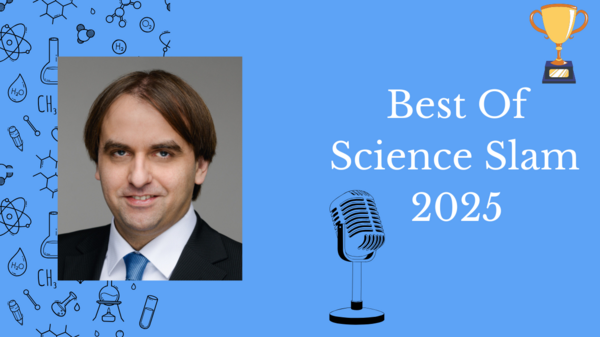
Slam title: End-User Software Engineering
What motivated you to take part?
That Science Slam was my very first one. I’d often toyed with the idea of taking part before, but in the end hadn’t done so due to scheduling conflicts and so on. To my great surprise and delight, I actually won the Science Slam straight away – and as it was such a brilliant experience and I’ve been to other Science Slams since then, I naturally had to say yes straight away to this “Best Of”. I also always look forward to seeing my former students, friends and other mates from my time in Würzburg, a few of whom I hope will be coming to this Best-Of Science Slam too!
What will you be talking about?
It’s broadly about programming for non-computer-science people. That is, those of a different persuasion who don’t start counting at 0.
What particularly excites you about your topic?
Although the topic is quite old and my PhD was completed some time ago, it hasn’t lost any of its relevance. What’s more, unlike many other topics in computer science, it’s quite down-to-earth and affects a great many people, which makes it well-suited to a Science Slam.
Dr Sebastian Markert
Engineering
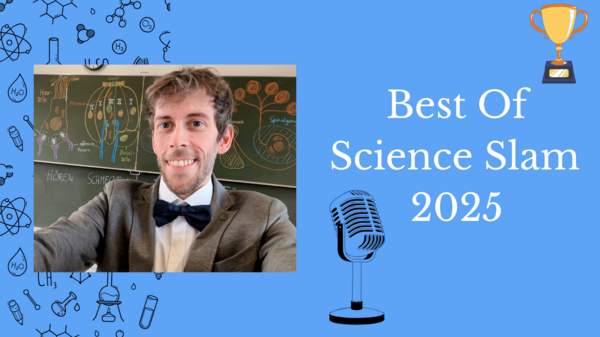
Slam title: What happens when you close your eyes?
What motivated you to take part?
My last Science Slam in Würzburg was via Zoom, because I was in the US at the time. But now I’m happy to take this opportunity to travel back to my lovely Würzburg. Besides, I naturally take every opportunity to talk about science anyway.
What will you be talking about?
What happens when you close your eyes. Yes, that’s a really difficult question! I needed a freezer that costs half a million, as well as several Pokémon, just to get anywhere near the answer to that question! And synapses feature too. After all, I’m a neurobiologist.
What particularly fascinates you about your topic?
Seeing is believing. Data is all well and good, but when you end up with images of what’s happening in synapses and cells – snapshots of the cellular machinery in action – that’s simply unbeatable.
Prof. Dr Klaus Brehm
Medical Parasitology
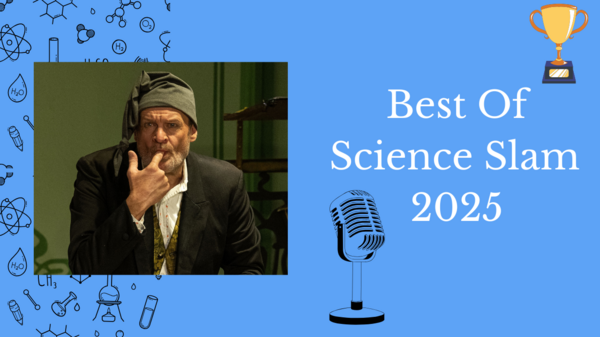
Slam title: Why tapeworms aren’t gendered, but still feel included.
What motivated you to take part?
Ms Thiel’s powers of persuasion.
What will you be talking about?
The beauty of tapeworm life and why, despite that, none of us wants to be one
What particularly excites you about your topic?
Immortality!
Dr Charlotte Schwenner
Science editor
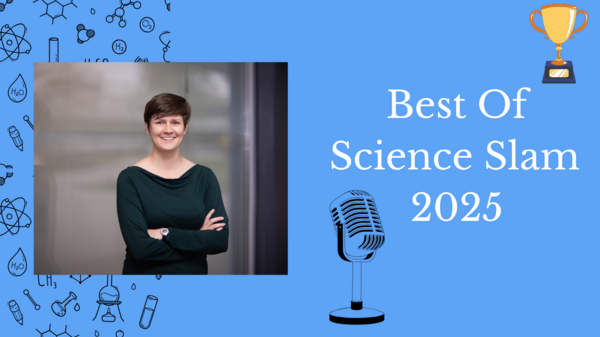
Slam title: Bacteria looking for a flat share
What motivated you to take part?
My first Science Slam at the University of Würzburg in 2016 also marked the start of my current career as a science communicator. So the Best Of Slam brings things full circle – and it’s a great excuse to visit lovely Würzburg again.
What will you be talking about?
About the world’s smallest shared flat and why we urgently need research into antibiotics to combat this flat-share.
What particularly fascinates you about your topic?
Bacteria seem like very simple organisms, but they have more up their sleeves than most people expect! If we don’t want to be caught off guard by the ‘silent pandemic’ of antibiotic resistance, we need to talk more about bacteria and antibiotic resistance.
Prof. Dr Björn Trauzettel
Theoretical physics

Slam title: Why life is easier as a quantum mechanical particle
What do you like about the Science Slam format?
Explaining science with humour.
What will you be talking about?
About how life would be much easier if we humans were significantly smaller, so that quantum mechanics would limit our scope of action rather than classical mechanics.
What has been your best experience so far during your time at university?
As a student and PhD candidate, I was in Freiburg and Seattle. As a postdoc in Paris, Leiden and Basel. As a professor in Würzburg and Berkeley. There were wonderful experiences everywhere. What all these wonderful experiences at the various universities have in common is that I tried, together with inspiring people from all over the world, to better understand complex relationships. Whenever we took a decisive step forward, it was a wonderful experience.
Prof. Dr Hans-Georg Weigand
Former Professor of Mathematics Education at JMU
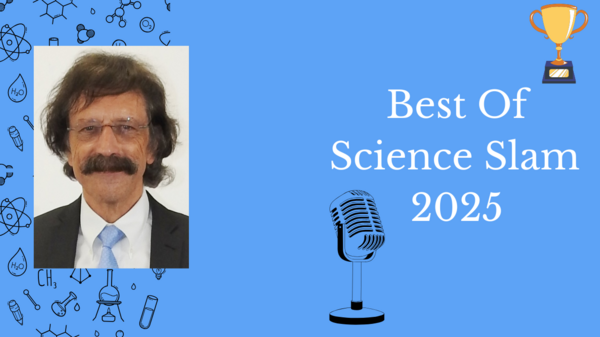
Slam title: How does a mathematician think?
What motivated you to take part?
It wasn’t just the PISA studies that showed that the general public’s mathematical literacy isn’t as strong as it could be. That’s why I want to take every opportunity to raise mathematical literacy among the general public. And, as there is often a misconception about mathematics, I want to show what mathematics (also) is!
What will you be talking about?
My title is: How does a mathematician think? – The title speaks for itself! The answer will be revealed in the talk.
What particularly inspires you about your topic?
A mathematician deals with abstract concepts that are not of this world, and yet, through mathematics, they can improve the world and sometimes understand it very well. The next step is to change the world for the better.