Slammer:innen 2024
The evening will be opened by Dr Moritz Göde, a graduate of the JMU School of Dentistry and winner of the 2023 Science Slam
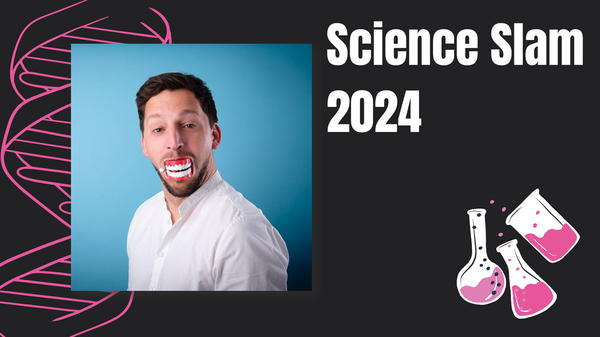
Slam title: An Oral Sermon
What do you like about the Science Slam format?
An intelligent, inquisitive audience meets scientists with a thirst to share their knowledge and a flair for entertainment. It’s the perfect evening!
What will you be talking about?
About all sorts of things in the mouth, around the mouth and concerning the mouth! In any case, I’ll try to make as many useful everyday connections as possible – after all, you can teach an old mouth new tricks!
What has been the best experience so far during your time at uni?
Actually, graduation. Studying dentistry is – quite fittingly – no walk in the park.
Prof. Dr Björn Trauzettel, Theoretical Physics
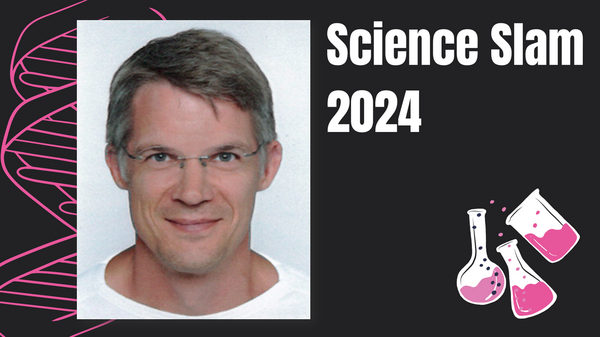
Slam title: Why life is easier as a quantum mechanical particle
What do you like about the Science Slam format?
Explaining science with humour.
What will you be talking about?
About how life would be much easier if we humans were significantly smaller, so that quantum mechanics would limit our scope for action rather than classical mechanics.
What has been your best experience so far during your time at university?
As an undergraduate and PhD student, I was in Freiburg and Seattle. As a postdoc, I was in Paris, Leiden and Basel. As a professor, I was in Würzburg and Berkeley. There were wonderful experiences everywhere. What all these wonderful experiences at the various universities have in common is that I tried, together with inspiring people from all over the world, to better understand complex relationships. Whenever we took a decisive step forward, it was a wonderful experience.
Prof. Dr Maik Luu, Translational Medicine
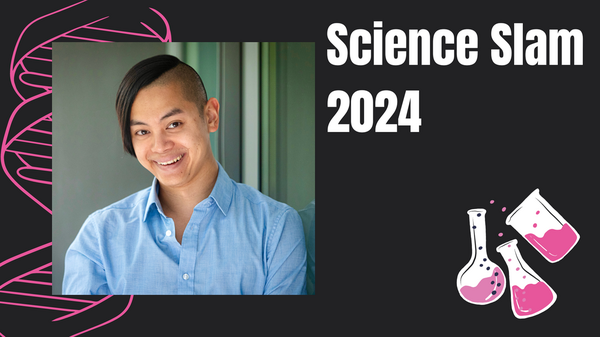
Slam title: You never walk alone
What do you like about the Science Slam format?
It makes science accessible to a wide audience in a short and snappy way and can get people excited about completely new topics if you manage to captivate them. It’s a wonderful challenge that spurs you on to make your own research understandable to everyone.
What will you be talking about?
We’ll be looking at the day-to-day activities of our single-celled housemates inside us.
What has been the best experience so far during your time at university?
There have been so many wonderful experiences I’ve had the chance to enjoy at university, but what has particularly stayed with me are the new discoveries we were able to make in the lab as a team, using our own concepts and experiments. We live for research because of our sheer curiosity to formulate hypotheses and test them. Hearing from students now that we’ve managed to inspire them with a passion for their own topic and pass that on is the best thing of all.
Dr Johannes Löw, specialist journalist and author
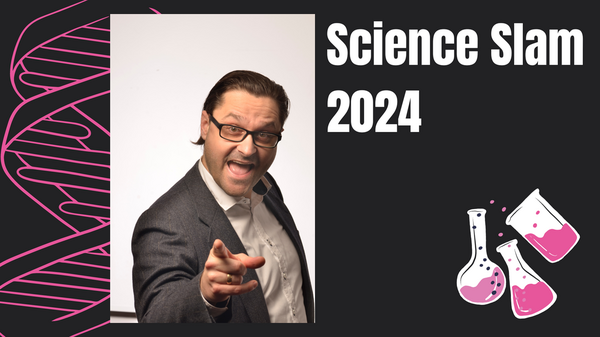
Slam title: Experience the birth of an academic discipline live!
What do you like about the Science Slam format?
It’s an absolute thrill to bring technical topics – which are otherwise often confined to academic backrooms – to life in a crisp and entertaining way for a discerning audience. It’s time to step out of the scientific bubble and onto the stage! What is usually celebrated in dry technical jargon must here be conveyed to non-specialists in a way that is understandable and striking. Far too often, the scientific community thinks it isn’t allowed to be funny. Yet it’s a real pleasure to break free from that straitjacket. Well-founded humour is an entertaining bonus for the audience and provides valuable, direct feedback for the slammers – a real energy boost that gets right under your skin.
What will you be talking about?
Many university disciplines and fields of research that seem self-evident to us today took a long time to establish themselves academically. I invite everyone to be there live for the difficult historical birth of an academic discipline. But be warned: the wild ride between Stone Age horror, nasty medieval migrant workers and Star Trek is not for the faint-hearted!
What has been the best experience so far during your time at uni?
I’ve always really enjoyed the semester breaks and the lecture-free periods (laughs). Joking aside, the lectures where the lecturer didn’t just read from a text but celebrated specialist knowledge through entertaining storytelling still inspire me today in my work as a journalist and non-fiction author. I’ll never forget, for example, the saltatory conduction of excitation, during which our physiology professor hopped right across the lecture theatre with his whole body.
Prof. Dr Hannes Taubenböck, Earth Observation Research Cluster
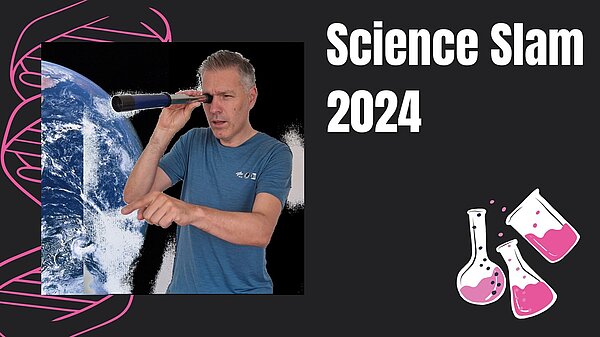
Slam title: I see something you don’t see, and that is …
What do you like about the Science Slam format?
The chance to go on a journey of discovery together with a curious audience! It’s great fun to inspire people – and perhaps surprise them – with the things that fascinate me. But who knows – maybe in the end I’ll be the only one left with my enthusiasm.
What will you be talking about?
About how sometimes you have to change your perspective to see the world in a new or different light. Remote sensing from space does exactly that. I’ll show how surprisingly people sometimes shape the Earth’s surface, what ideas they’re pursuing with it, and how these insights might help us make better use of the limited space on our planet.
What has been the best experience so far during your time at university?
The highlights of my time at university have been experiences during field trips. Experiences I would probably never have had on ‘normal’ trips. I probably learnt just as much in moments when a sandstorm in the desert made my fellow travellers disappear from around me for hours, or when a camel bolted during a visit to the pyramids, as I did during my studies themselves.
Prof. Dr Claudia Wunderlich, Language Research and Corpus Linguistics
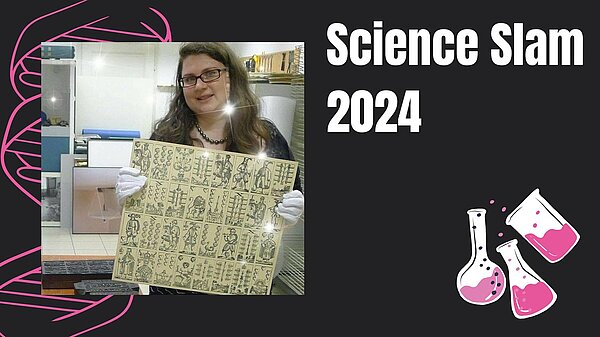
Slam title: What playing cards tell us about culture and the (current) political situation
What do you like about the Science Slam format?
It’s a wonderful challenge to present scientific research in a brief, concise and accessible way that’s entertaining, without losing the scientific rigour.
What will you be talking about?
Playing cards and their cultural and political significance. I’m sure we’ve all held a pack of playing cards in our hands at some point, and most of us have played with them. Many have certainly also noticed that there are, among other things, cards with French and German suit symbols. The latter are not known everywhere in the world. However, few are likely to know that playing cards – which were produced by craftsmen and coloured by hand right up until the 19th century – not only feature different card designs and motifs, often regional in German-speaking countries, which have changed over the centuries and address cultural and political themes. During the French Revolution, for example, there were special cards in France without kings, and playing cards also express worldviews. Currently, this can be seen, for instance, in the Schafkopf variants published last year by the Green Party in Bavaria.
What has been your best experience so far during your time at university?
There have been many incredibly wonderful moments during my timeat university. But of course, my stays abroad were unforgettable, and there I learnt not only other languages but, above all, a great deal about culture and worldviews. First of all in Canada, where I completed a master’s programme in the province of Quebec after my intermediate exams. The natural surroundings were stunning, and I not only met incredibly nice people there, but also learnt about the cultural differences and distinctive features of Canada’s Anglophone and Francophone inhabitants. Later, I was able to spend several months in Italy as an Erasmus student, immersing myself not only in the country’s art and cultural history but also in the writings of Umberto Eco. These experiences have had a profound impact on my life.
Prof. Dr Fabian C. Moss, Digital Music Philology and Music Theory
Slam title: "Music and Mathematics – How do they actually fit together?"
What do you particularly like about the Science Slam format?
The exciting aspects of science are often only recognisable or even understandable to those in the know, because we often have to develop a specialised language to talk about complex issues. However, it is important that researchers make the effort to explain their questions or insights in a way that makes them accessible. Science Slams provide a good incentive for this.
What will you be talking about in your talk?
The curious ‘love-hate’ relationship between music and mathematics, and what that might have to do with our everyday listening to music.
What has been your best experience so far during your time at university?
It’s hard for me to narrow it down to a shortlist, but one of the key things is definitely that I’ve met some great people during my studies who continue to have a big influence on me to this day. It was also definitely lovely to be able to take the time needed for certain things, or to attend events that weren’t part of the compulsory curriculum but which simply fascinated me.
Sven Kretzschmar, BSc (Hons) in Business Administration, Business POET
Slam title: What do raccoons have to do with marketing?
What do you like about the Science Slam format?
For me, there’s nothing better than when people who are experts in their field talk about it to others in a way that’s understandable, vivid and, ideally, humorous, thereby enriching them and giving them new perspectives.
What will you be talking about?
It will be a marketing topic, although I really doubt that marketing is a science...
But there is a great deal of science and scientific findings that marketers adopt or use to understand consumers even better, so they can inspire them even more with their brand, products or services. And ideally, turn them into fans in the end. And how does that work? You’ll have to listen to find out!
What has been the best experience so far during your time at university?
Definitely the best experience of our university days was our wedding. We both studied in Würzburg. My wife studied medicine, I studied business administration with a focus on marketing and a minor in sociology. And at our wedding in 1998, lots of our fellow students were there. It was a brilliant party. The next day, we all went down the Alz together in rubber dinghies. Back home on Lake Chiemsee.
As for the studies themselves: the intensive study sessions with my best mate and fellow student Oli, who always made us excellent coffee.