Female Science Slam 'She talks'
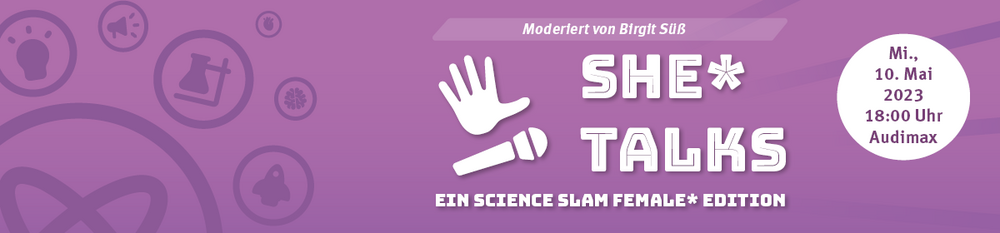
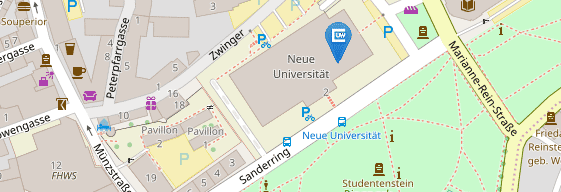
On 10 May 2023 at 6.00 pm, a slam featuring exclusively female slammers took place in the Audimax at Sanderring 2, in collaboration with the student's representation and the JMU Women’s Office. In 10-minute slots, they presented their work or their field of research – giving the audience an additional insight into a wide range of professional fields.
The evening was hosted by Birgit Süß.
The event was completely sold out! If you might be interested in our Female Science Slam 2024, don’t forget to get your tickets early!

Prof. Manuela Scheuermann, Chair of International Relations and European Studies, Institute of Political Science and Sociology, JMU Würzburg
Slam title: Fuss or no fuss? What women are doing in security policy
What do you like about the Science Slam format?
Science Slams give us scientists the opportunity to bring the subject of our curiosity to the public. And humour, seasoned with at least a pinch of self-deprecation, should be part of the mix.
What will you be talking about?
About women and their long journey into security policy. About the Märzens and Baerbocks in Germany. And about a lot of fuss. Or no fuss?
What particular experience, enrichment or challenge as a woman in science do you tell your friends about?
A particular challenge is the academic culture, which still makes it difficult for a woman – especially a woman with a family – to forge her own path. A great source of enrichment is the exchange with many, many interesting people, especially the students. But the greatest asset is the freedom to pursue my academic curiosity. That is incredibly motivating.
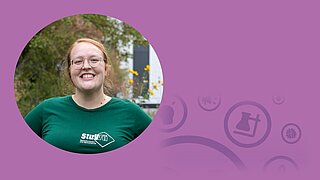
Pia May, a Master’s student in Museology and European Ethnology, Chair of the Student Council at JMU Würzburg, and (occasional) podcaster
Slam title: How we learn at the museum (and how we don’t?)
What do you like about the Science Slam format?
Science communication is the be-all and end-all of this society. The word ‘democratisation’ should no longer be used in science solely in the context of elections and politics, because we all have a right to knowledge. And what could be better than spreading it with humour and charm?
What will you be talking about?
Phew, where do I start? The subject of museums is a very personal one; some people love them, others have only bad childhood memories of being dragged there by school and parents. For me, the question has always been, ‘Why do they do it that way?’ Why is an object here, why is the text there? I’d like to shed a little light on that, so that you can put that knowledge to use later on.
What particular experiences, enrichments or challenges as a woman in academia do you tell your friends about?
I come from two fairly female-dominated small disciplines, and humanities at that. Within my subjects, I feel very supported and taken seriously, but once you step into the wider world, that changes. Stereotypes run rampant and try to make you believe that you should only have certain interests. (For example, that as a woman you should only be interested in education. I’m the prime example of that, after all…) In museology, I’m fortunate enough to face fewer stereotypes, as the subject is relatively unknown and, on top of that, highly interdisciplinary.
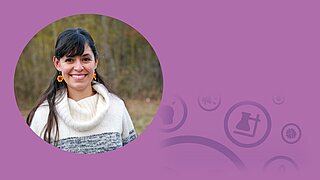
Gemma Villagomez Garduño, PhD student in biology, JMU Würzburg
Ms Villagomez Garduño will be holding her slam in English!
Slam Title: The bees that do not sting and their resources
What do you like about the Science Slam format?
I have never taken part in a Science Slam before, but they seem to be fun and informal events where researchers can share their work outside their usual research setting. I think they are great science outreach events, which is why I wanted to take part.
What are you going to talk about?
I will talk about some of the research I have done on my favourite group of insects, the stingless bees. What do they look like? Where do they live? What resources do they need to survive? And, above all, why are they so cool?
What special experience, enrichment or challenge as a woman in science would you tell your friends about?
Throughout my studies, I have had the great opportunity to meet wonderful people with a lot of love and passion for science. Seeing that passion and seeing women doing what they love has been a great inspiration for me and has encouraged me to follow my dreams, even if it was scary at times.

Prof. Dr Martina Prelog, M.Sc., a professor through and through, immunologist and paediatrician, JMU Würzburg
Slam title: Of Cells and Goals
What do you like about the Science Slam format?
Brevity is the soul of wit. What appeals to me is: just how much I can say in three sentences. Or, to paraphrase Friedrich Schiller’s line from the eulogy in the Wallenstein trilogy: to give a short speech a long-lasting (resonant) meaning?!
What will you be talking about?
About the immune system. Mainly about T-cells, what they’re good for and what they’re bad for. And what they get up to and how they work together.
What particular experience/enrichment/challenge as a woman in science do you tell your friends about?
My credo: You have to put your heart and soul into it. Blood means effort, sacrifice, perseverance and diligence. Heart means joy, curiosity and enthusiasm.
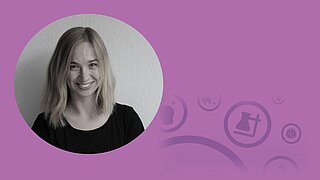
Victoria Porcu, Master’s student in European Ethnology/Empirical Cultural Studies/History, JMU Würzburg
Slam title: Queer Female Gaze. A unique perspective on films and TV series?
What do you like about the Science Slam format?
In my studies, I focus on people’s everyday lives. You can’t get much closer to society than that, yet I often find there’s a lack of spaces to share our findings with society itself. Because science shouldn’t be confined to an ivory tower – it belongs on stage! And the Science Slam is just such a stage.
What will you be talking about?
Queer women face particular challenges and obstacles in a heteronormative world. Their specific experiences in this context are also reflected in how they perceive and view films and TV series – that is the thesis of my Master’s thesis. Through interviews, joint film evenings and group discussions, I have explored the question of how queer women watch films and TV series and how they recount these viewing experiences. I will present my key findings in my talk and also discuss what it is like to conduct research as a queer researcher in a queer field.
What particular experiences, enrichments or challenges as a woman in academia do you tell your friends about?
Most of the time, I rave to my friends about my lecturers. At the Chair of European Ethnology, these are mainly women. They impress me with their professional and social skills. For me, the team is an example of the fantastic and innovative work that can be achieved when women work together.
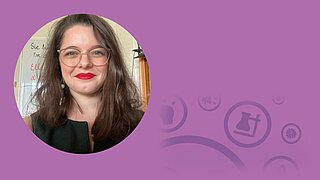
Raphaëlle Jung, PhD student in Romance Studies (French), JMU Würzburg
Slam title: Hoist the sails! A medieval voyage aboard the French Ship of Fools.
What do you like about the Science Slam format?
That learning a lot and having a good laugh go hand in hand!
What will you be talking about?
About the European Middle Ages – an exciting, often misunderstood, somewhat fictionalised and still influential era; about its literature and, above all, about the work on which I am writing my PhD thesis, La Nef des Folz.
What particular experience/enrichment/challenge as a woman in academia do you tell your friends about?
The field of Romance Studies (French, Spanish, Italian) at the University of Würzburg is a very female-dominated academic domain. Most of my direct role models are women who have recently – or for some time now – paved the way for young female academics like me. At the same time, the way academic careers are structured is still completely (!) unsuitable for women who have a family or want to start one. And yet I love my job: teaching students, doing research, working on exciting topics with fascinating people – I’m never bored!

Sarra Sassi, student of Medicine and Translational Medicine, JMU Würzburg
Slam title: Stiff Person Syndrome – One in a Million
What do you like about the Science Slam format?
I really like the openness of the format and the opportunity to communicate my own research topic in a way that is accessible (and ideally with a touch of humour) beyond the confines of my own discipline. This is the first time I’ve taken part in a Science Slam as a slammer, which makes me all the more excited.
What will you be talking about?
What is a Dr. med.? What is Stiff Person Syndrome? Why has Céline Dion postponed her world tour?
I am currently working on my medical PhD in neurology at Würzburg University Hospital, investigating whether and how certain antibodies in patients with a rare neurological condition end up where they’re meant to go (though I can’t say with 100% certainty whether they actually want to). As a student, it was a completely new experience for me back then to join a research group and be able to actively contribute to medical progress. I’m delighted to share my insights with the general public.
What particular experiences, rewards or challenges as a woman in science do you tell your friends about?
From the first admission of women to medical school at the end of the 19th century to today, where the proportion of women among medical students is soon to reach two-thirds – medicine is becoming increasingly female.
As a student, I still find myself in what is admittedly a very sheltered environment. Looking to the future, however, I can see the challenges my more senior female colleagues face – from being called in to work overtime to not being taken seriously; the list is long and not limited to medicine. Furthermore, women remain under-represented in research, and the proportion of women dwindles the higher the academic rank. That is why I am delighted to have female role models in my research group and to see what female leadership can look like.

Margaux Borgmann, Master’s student in Information Systems, JMU Würzburg
Slam title: SELECT * FROM… What?
What will you be talking about?
In the age of big data, the volume of data generated and stored is growing daily. This data is often stored in databases. Access to this data is limited not only by access restrictions, but also by one’s ability to work with databases in the first place. How can these barriers be broken down, and what does this have to do with language models like ChatGPT? I’ll be exploring these questions in my slam.
What particular experience/enrichment/challenge as a woman in academia do you tell your friends about?
As a student assistant in the Office of the University Women’s Representative (UFB), I helped compile the Gender Data Report in 2019 and 2021. That’s why I pay particular attention to female PhD students, female post-docs and female professors at the university. Every single one of them is a role model, all the more so in fields where women are under-represented.