Deutsch Intern

    Excellent news

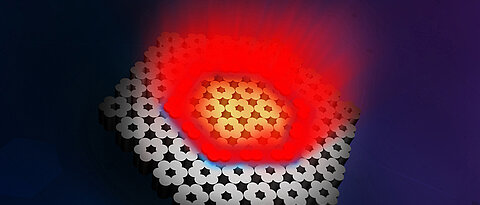
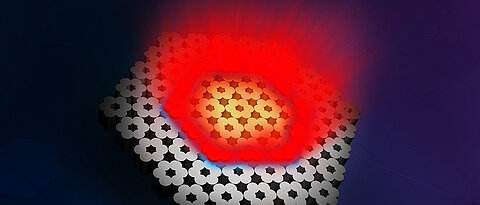
    Artistic rendition of a topological array of vertically emitting lasers. All 30 microlasers along a topological interface (blue) act as one, collectively emitting coherent laser light (red).

    Israeli and German researchers have developed a way to force an array of vertical cavity lasers to act together as a single laser - a highly effective laser network the size of a grain of sand. The findings are presented in a new joint research paper published online by the prestigious journal Science on Friday, September 24.


    more
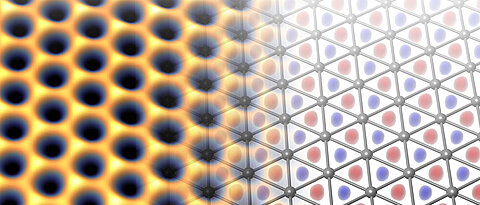
    In der Überlagerung von gemessener Elektronenverteilung (links) und dreieckiger Atomstruktur (rechts) wird deutlich, dass die Elektronen (gelb) nicht auf den grauen Indium Atomen sitzen, sondern sich in den leeren Regionen (rot und blau) sammeln und ein Honigwabenmuster bilden. Dieser Effekt macht die topologischen Eigenschaften des Quantenmaterials Indenen besser als die des Wunderwerkstoffs Graphen.

    Researchers from the Cluster of Excellence ct.qmat–Complexity and Topology in Quantum Matter–have recently conceived and realized a new quantum material. The research results have appeared in the journal Nature Communications.

    more
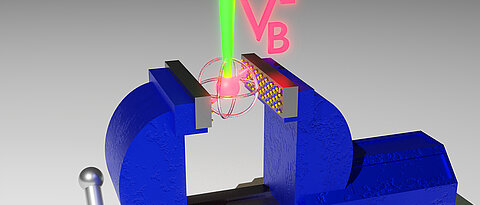
    Illustration of an optically excited qubit under pressure.

    A new type of atomic sensor made of boron nitride is presented by researchers in "Nature Communications". The sensor is based on a qubit in the crystal lattice and is superior to comparable sensors.

    more
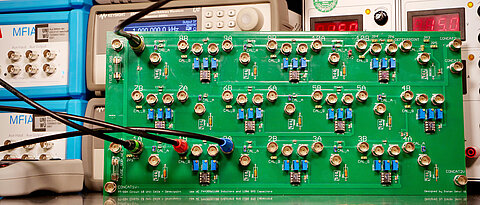
    The image shows a "topolectric circuit" used to realize the topological states studied here

    Through a recently developed experimental platform, topological matter can be realized in a fast, cost efficient, and versatile way. Würzburg physicist have now achieved with it a breakthrough that might enable optronic technologies in the long run.

    more
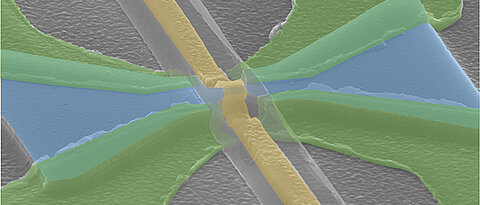
    Researchers from Jülich and Würzburg are jointly investigating new, exotic quantum states that form at interfaces between superconductors and topological materials. The image shows a quantum dot contact structure constructed at JMU from the topological insulator mercury telluride (blue), which is contacted with superconducting electrodes (green). An electrostatic gate (yellow) is used to control current conduction across the junction. Similar structures will be used in the future to investigate fundamental properties of topological qubits.

    Forschungszentrum Jülich and the University of Würzburg will together investigate the quantum phenomena of topological materials and the opportunities they present within quantum computing. The Free State of Bavaria is funding the project to the tune of € 13 million.

    more
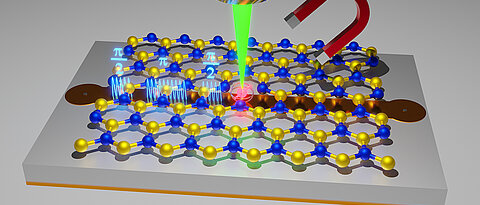
    Schematic representation of the coherent control of a spin defect (red) in an atomic layer of boron nitride. Boron nitride consists of boron (yellow spheres) and nitrogen (blue spheres) and lies on a stripline. The spin defect is excited by a laser and its state is read out via photoluminescence. The qubit can be manipulated both by microwave pulses (light blue) of the stripline and also by a magnetic field.

    An international research team has made progress towards improved materials for quantum sensor technology. Medicine, navigation and IT could benefit from this in the future.

    more

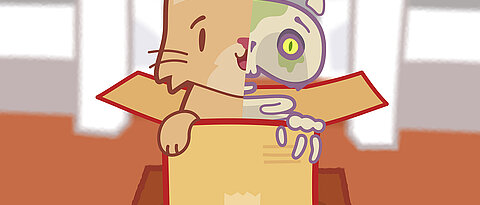
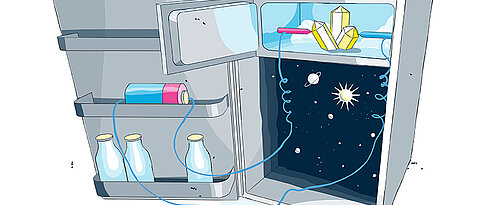
    Freeze Like a Star

    11/27/2020

    A new web exhibition of the Würzburg-Dresden Cluster of Excellence ct.qmat – Complexity and Topology in Quantum Matter explores the mysteries of the quantum world.

    more

    The Quantum Alliance, in which the Cluster of Excellence ct.qmat (Würzburg-Dresden) is represented, welcomes the German government’s initiative to promote quantum technologies. It includes two billion euros for quantum technologies.

    more

    A funnel of light

    03/27/2020
    The figure shows how light is caught through the light funnel (Graphic: University Rostock / Alexander Szameit).

    Physicists of the University of Würzburg, in a joint collaboration with colleagues from the University of Rostock, have developed a light funnel apparatus. It could serve as a new platform for hypersensitive optical detectors.

    more
    Atomic thin layer of boron nitride with a spin center formed by the boron vacancy. With the help of high frequency excitation (red arrow) it is possible to initialize and manipulate the qubit.

    Physicists from Würzburg for the first time have experimentally observed spin centers in two-dimensional materials. Such centers can act as quantum bits - even at room temperature.

    more
    Kick-off meeting of the Cluster of Excellence ct.qmat in the Fürstensaal of the Würzburg Residenz.

    The universities of Würzburg and Dresden have officially celebrated their success in the Excellence Strategy. In the newly established Cluster of Excellence ct.qmat, they are jointly researching quantum materials.

    more
    The graphic illustrates the interplay between topology (blue ring) and strong correlation (electron spins; coloured arrows on the square grid). This is what the Würzburg Collaborative Research Centre ToCoTronics is all about.

    A great success for Würzburg's physics department: its Collaborative Research Centre was rated as excellent and is now entering its second funding phase. The German Research Foundation is providing 12 million euros for this purpose.

    more
    [Translate to Englisch:] Fahnen der Universität Würzburg. (Foto: Daniel Peter)

    The University of Würzburg has been successful with a proposal for a research cluster in the Excellence Competition. This allows new projects to be launched in an important field of physics with great future promise.

    more