
AI in education: Maths didactics cooperates with Hong Kong
12/09/2025The University of Würzburg and the Chinese University of Hong Kong are intensifying their collaboration. A joint research project on AI in maths lessons aims to provide new insights for the education of the future.
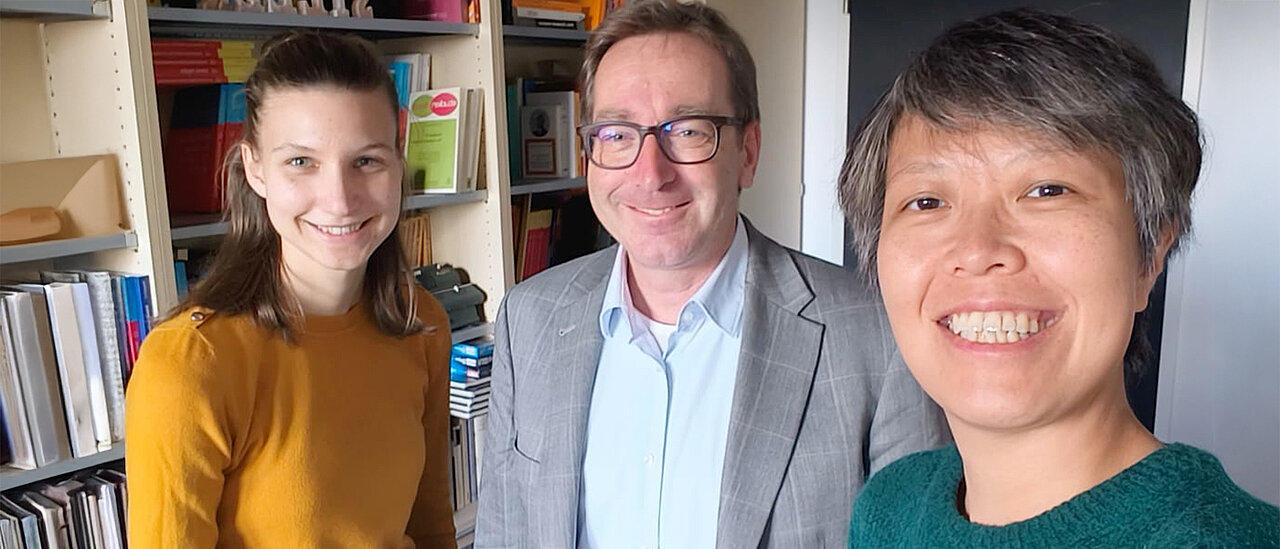
The Chair of Mathematics Education at the University of Würzburg is expanding its collaboration with the Chinese University of Hong Kong. This is the result of a visit by Professor Dr Oi-Lam Ng from the University of Hong Kong to Würzburg at the end of October. The cooperation, which has already existed for some time, is thus to be significantly intensified. Oi-Lam Ng and Würzburg Chair Professor Hans-Stefan Siller have agreed on the concept for a joint international research project.
The planned project will comparatively analyse the use of AI in mathematics lessons in Germany and Hong Kong. "Professor Ng's visit served to deepen our joint data basis and concept for an international research project," explains Dr Norbert Noster from the chair's team. The comparison of two different education systems promises unique insights into the didactic potential and risks of AI applications in the classroom.
Established AI expertise at the chair
The topic of "Artificial intelligence (AI) in mathematics lessons" has indeed been a focus of the Würzburg Chair of Mathematics Education for some time - and not just in research. In addition to its academic work, the Chair is also heavily involved in teacher training. Five events on this topic have already been organised in 2025: Two further training courses organised by the Chair itself took place at the University of Würzburg, one at the Academy for Teacher Training and Personnel Management (ALP) in Dillingen, one at the subject leader conference at Wirsberg-Gymnasium and one at the autumn conference of the Professional School of Education (PSE).
The training courses are based on empirical results from the chair's staff and pursue a central goal: to enable teachers to use AI applications in a reflective and responsible manner. In order to achieve this goal, feedback from participants is particularly important. "Feedback from teachers is very valuable to us," says PhD student Alissa Fock, "because it flows directly into the further development of our formats."
A space to try things out and fail
At the centre of the training courses is the independent testing of AI systems. "We create a space in which experimentation and failure are expressly permitted," explains Professor Siller. "This allows teachers to decide on the basis of their own experience which technologies are useful for their lessons and which are not." Each trial phase is accompanied by a discussion in which the opportunities, limitations and risks of using AI in the classroom are openly addressed.
In terms of content, the spectrum ranges from the reflective use of AI in planning, material creation and assessment to its use as an individual learning companion. Teachers learn about tutorial systems, try out their own AI tutors and consider how AI-supported learning phases can be integrated into lessons.
Research and practice hand in hand
AI also becomes the subject of mathematical reflection during the training courses: learners are encouraged to critically scrutinise the functions, limits and social implications of AI, which, according to Siller, is an important contribution to digital education.
Accordingly, the conclusion of the Chair's team is clear: the international research exchange and the diverse training programmes offered by the Chair of Mathematics Education show how closely research and practice can work together to sustainably shape the responsible use of artificial intelligence in mathematics lessons.
Contact
Prof. Dr Hans-Stefan Siller, Chair of Mathematics V (Mathematics Education),
T: +49 931 31-89867, hans-stefan.siller@uni-wuerzburg.de