

My Green Lab: Certification for Orthopaedic Chair
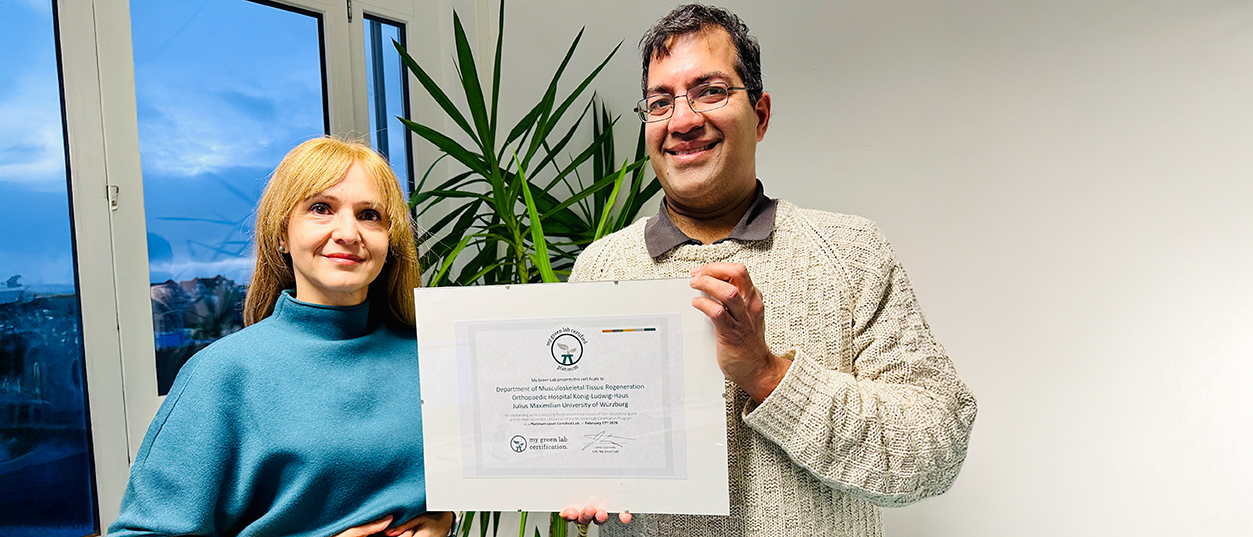
12/02/2025Sustainability is a top priority here: Professor Denitsa Docheva's chair was the first orthopaedic research laboratory in Germany to be certified by My Green Lab.
Sustainability is becoming an increasingly important topic for laboratories that want to reduce their carbon footprint and contribute to the United Nations 2030 Agenda for Sustainable Development.
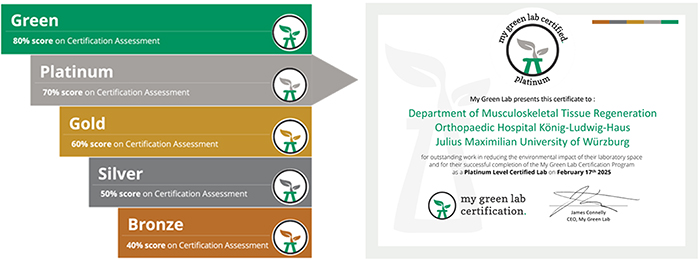
The JMU Chair of Regeneration of Musculoskeletal Tissue, headed by Professor Denitsa Docheva, is already very advanced in this field: the team recently successfully underwent the rigorous "My Green Lab" certification process. This involved assessing its sustainability and identifying ways to further reduce its carbon footprint.
The chair team is thus contributing to JMU's sustainability initiative as well as to the corresponding efforts of the Orthopaedic Clinic König-Ludwig-Haus of the District of Lower Franconia, where the chair is based: under its director Professor Maximilian Rudert, the clinic recently published a study on the carbon footprint of orthopaedic procedures.
Rethinking Established Practices
Anja Schlömerkemper, JMU Vice President for Equal Opportunity, Career Planning and Sustainability, is delighted with the Chair's commitment: "With the help of this programme, our colleague Docheva has impressively succeeded in initiating the further development of laboratory work with regard to sustainability aspects and thus promoting a rethink of established practices in her Chair."
Chair Achieved Platinum Status
The "My Green Lab" certification assesses the sustainability of laboratories based on a detailed analysis of the practices applied there. It assesses areas such as waste reduction and recycling, cold storage, water conservation, green chemistry, lab or fume hood use and travel.
After a first round in April 2024, the team took part in a second assessment nine months later. During this time, the chair was able to improve its sustainability score from 55 to 77 per cent, for which it was awarded platinum. This is the second highest of five certification levels.
Professor Docheva's laboratory is the first orthopaedic research laboratory in Germany to receive certification under the MyGreenLab programme.
Key improvements that have contributed to this success include
- Appointment of a GreenLab officer (Dr Girish Pattappa)
- Conducting annual GreenLab training sessions to raise awareness of sustainable practices
- Separation of plastic and paper waste in the labs
- Reducing the use of plastic in experiments, for example by using glass pipettes in cell cultures or refillable tip boxes
- Installation of a recycling box for plastic bottles and a corresponding system for cell culture
- Consolidation of supplier orders to minimise transport-related emissions
- Use of ACT (Environmental Impact Factor) labelling to select environmentally friendly consumables, equipment and reagents
- Regular cleaning of freezers and use of the ultra-low freezer with a temperature of down to minus 70 degrees Celsius to improve energy efficiency
- Autoclaving and dishwashing only when appliances are fully loaded
- Switching off PCs, lights and appliances after use
Professor Docheva: "The knowledge gained from the certification process has motivated the lab members to adopt more sustainable practices and critically evaluate purchases. We are aiming for the top environmental certification - 80 per cent or more - of the MyGreenLab programme at our next assessment in early 2027."
Seminar: Sustainability in Laboratories
To further raise awareness and encourage joint action at JMU, a seminar entitled "Green and sustainable practices in orthopaedic research" took place on 27 November 2025 in the lecture hall of the König-Ludwig-Haus. It was part of the "MSc Exercise Science and Training course" and a contribution to the Public Climate School 2025 of the University of Würzburg.
Dr. Girish Pattappa presented the MyGreenLAB certification process undertaking by the department, describing the sustainability measures taken. He then discussed the carbon footprint in sports using case studies from marathon runners and football clubs on the amount of carbon emissions generated and how even without long-distance travel, emissions are produced from other sources (e.g. food, energy).
Within this symposia, there was also talk by Dr. Annette Eidmann, who presented the CO2 emissions generated from various orthopedic surgeries and showed how the healthcare sector is large contributor to greenhouse gas emissions.
The symposia was attended by students on the course and interested persons from other departments. All attendees found the symposia enjoyable informative and posed relevant questions to speakers that allowed for a good discussion at the end of the session.
Contact
Prof Dr Denitsa Docheva, denitsa.docheva@uni-wuerzburg.de
Dr Girish Pattappa, girish.pattappa@uni-wuerzburg.de
Additional images