
Natural sciences and engineering
Biochemistry
Leonie Arnetzl
As I have long been interested in the natural sciences and especially in the processes in the human body, I started studying biochemistry in Würzburg. I've been part of the uni@school team for a long time and think the project is great.
Whether virology, neurobiology, cancer research or genetics: biochemistry has many facets. The biochemistry degree programme gives you an insight into all these areas and many more. In order to understand the research-related content, basic lectures in chemistry, biology and physics are required in the first semesters. Later on, elective subjects await you, which provide a detailed insight into the diverse mechanisms of the cell and do not neglect current scientific topics. The degree programme has a relatively large practical component due to various laboratory practicals.
Any questions? Just get in touch at leonie.arnetzl@stud-mail.uni-wuerzburg.de
Chemistry
Johannes Bandorf
I've been studying chemistry at the University of Würzburg since the summer semester of 2018. I can't remember exactly how I got into it, but it wasn't planned, it was more of a happy coincidence. All the better, of course, that I discovered the perfect natural science for me and will soon be able to write my Bachelor's thesis.
Studying chemistry provides you with a broad basic knowledge of the natural sciences and also gives you a deep insight into all facets of chemistry. This opens up many exciting areas of research such as mobility, energy, new materials and health and gives you the opportunity to shape the future in a sustainable way. Of course, you first have to understand numerous theoretical models and also learn how to work scientifically in the laboratory. If you can imagine yourself in a lab coat cooking up the latest substances, you should definitely consider studying chemistry.
Questions? Just get in touch at johannes.bandorf@stud-mail.uni-wuerzburg.de

Chemistry
Sönke Menke
I started studying chemistry in Würzburg in the winter semester of 2017/18, straight after my A-levels in Marktheidenfeld (Main-Spessart). For me, chemistry is the most fascinating science of all! Chemistry explains how our world is structured, how the individual atoms and molecules interact with each other and with us. I am currently working on my Bachelor's thesis. I am trying to modify two drugs (paclitaxel (against breast cancer) and efavirenz (against AIDS)) so that they are absorbed as effectively as possible in the body.
Studying chemistry combines practice and theory: we spend a lot of time in the lab, but also attend many lectures that build on what we learnt at school. Here we can specialise in different areas that interest us. This prepares us ideally for our future:
As a chemist (usually with a doctorate), you often work as a laboratory manager, supervise ongoing processes and are the point of contact for many lab technicians who have questions.
Questions? Just get in touch at soenke.menke@stud-mail.uni-wuerzburg.de

Food chemistry
Sarah Schmidt
I started studying food chemistry at the University of Würzburg in October 2018. Although I only realised my increased interest in chemistry in secondary school, my enthusiasm was so great that I wanted to start studying straight after my A-levels. I am now in my fourth semester and still very enthusiastic.
Food chemistry is mainly about analysing complex substances and assessing the results. This means that food, but also consumer goods, animal feed and cosmetics, can be tested for safety and quality. In addition to building up general scientific and well-founded knowledge of food chemistry, the programme also includes practical work in the laboratory.
Questions? Just get in touch at sarah.schmidt2@stud-mail.uni-wuerzburg.de

Functional materials
Lavinia Appold
I started studying functional materials straight after leaving school. My passion for natural sciences had already developed during my school days. I was particularly interested in chemistry.
Very few people know about this unique degree programme in functional materials. You can only study this programme at the University of Würzburg. The programme combines the subjects of chemistry, physics and medicine as well as mathematics and engineering. Students learn how to develop new materials, which form the basis for further developments in important areas of technology and are increasingly a prerequisite for the realisation of new technical products. Functional materials are among the key technologies of the 21st century because they offer solutions to problems in the areas of health, transport, energy, communication, the environment and society.
Questions? Just get in touch at lavinia.appold@stud-mail.uni-wuerzburg.de
Games Engineering
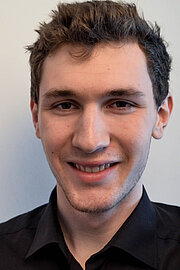
Jonas Wolpold
I started studying Games Engineering in the 2016/17 winter semester. Computer games, the technology behind them and computer hardware have fascinated me for as long as I can remember. After my A-levels and a subsequent FSJ, it was clear to me that I wanted to study a degree programme in this field. It was therefore perfect that Games Engineering was offered for the first time in Würzburg at that time. I am currently in my 8th semester and am writing my Bachelor's thesis.
Games Engineering mainly deals with the programming of games and real-time systems. You deal with technical implementation, i.e. the player sees objects on their screen or that a game level can be built at all, as well as with game mechanics such as the character's ability to jump. The degree programme is very practically oriented, so each student works on three large projects ranging from a game to an engine during the course of their studies.
Questions? Just get in touch at jonas.wolpold@stud-mail.uni-wuerzburg.de

Physics
Tim Winkler
I graduated from high school in 2016 and didn't know what to do next. I initially went to a vocational school for music, but I was denied entry to a music college and started studying physics at the University of Würzburg. After 2 semesters, I switched to the more theoretical mathematical physics programme.
The physicist tries to describe the structure of our universe from the smallest particles to the largest structures of the cosmos in order to get a glimpse under the bonnet of the universe. They use both experimental and empirical methods as well as mathematical and theoretical descriptions of these processes. To be able to study physics successfully, you need to enjoy puzzling and tinkering and have stamina. Physicists are in demand on the labour market as problem solvers. They can quickly familiarise themselves with complex contexts and overcome difficulties through analytical thinking.
Any questions? Just get in touch at tim.winkler@stud-mail.uni-wuerzburg.de