

Organoids: databases for cancer research
01/08/2026Increased use of organoids in cancer research: The Würzburg lighthouse project "Preclinical Models" is working towards this goal. The Bavarian Centre for Cancer Research is funding it with almost one million euros.
Lighthouses provide orientation and security, they have radiance and stand for confidence. All of this also applies to the lighthouse projects of the Bavarian Centre for Cancer Research (BZKF): They provide visible impetus and show the way forward for innovative cancer research in Bavaria.
Each of the six BZKF sites has such a lighthouse, focussing on the specific strengths of the respective location. At the University Hospital Würzburg (UKW), in Surgical Clinic I, the expertise lies in organoid technology, among other things. Organoids are small, organ-like tissues. They can be used to understand disease mechanisms and test new therapeutic approaches.
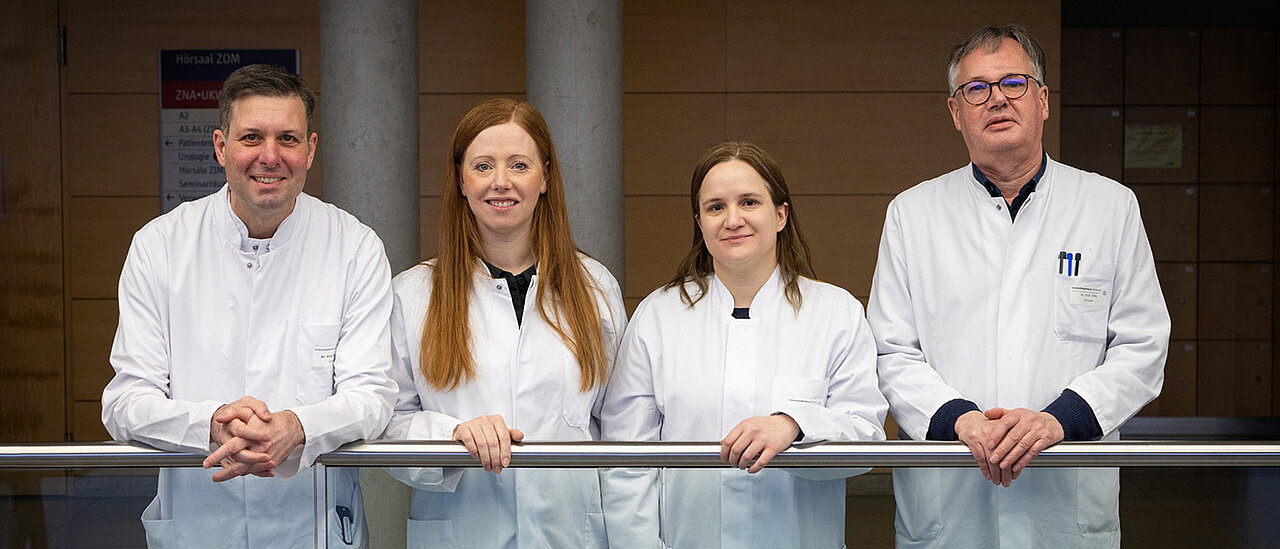
For this reason, the BZKF "Preclinical Models" lighthouse was set up here two years ago under the planning of Professor Armin Wiegering. Following Wiegering's move to Frankfurt am Main, Professor Nicolas Schlegel took on the role of spokesperson. Together with his team consisting of Professor Christoph Otto, Anne Rech, Dr Mahasen Saati and Professor Gabriele Büchel from the University of Würzburg, he was able to establish two cross-site databases during the first funding period: the organoid database, which now contains around 150 ex-vivo models of various tumour entities, and the database for in vivo models, which currently contains almost 40 oncological animal models.
980,000 euros for the second funding period
The intensive amount of work in this short time has convinced the BZKF: the second funding phase has been approved.
"An enormous success," says a delighted Nicolas Schlegel. With the maximum possible funding amount of 980,000 euros, the team wants to make the availability of preclinical models at all six BZKF sites more visible over the next two years. To this end, the databases are to be optimised and brought together on one platform.
Another important goal is to further expand the unit for validating promising therapeutic target structures in order to achieve a faster translation of basic research into clinical application.
Avoiding duplicate structures, creating synergy effects
"Preclinical models are indispensable for medical research - both for the path from basic research to the clinic and back again," says Nicolas Schlegel. However, developing such models is very time-consuming.
To avoid each research group having to establish everything from scratch, databases provide information on which models are available where and who can be contacted to carry out the experiments. This is intended to avoid duplicate structures and create synergy effects. An important goal here is to reduce, replace and improve the number of animal experiments.
"Now that we have set up the two databases on the web-based REDCap platform and developed a separate input screen for each tumour entity, we want to make data entry and retrieval even more intuitive in the next step and merge all models. The aim is to map the entire translation on one platform in a logical context," reports Nicolas Schlegel.
Two examples: "We have an organoid from a patient's tissue donations that has certain mutations. We could use the database to associate a suitable animal model with the human mutation. We could also develop murine organoid models from this animal model. This matches the human model and reduces animal testing. We proceed in a similar way when we discover an interesting target structure in cell culture experiments: This is first tested for efficacy in an organoid and, in the next step, applied in an animal model if necessary before it can be further developed for use in humans. The aim of the database is to simplify these complex steps."
Removing bureaucratic hurdles in trial planning
Unfortunately, it is not yet possible to dispense with animal experiments, especially when it comes to mapping the complexity of an entire organism in connection with immunological processes and tumour development.
However, despite the high standard of experiments, the bureaucratic hurdles to further developing new things are often even higher. This makes international competition more difficult, jeopardises careers and drives young talent from academic research into industry, points out Nicolas Schlegel.
"One goal is therefore to improve the approval processes by mapping protocols in detail, standardising applications and harmonising animal testing projects," he explains, referring to other federal states where standardisation is working well.
Simplifying target validation
Another important focus of the lighthouse project is Professor Gabriele Büchel from the Chair of Biochemistry and Molecular Biology at JMU. The Professor of Dynamics of Cellular Protein Complexes is attempting to address previously inaccessible target structures in tumour cells with a new class of drugs. These can specifically degrade pathogenic proteins in the body.
In oncology, attempts are normally made to inhibit these disease-causing proteins, for example by blocking their enzymatic activity. In the new approach, however, the proteins are completely removed from the cell by initiating their degradation.
This is done with the help of the cellular rubbish bin system, the proteasome. The proteins are labelled with so-called PROTACs (proteolysis targeting chimeras) so that they reach the proteasome in a targeted manner. However, the PROTACs have to be produced individually for each target protein, which is very complex and time-consuming. Gabriele Büchel is therefore currently developing a model system that can be used to test whether a protein is actually therapeutically promising and whether it is worth developing an expensive PROTAC in the next step.
"With the help of this simplified and efficient research model, new therapeutic target structures can be tested without having to immediately produce complex active substances," summarises Nicolas Schlegel.
Call: Researchers should register in the network
"The more scientists register and make their models available, the better the network and ultimately the research in the entire BZKF will be," says Schlegel.
He allays the concerns of sceptics: "There are transfer agreement sheets that contractually regulate exactly what can be done with the organoid." On the other hand, the database should also help with research.
Schlegel would like people within and outside the BZKF network who want to answer questions about a tumour entity to first use the database to get an overview of the availability of human organoid and animal models. This would save considerable time and money.
A contact form for registration is available on the website of the Chair of Experimental Visceral Surgery.
About the lighthouse structures of the BZKF
The lighthouse structures are the basis for complex further developments in the respective areas. They fulfil service functions for the entire BZKF. The exchange of samples and the referral of patients with particular issues to the respective highly specialised unit enables optimal diagnostics and treatment and faster progress to be made in the respective areas. This progress in turn benefits everyone. The lighthouse structures and the cross-site use of their expertise ensure international excellence and Bavaria-wide participation as well as the improvement of patient care at the BZKF.
Further information on the BZKF website