
Vanessa Borst is a IT Woman of the Year
12/02/2025Success for computer science doctoral student Vanessa Borst: she was selected as one of the IT Women of the Year 2025 in the "Young Leader" category in the field of eHealth.
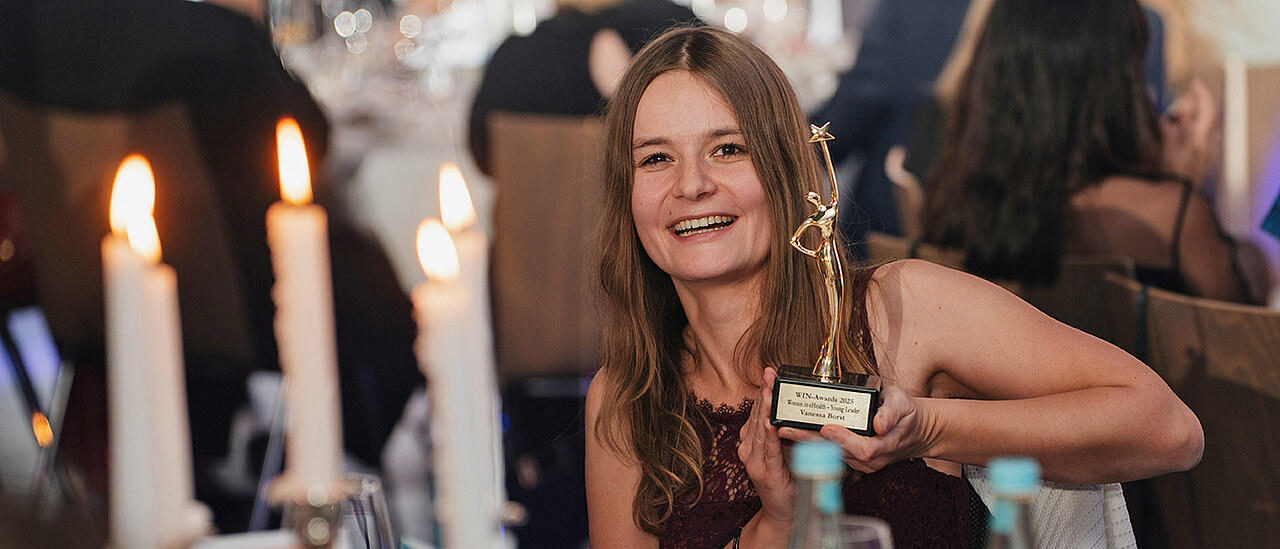
Vanessa Borst (29) is a doctoral student at the Chair of Software Engineering under Professor Samuel Kounev at the University of Würzburg. Together with a team from the Department of Dermatology at the University Hospital of Würzburg (Professor Astrid Schmieder and Dr Tassilo Dege), she has developed an app that patients can use to document their chronic wounds at home and securely transmit the data to medical professionals. This provides an opportunity to improve the care and quality of life of those affected and reduce the burden on the healthcare system.
The app is also based on AI technology that measures the size of wounds automatically and in a standardised way based on smartphone photos. For the first time, the technology combines modern image analysis with the practical requirements of wound care. Vanessa Borst was honoured for the "WoundAmbit" paper on this topic at the European Conference on Machine Learning and Knowledge Discovery in Databases 2025 in Porto.
Reader's Choice Awards Presented in Augsburg
In July 2025, the Würzburg doctoral student was nominated for the IT Women of the Year 2025. With the WIN Awards, the Women's IT Network (WIN) and the Vogel IT Academy recognise outstanding women from business IT, eHealth and eGovernment in various categories. These are Reader's Choice Awards, which means that the winners are determined by means of an online vote.
Vanessa Borst impressed across the board: she was awarded platinum in the "Young Leader" category - and thus 1st place - and named IT Woman of the Year 2025 in the field of eHealth. She received her award on 27 November 2025 in Augsburg as part of the "FIT - Females in IT, Future of IT" congress.
Advancing AI in Everyday Clinical Practice
Vanessa Borst is delighted with the award: "The nomination alone was a great personal honour and a good opportunity to raise awareness of AI applications in medicine that can really make a difference," she says.
"I never thought I had a chance of winning - so I'm all the more delighted that my work has been recognised in this special way. It motivates me to build on what we have already achieved together with my team and to continue advancing the meaningful use of AI in everyday clinical practice."