
Made in Würzburg: New radiotracers for adrenal imaging
01/20/2026A tracer for primary hyperaldosteronism is designed to localise the cause of high blood pressure using simple imaging. It was developed at the University Hospital of Würzburg.
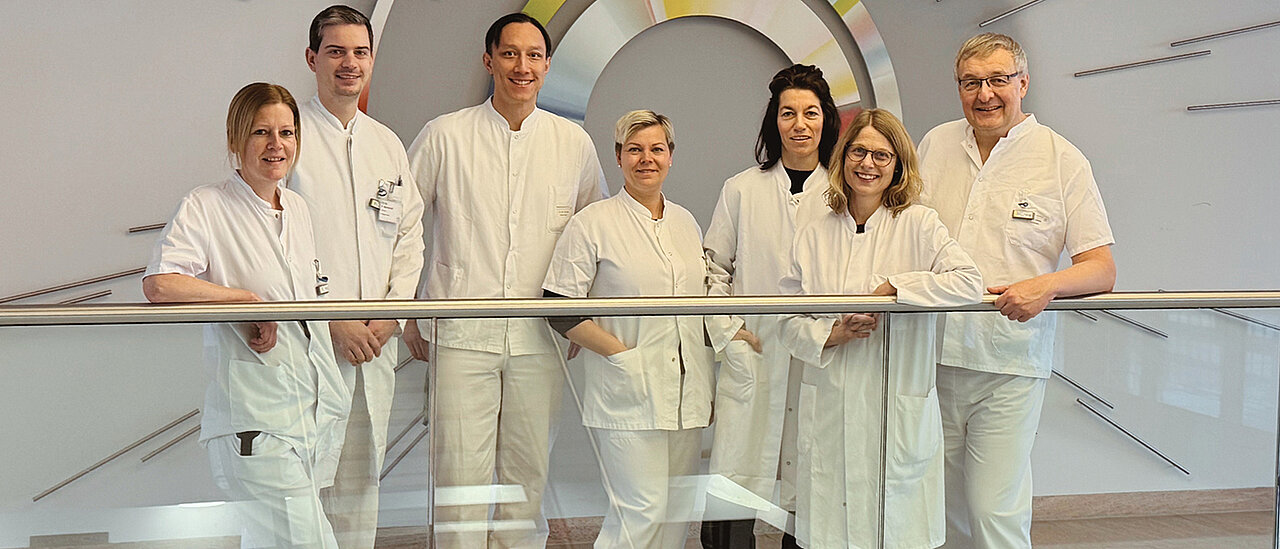
While the first tracer developments by the working group led by endocrinologist Professor Stefanie Hahner and radiochemist Priv.-Doz. Andreas Schirbel from the University Hospital of Würzburg were primarily aimed at the general characterisation of adrenal tissue and the diagnosis and treatment of the rare adrenal carcinoma, the focus is now shifting to a broader clinical field: primary hyperaldosteronism, the most common cause of secondary hypertension. Hahner and Schirbel have now developed their fourth tracer for adrenal imaging, which is intended to improve the diagnosis of primary hyperaldosteronism and has recently been successfully transferred to clinical application and submitted for patent registration.
Thanks to its global and interdisciplinary research and innovative procedures in the diagnosis and treatment of adrenal gland diseases, the University Hospital of Würzburg (UKW) is regarded as an international reference centre and is an important point of contact and guide for patients with complex adrenal gland diseases. The novel radiopharmaceuticals iodine-123-IMAZA and iodine-131-IMAZA bind specifically to enzymes of the adrenal cortex and thus enable more precise imaging as well as radiotherapy aimed directly at the tumour (theranostics).
Seamless chain from the development of new tracers in the laboratory to clinical application
Endocrinology and nuclear medicine at the UKW have been working together intensively for over two decades. During this time, they have established a seamless chain from the development of new tracers in the laboratory to the clinical application of these radionuclide-labelled substances. "Our strength lies in the close and interdisciplinary connection between basic research and patient care," emphasises Stefanie Hahner, Deputy Head of Endocrinology at Medical Clinic I. "In addition, medical translation requires perseverance," adds Andreas Schirbel from the Department of Nuclear Medicine. "And this perseverance is paying off right now." The working group of the endocrinologist and radiochemist is currently making significant progress in the diagnosis of adrenal diseases. A larger number of patients could soon benefit from these advances.
FAMIAN study demonstrates precision of iodine-123 iodometomidate for non-invasive characterisation of adrenal tissue
While adrenocortical carcinomas (ACC) are very rare but often extremely aggressive and require highly specialised treatment, adrenocortical adenomas (ACA) are common, benign tumours that usually do not require surgery. However, non-invasive methods for characterising these tumours are limited. For this reason, Hahner and Schirbel's team developed the tracer iodine-123 iodometomidate (IMTO). The precision of this tracer was proven in the multicentre FAMIAN study initiated by the researchers. In the combined FDG/IMTO imaging, benign tumours were identified with a very high degree of certainty, thus avoiding unnecessary operations. The results of the study, which was funded by the EU and the DFG, were published in "eBioMedicine".
Fourth Würzburg tracer successfully transferred to clinical application for the diagnosis of primary hyperaldosteronism
The team recently celebrated the fourth so-called "bench-to-bedside" translation with the first application of the new radiotracer in humans. This was developed specifically for the diagnosis of primary hyperaldosteronism. The disease is caused by an overproduction of the hormone aldosterone in the adrenal gland and is considered the most common cause of secondary hypertension. Around five to ten per cent of all hypertensive patients are affected by primary hyperaldosteronism. The decisive question for therapy - whether surgery or drug treatment is more effective - has so far usually required an invasive adrenal vein catheter. This procedure is technically demanding, is only well established at a few centres and is stressful for patients.
The new Würzburg diagnostic tracer, on the other hand, accumulates highly specifically in the tissue that produces aldosterone. "In Würzburg, our interventional radiology department has outstanding expertise in technically sophisticated adrenal vein catheters," says Stefanie Hahner: "However, our new procedure could offer a much simpler and widely available alternative in the future: The cause of the high blood pressure could then be localised using imaging without any intervention and regardless of the examiner's experience," adds Andreas Schirbel.
The initial "first-in-human" data confirms the potential of the new tracer. A patent application was filed shortly before Christmas to secure its future use. "While our previous tracers have already been very useful for some patients and mainly address niche indications such as the rare adrenal carcinoma, our latest tracer has the potential to remain more than just a 'Würzburg hobby'. If everything goes well, it can be used more widely and also commercialised," says a delighted Stefanie Hahner.
Interdisciplinary collaboration as a foundation
Professor Matthias Frosch, Dean of the Faculty of Medicine: "The success of the Würzburg radiotracers is the result of close, interdisciplinary collaboration. Experimental and clinical endocrinology, nuclear medicine, radiochemistry and medical physics work hand in hand, from the clinical question to chemical development and application at the patient's bedside. It is only through this interaction that precision medicine is created, which sustainably transfers innovative approaches into patient care and strengthens Würzburg as a reliable point of contact and centre of excellence for people with complex adrenal diseases."
Publications
Hahner S, Hartrampf P, Beuschlein F, Miederer M, Miehle K, Schlötelburg W, Fuß CT, Pfluger T, Fottner C, Tönjes A, Herrmann K, Amthauer H, Reincke M, Schreckenberger M, Sabri O, Werner J, Reuter M, Kircher S, Arlt W, Fassnacht M, Buck AK, Müller HH, Schirbel A; FAMIAN investigators. Combined[18F]Fluorodeoxyglucose PET and [123I]Iodometomidate-SPECT for diagnostic evaluation of indeterminate adrenal neoplasias-the cross-sectional diagnostic test accuracy study FAMIAN. EBioMedicine. 2025 Jun;116:105735. doi: 10.1016/j.ebiom.2025.105735. PMID: 40398350; PMCID: PMC12148602.
Hahner S, Hartrampf PE, Mihatsch PW, Nauerz M, Heinze B, Hänscheid H, Teresa Fuß C, Werner RA, Pamporaki C, Kroiss M, Fassnacht M, Buck AK, Schirbel A. Targeting 11-Beta Hydroxylase With [131I]IMAZA: A Novel Approach for the Treatment of Advanced Adrenocortical Carcinoma. J Clin Endocrinol Metab. 2022 Mar 24;107(4):e1348-e1355. doi: 10.1210/clinem/dgab895. PMID: 34904171.
Heinze B, Schirbel A, Nannen L, Michelmann D, Hartrampf PE, Bluemel C, Schneider M, Herrmann K, Haenscheid H, Fassnacht M, Buck AK, Hahner S. Novel CYP11B-ligand [123/131I]IMAZA as promising theranostic tool for adrenocortical tumors: comprehensive preclinical characterisation and first clinical experience. Eur J Nucl Med Mol Imaging. 2021 Dec;49(1):301-310. doi:10.1007/s00259-021-05477-y. Epub 2021 Jul 3. PMID: 34215922; PMCID: PMC8712301.