
What Tourism Brings to German Natural Landscapes
12/02/202525 years of research have gone into a guide to monitoring the added value of tourism in German natural landscapes. It was compiled by researchers from the Würzburg Geography.
In Germany, 104 nature parks, 18 biosphere reserves, 16 national parks and 3 wilderness areas protect around one third of the country's surface area. They make a significant contribution to recreation, environmental education and sustainable regional development.
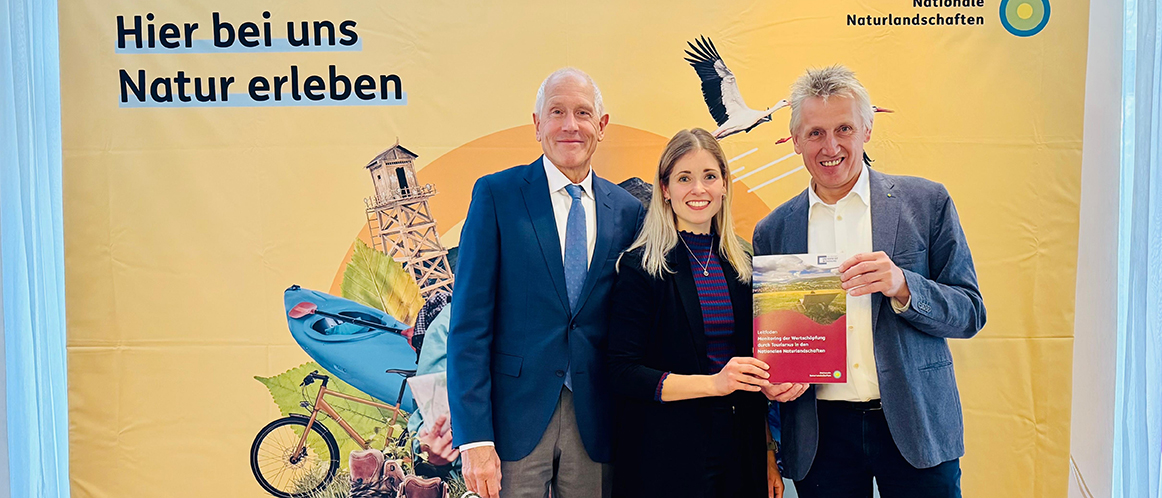
These institutions are united in the organisation "Nationale Naturlandschaften (NNL) e. V.", whose general meeting took place from 10 to 14 November 2025 in the Baltic seaside resort of Sellin. Researchers from Julius-Maximilians-Universität (JMU) Würzburg were also present.
One focus of the meeting was on the future of socio-economic monitoring in protected areas. Senior Professor Hubert Job and Dr Lisa Majewski from the JMU Institute of Geography and Geology were on hand to conclude more than 25 years of research into the regional economic effects of tourism in large protected areas and to symbolically hand over the methodology to the NNL for permanent use. With this step, responsibility for the maintenance and further development of the methodology was transferred to the umbrella organisation.
25 Years of Research as the Basis for Long-term Monitoring
The methodology has been developed since the early 2000s under the direction of Professor Job - initially at the LMU Munich, later for many years at the Chair of Geography and Area Studies at JMU Würzburg. (The chair, now called Chair of Human Geography, was transferred to Professor Matthias Naumann on 1 August 2025).
The starting point was the first regional economic study in the Berchtesgaden National Park in 2001. Based on this pioneering work, a uniform method for analysing tourism value creation in large protected areas was developed, standardised and gradually transferred to all German national parks and biosphere reserves. Numerous empirical studies - funded by federal authorities, foundations and protected area administrations - deepened and expanded the methodology by 2023.
The method makes it possible to record visitor numbers, visitor motivation and regional economic effects in detail. Standardisation has created a nationally comparable and aggregatable data basis.
Knowledge Transfer and Joint Dialogue
The study phase was followed by a transition phase: under the leadership of Dr Majewski, a project funded by the Deutsche Bundesstiftung Umwelt took place, which was accompanied by an intensive dialogue and transfer process. The methodological principles were communicated to the NNL in workshops, expert discussions and lectures.
One milestone was a two-day exchange meeting on 8 and 9 July 2025 at the JMU Würzburg. Through the exchange with regional administrations, specialised committees, research institutions and other partner institutions, central guiding principles of future monitoring were established: Standardisation, continuity, transparency and efficiency.
This process resulted in the "Monitoring der Wertschöpfung durch Tourismus in den Nationalen Naturlandschaften" guidelines for applying the methodology. It was drawn up by the Würzburg working group and can be downloaded from the NNL website .
Importance of Socio-economic Monitoring
The research results to date emphasise the high relevance of the NNL for regional development:
- around 700 million visitor days per year,
- around 14 billion euros in tourism value added,
- numerous secure jobs in rural regions.
Tourism in and around the NNL is a key driver of regional development: it generates income, strengthens local economic structures and stabilises rural areas. In order to make these effects comprehensible, comparable and communicable, scientifically sound recording is essential.