
AI in the university: a topic for everyone
12/16/2025The university-wide Teaching Day stands for the appreciation and visibility of teaching. In 2025, the topic of "Artificial Intelligence" took centre stage.
How does generative artificial intelligence fit in with literature, art and creativity? This is a current research focus of Professor Stephanie Catani. She gave the first of the two keynotes. The holder of the Chair of Modern German Literature I has already dealt with AI-supported artistic and literary production in numerous publications and the role AI could play in literary studies now and in the future.
In her keynote speech "KI trifft Literatur(wissenschaft). Writing, research and study in transition", Catani opened up a humanities and social science perspective with reference to the changing cultural techniques of writing, reading and interpreting and the resulting consequences for her own and other subjects.
In her view, a current challenge with regard to productive work with AI is that OPEN ACCESS publications in German studies have so far been an exception and the freely available primary literature is generally only accessible in non-citable editions. This lack of data is reflected not least in qualitative terms in the use of AI for academic work. There are already interesting areas of application. For example, AI can be used as a sparring partner when analysing narrative structures or character constellations.
The keynote concluded with an outlook on the planned publication of dynamic and asynchronously usable learning materials. These are intended to support students in developing basic skills in critical media use and AI-supported academic work.
AI never without media-critical reflection
In the second keynote speech "Research-based learning, peer feedback, storytelling - how we can train our AI skills together", Dr Klaus Wannemacher from the HIS Institute for Higher Education Development gave an overview of didactic concepts in the use of AI in the German higher education landscape.
The focus was on a recent explorative study conducted by HIS-HE for the Hochschulforum Digitalisierung (HFD) on behalf of the CHE Centre for Higher Education Development, which examined a total of 77 use cases for the application of AI tools in studying and teaching.
"The development of AI expertise should always be based on an integrated approach in which knowledge acquisition about the functions and uses of AI is never isolated from critical reflection on the media," Wannemacher concludes. The study shows that methods of activating teaching in particular, i.e. problem- or project-based or scenario-based learning, promote reflective and creative work with AI and the joint acquisition of AI skills. Spaces for reflection should also not be neglected, for example in the form of exchange formats and counselling services, which can also be used to discuss and further develop the use of AI in teaching among colleagues.
The entire study can be found on the website of the Hochschulforum Digitalisierung.
Award ceremony and dialogue
As every year, Vice President Professor Andreas Dörpinghaus and the chairpersons of the student representatives awarded the student prize for outstanding teaching as part of the opening ceremony. For the first time, there were two prizes, one in the natural sciences and one in the humanities. The winners in the category "Future-oriented teaching with artificial intelligence" are the psychologist Professor Armin Stock and the team of physics didactics experts Jens Damköhler and Wolfgang Lutz.
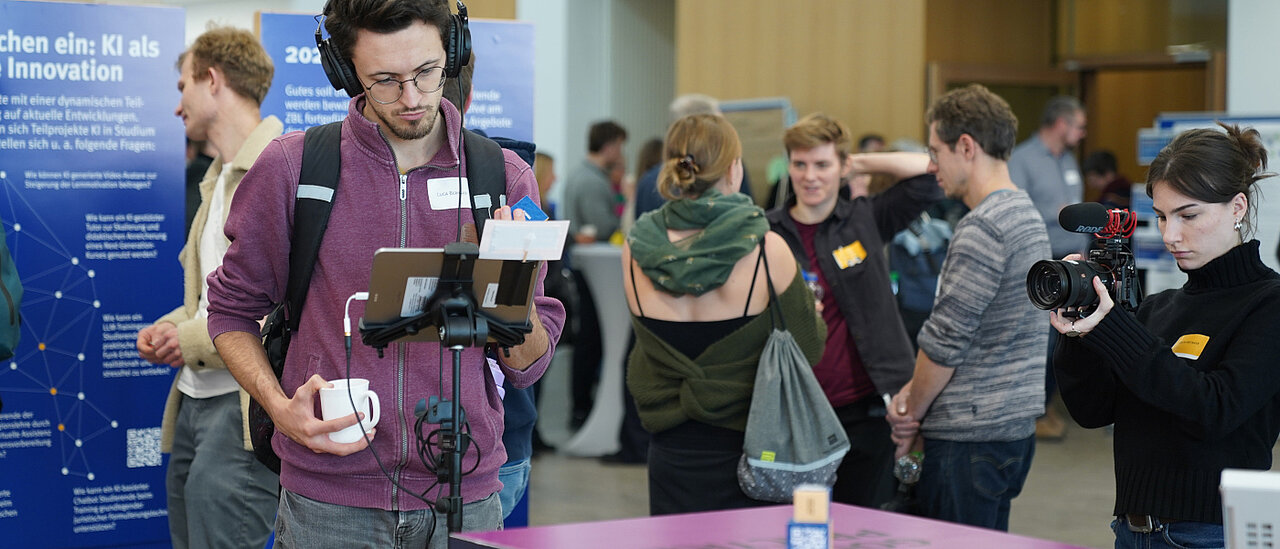
After the opening event in the lecture theatre, there were various opportunities for the almost 200 participants to exchange ideas and learn more, including Christian Burdack, Head of the Examinations Office, who was on hand to discuss our university's AI guidelines, which are currently being developed. Writing tutors from the Writing Centre provided opportunities to exchange ideas on AI tools for academic writing. The final exhibition of the WueDive project was interactive. At several hands-on stations, the team showed what has been created in the four years of the project and what the University of Würzburg will retain and benefit from at the ZBL in the future.
From concrete research tips to philosophical considerations
In the afternoon, workshops and specialist lectures focussed on individual in-depth study.
In an interdisciplinary exchange with lecturers and students, Dr Thorsten Aichele and Tobias Haase identified the prerequisites and application scenarios for AI as learning support for self-regulated learning. The AI application SRL-GPT was presented as a concrete learning support, which is based on the results of empirical meta-studies on the use of AI to promote learning and is intended to support both students and teachers in initiating self-regulated learning. The presentation was made available via the WueCampus course room "Text- and media-generating AI in teaching" and can also be requested by e-mail.
The workshop by Dr Gabriele Blümig from the University Library began with the question of how AI is currently shaping the everyday lives of participants. Blümig presented tools such as Semantic Scholar, Research Rabbit and Elicit for academic work and literature research and shared possible uses and valuable experiences.
Dr Thomas Schröter used a design thinking process to develop teaching-learning scenarios in which learners are encouraged to engage with AI-generated output in greater depth instead of receiving it uncritically. To this end, the participants selected one of the roles that AI can take on in a human-AI collaboration - that of expert, moderator or peer - and explored how AI can be meaningfully integrated into learning activities involving the construction, reconstruction or deconstruction of knowledge.
Professor Wolfgang M. Schröder's lecture focused on ethical perspectives on the use of AI in university teaching. The discussion of the question of what role teachers should play in the age of AI was particularly influential. Instead of focusing on their own knowledge authority, Schröder emphasised the importance of a learning culture in which the ability to learn is central. He also presented various ethical approaches that help to critically reflect on the use of AI in teaching.
In his lecture, Dr David Obremski first gave an overview of current tools and possibilities of generative AI - also with regard to the potential of virtual reality for psychotherapeutic applications. Finally, he impressively demonstrated a user-orientated combination of various AI tools from the fields of image/sound and text processing using an authentic practical example from his research.
The Day of Teaching 2025
The "Teaching Day" on 19 November 2025 was held under the motto "Hey ChatGPT, how does good university teaching actually work?". It was organised by the Centre for Teaching and Learning (ZBL). Watch the video insight.
Another event tip
On 21 January 2026, another [denk]anstoß on artificial intelligence in teaching will take place at the ZBL. In her online lecture, educational scientist and founder of the eBildungslabor Nele Hirsch will talk about why AI language models do not work as answer machines, but how they can serve well as resonance machines for learning.