
JMU's quality management seal of approval renewed
01/13/2026The University of Würzburg can accredit its degree programmes itself for a further eight years as part of the university's own quality management system.
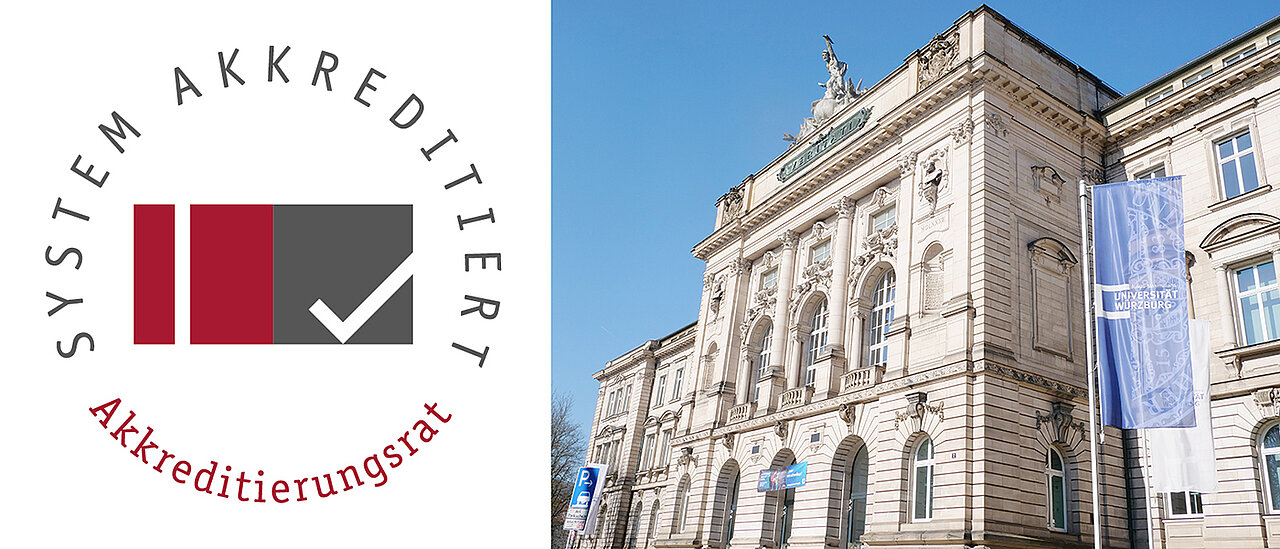
The University of Würzburg has done it: at the end of a multi-year review process, it has once again been awarded the seal of system reaccreditation without any conditions. This means that it can award the seal of the Accreditation Council to study programmes that have undergone JMU's quality management for a further eight years.
Without this seal, it is not possible - in Germany, study programmes may not be operated without accreditation. The seal is also a sign of quality for employers when recruiting JMU graduates. Around 40 degree programmes go through the entire system every year, every eight years.
Great effort for the faculties too
The focus of the five-member expert group was clearly on the practical implementation of the quality management system in the faculties and on the interaction with the centrally organised parts of the system.
Preparation was therefore also time-consuming for the faculties. Their teaching staff, students and employees from the academic support area cooperated very well with colleagues from Unit A.3 (Quality Management, Organisational Development & Campus Management) of the Central Administration during the review process.
It was precisely this that convinced the expert group: the quality management (QM) players had grown together and kept the system alive, as the report states. Reliable communication, transparent information and mutual trust formed a stable basis for this.
Assessment emphasises six points
Overall, the reviewers rated the university's QM system for teaching and learning as exemplary. They emphasise the following aspects:
- All degree programmes meet the formal and subject-related content criteria for accreditation. The QM system supports their continuous further development.
- The qualification objectives of the degree programmes are linked to current socially relevant topics.
- The quality cycles are closed and the QM instruments and processes are reliably implemented.
- The expert groups are very well supported during the programme audits. The Presidential Commission for Quality in Teaching and Learning makes consistent decisions regarding accreditation.
- The system leaves room for individual initiatives and subject-specific specialities. It is firmly anchored in everyday university life and enjoys a high level of approval.
- The close connection between quality management and programme development is beneficial.
The full report can be viewed on the central QM website: Accreditation - Quality Management
How quality management is being further developed
What has been achieved with the system reaccreditation is a great joint success for the university. However, it cannot rest on its laurels: quality management means continuous further development. The expert group also provided valuable suggestions for this.
"Our system is round, but also complex. We will work with the faculties to see whether we can reduce the workload," says the QM team from Department A.3.
"We will also consider focussing on a specific annual topic, which should then be examined in detail across all instruments. This would allow us to accelerate further developments in a specific area."
The expert group recommends the modularisation of degree programmes as the theme for the year. This is because the way in which modules are organised at JMU seems very diverse and lacks coordination.
The seal of system accreditation must be renewed in 2032. The university must then once again demonstrate its ability to provide quality-assured further development in the areas of study and teaching.