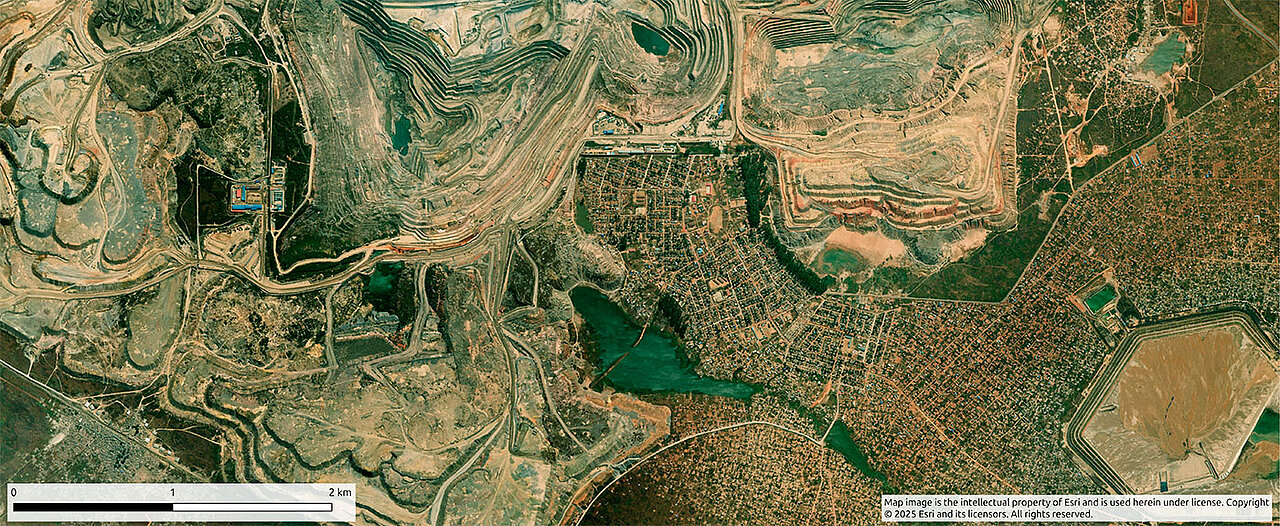


Satellite images to capture cobalt mines in Congo
01/27/2026How does cobalt mining influence settlement movements in the Democratic Republic of the Congo? What are the risks for the population and the environment? A research team from the University of Würzburg is looking for answers.
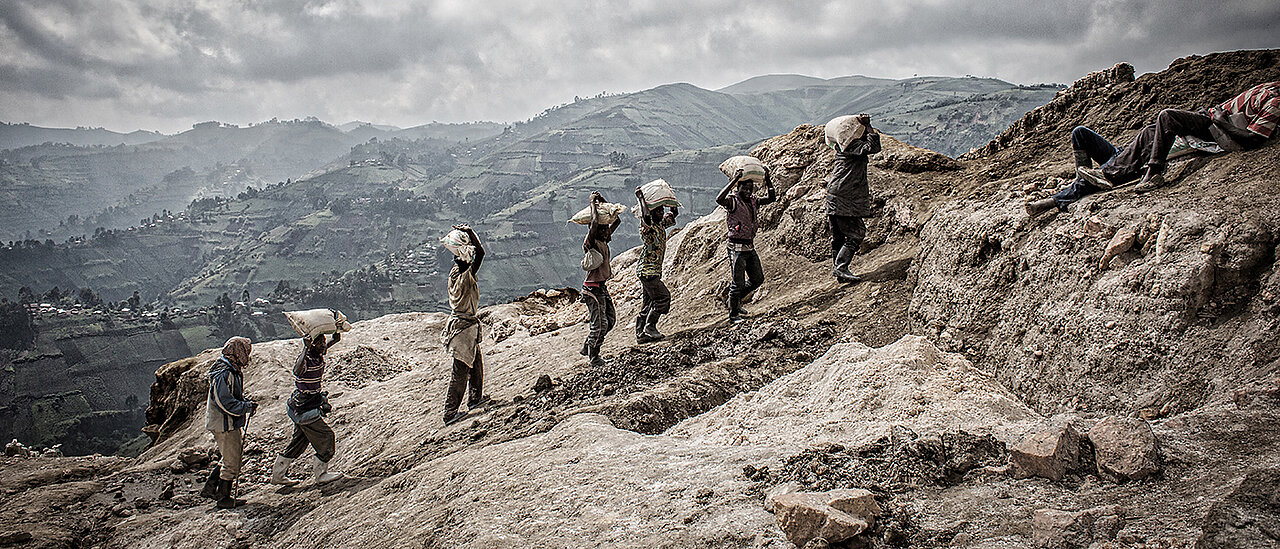
Cobalt may just be one of many metals for many people. What some may not realise: It can be found in most trouser pockets. More precisely, in smartphones. It also plays an important role in electric cars. There, cobalt ensures a longer service life for lithium-ion batteries. Worldwide, more than 60 per cent of the metal is produced in the Democratic Republic of the Congo.
Reports of child labour have been circulating in the media for years, as well as a large proportion of informal work with legal uncertainties for workers and dangerous and unhealthy working conditions in many mines. Nevertheless, the sector continues to grow steadily and influences settlement and population trends in the Central African state.
Researchers from the Chair of Global Urbanization and Remote Sensing at the Earth Observation Research Cluster (EORC) at Julius-Maximilians-Universität Würzburg (JMU) have set out to document and analyse these and other spatial dynamics. The EORC is based on a cooperation between the JMU and the Earth Observation Centre (EOC) of the German Aerospace Center (DLR).
Construction and population boom in the Cobalt Belt
The team assumes that the mines in the Cobalt Belt in the south-west of the country are a magnet for settlement movements. "In the capital Kinshasa, there was a 52 per cent increase in buildings between 2016 and 2023. In contrast, Kolwezi, the largest city in the belt, recorded an increase of 112 per cent in the same period," says Dr. John Friesen, project manager and research associate at the JMU Chair.
There is a similar trend in population growth: if the population is estimated on the basis of buildings, it can be assumed that the state's population has grown by almost 22 million in the last five years, over 2.5 million of them in the Cobalt Belt alone. "If these estimates are correct, we therefore have just under 12 per cent of the growth on around 2 per cent of the state's surface area," says Konstantin Müller, research associate on the project.
What makes Kolwezi and the Cobalt Belt so attractive? "The prospect of work, of income. In the city alone, there is a mining and refinery area of over 120 square kilometres. That's roughly twice the area of the New York borough of Manhattan," explains Professor Hannes Taubenböck, head of the chair. The team will now use satellite images to analyse settlement developments, environmental changes and mine growth over the last ten years.
Machine learning will also be used to develop a method for automatically localising and categorising mines. This is because the Democratic Republic of the Congo has both large industrial mines and small, unregulated excavation sites, where the risk of illegal mining, informal employment and exploitation can be high. One aim of the project is also to be able to use the method for other mining regions in the Global South, says Friesen.
More transparent supply chains and more sustainable raw material extraction
The researchers are also interested in showing the health status of the population: "Synergistically analysing and comparing the large-scale trends from Earth observation with local health studies will be the key to obtaining a picture of the health risks," explains Taubenböck.
The JMU scientists want to make the results available to government agencies such as the Federal Institute for Geosciences and Natural Resources and non-governmental organisations. "We are not naïve enough to believe that this will fundamentally change the situation," says the JMU professor, "but we hope that our findings can help to make key components along global supply chains more transparent." The project thus offers a basis for more sustainable raw material extraction.
Funding
The KSB Foundation of the pump company KSB (named after the company founders Johannes Klein, Friedrich Schanzlinand Jakob Becker) is funding the project "Transparenz im Rohstoffabbau: Fernerkundungsgestützte Detektion und Quantifizierung von Kobaltminen im Globalen Süden". The project will run for three years. The team has more than 60,000 euros at its disposal for the first year. In total, more than 180,000 euros have been requested for the project.
Contact
Prof. Dr. Hannes Taubenböck, Head of the Chair of Global Urbanization and Remote Sensing at EORC, Head of the "Georisks and Civil Security" Department at DLR's EOC, T. +49 931 31-86778, hannes.taubenboeck@uni-wuerzburg.de
Dr. John Friesen, Chair of Global Urbanization and Remote Sensing at the EORC, T. +49 931 31-87996, john.friesen@uni-wuerzburg.de
Konstantin Müller, Chair of Global Urbanization and Remote Sensing at the EORC, T. +49 931 31-82520, konstantin.mueller@uni-wuerzburg.de
Additional images