
Robot dog to support dermatological clinic staff
01/27/2026The HELIA robot dog is being trained to communicate verbally with staff at the University Dermatological Clinic. The Federal Ministry of Research, Technology and Space is providing 1.8 million euros for the project.
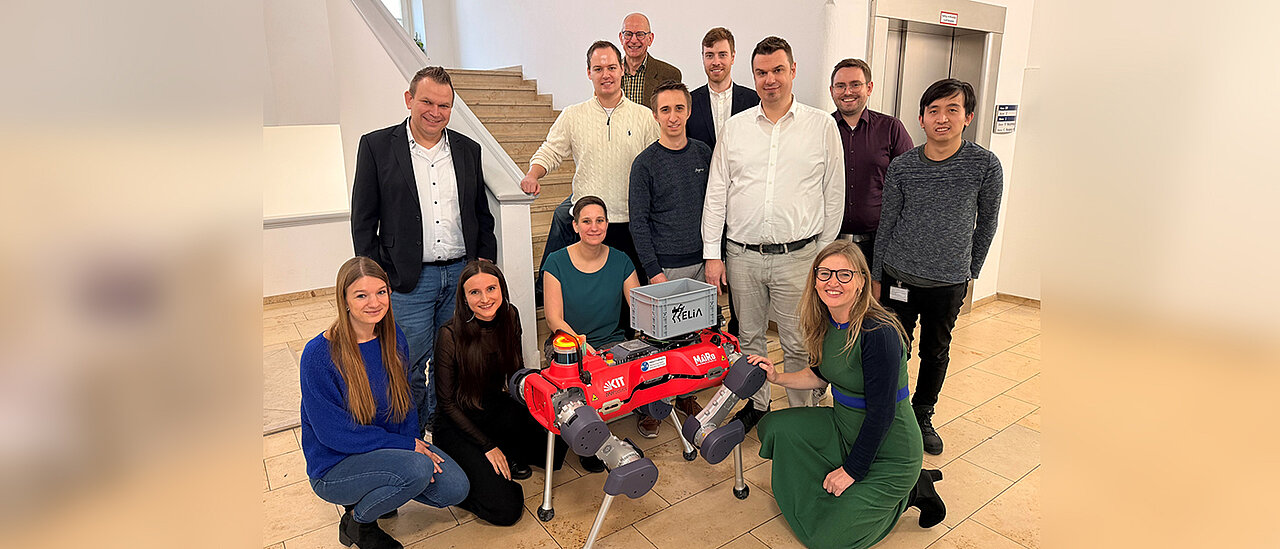
HELIA is still a little clumsy, stomps through the corridors with loud steps and only moves according to the impulses of the remote control. But right from her first appearance on ward H21/22 of the Department of Dermatology at the University Hospital of Würzburg (UKW), the red robot dog with the silver legs had everyone's hearts racing: nursing staff, cleaning staff, doctors and patients pulled out their mobile phones or reached out their hands to stroke HELIA or at least take a picture of her.
HELIA stands for "Helpful robot in everyday hospital life". Over the next three years, the UKW will be testing how exactly the four-legged robot can and may be used in a hospital together with the Karlsruhe Institute of Technology (KIT), the FZI Research Center for Information Technology and the Forschungszentrum Jülich (FZJ).
What tasks the robot dog will perform
The aim is for HELIA to listen to and carry out verbal commands from authorised nursing and medical professionals in the future. It will accompany patients on ward rounds and relieve staff - for example by recording the ward round, documenting findings and ideally transferring these to the hospital information system.
HELIA could also collect data itself, for example by photographing wounds and measuring vital signs. It is also planned that the walking robot will accompany patients to appointments, display what is said on a screen and explain the technology in the patient's room.
Staff quickly convinced by the project
"Of course, the prerequisite for this is that both the staff and the patients agree to HELIA accompanying them during the admission examination and during their inpatient stay," says Professor Astrid Schmieder. The dermatologist and senior consultant at the Clinic and Polyclinic for Dermatology, Venereology and Allergology is delighted with the four-legged robot.
When Dr Arne Rönnau, Professor of Machine Intelligence and Robotics at KIT, and Christoph Zimmermann, Head of the Department of Medical Information Technology at the FZI, approached her with the idea of a robotic dog on the ward, the doctor and scientist was immediately enthusiastic about the new research project. She had no trouble getting the staff enthusiastic about HELIA. Everyone sees the potential of this future technology, which could be used in healthcare facilities, home care and the emergency services in the future. And everyone is looking forward to setting standards here.
Good experience from previous cooperation
Why Würzburg? "We had already worked together excellently on the HybridVITA project. We were effective, achieved a great deal, could always rely on each other and we also had fun. That's why we wanted to research the implementation of a robot dog in a hospital in Würzburg with Astrid Schmieder," says Christoph Zimmermann.
The electrical engineering and information technology graduate and his team from the FZI are investigating how natural linguistic communication can take place between specialist staff, dog and patient and how the system can support the continuous recording of skin surfaces or the observation of wounds.
Humanoid machines create discomfort
Why is the HELIA project focussing on a dog-like walking robot instead of a humanoid machine?
People often react sensitively when technology looks too much like them. This phenomenon is known as the "Uncanny Valley" - the more human a robot appears without looking completely real, the more uneasy many people feel. In contrast, a four-legged robot remains clearly recognisable as technical support and avoids this effect.
Voice communication with the robot as a goal
"We want to develop a system that employees intuitively perceive as helpful in everyday clinical practice," says Arne Rönnau.
His team at the Institute for Information Management in Engineering at KIT is researching how a walking robot no longer needs to be laboriously programmed using software, but can learn tasks simply from naturally spoken explanations. Employees in the clinic should be able to describe to the robot what it should do - and the artificial intelligence converts these instructions directly into functional programmes.
"It's as if the robot had been told what to do and then learnt it itself," explains Rönnau. To this end, the researchers are developing the "Explained-programmed-done!" system, which combines speech processing, robotics and person recognition.
Gripper arm for mechanical tasks
HELIA is now going to dog school to learn who is allowed to give her commands. Speech software converts the employees' sentences into codes so that the Robo-Dog can carry out the tasks that arise on the ward.
"We are excited to see how we can best help here," says Arne Rönnau. In the next step, HELIA will receive a gripper arm, for example, so that it can also open doors, restock goods, clear food and photograph wounds.
Ethical, legal and social issues
The use of robots in hospitals raises ethical, legal and social issues. The FZJ is addressing these issues. Professor Jan-Hendrik Heinrichs summarises the challenges as follows:
"It is central that the HELIA system is used for the benefit of patients and does not jeopardise them. In addition, HELIA is intended to relieve the burden on medical professionals while still enabling a safe working environment. This means that resources can be used where they create the greatest medical or nursing benefit without creating new inequalities in the use of healthcare resources."
Robot dog comes from Switzerland
After her successful debut on the ward, HELIA returned to her basket in the dermatology library, where she could recharge her batteries in peace.
There was much discussion on the ward about which eyes to stick on the dog and whether HELIA should have a little barrel hanging around her neck - after all, she is not only the size of a St Bernard but also comes from Switzerland.
The robot dog HELIA was developed by the Swiss company ANYbotics and is actually called ANYmal. Around 200 ANYmals are currently in use, but primarily in places that are dangerous for humans. As inspection robots, they monitor oil platforms, wind farms and steelworks.
Hospital wards are new for the animal-like machines. "As nobody expects to see a robot dog here, we have to warn them at the entrance," says Astrid Schmieder and smiles: "Watch out, there's a robot dog here for research purposes!"
Funding
HELIA is being funded by the Federal Ministry of Research, Technology and Space with 1.78 million euros as part of the "Natural language integration of robotics in healthcare facilities" funding programme. Eight projects were selected for funding from 54 outlines submitted.