
One year in space: Würzburg small satellite InnoCube
01/20/2026On 14 January 2025, a SpaceX rocket launched InnoCube into orbit. The small satellite from the University of Würzburg is now celebrating its first anniversary - and can already look back on some great successes.
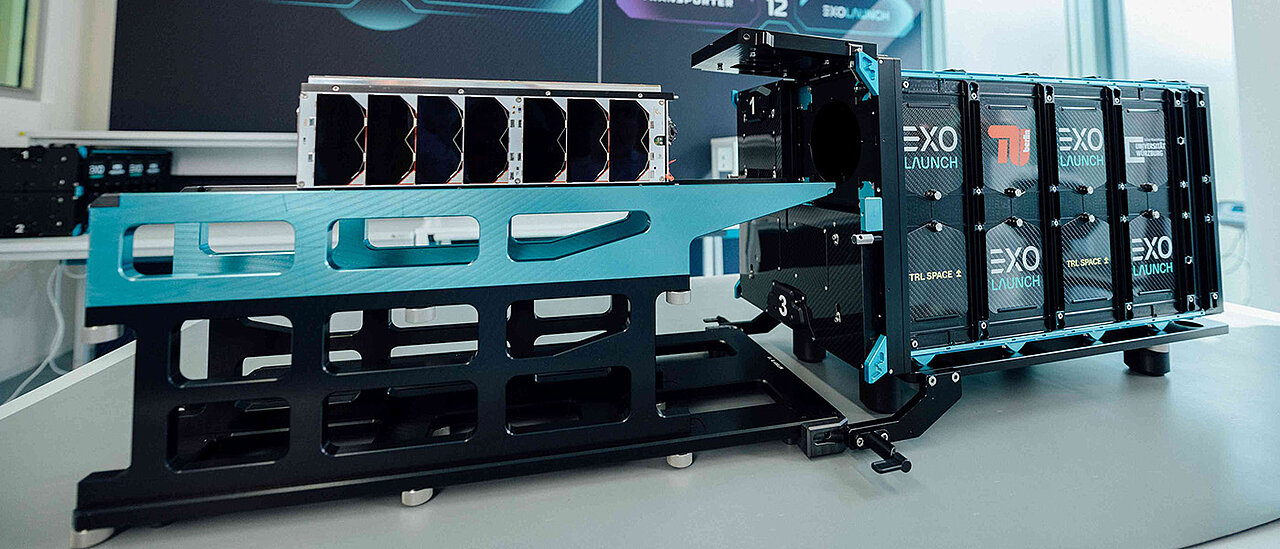
The Würzburg University satellite is equipped with several innovative technologies that have been used in space over the last 12 months. These include the world's first completely wireless satellite bus SKITH and, most recently, the first AI attitude controller on a satellite. InnoCube was developed in co-operation with the Julius-Maximilians-Universität Würzburg (JMU) and the TU Berlin. In Würzburg, Professor Sergio Montenegro's Chair of Computer Science VIII and his team are supervising the project.
Since 14 January 2025, the small satellite, which weighs around four kilograms, has been orbiting the earth at an altitude of 500 kilometres.
Successful year in orbit
During its first year in orbit, InnoCube successfully tested new, innovative technologies: The wireless satellite bus SKITH (Skip The Harness) developed in Würzburg, which enables data to be exchanged on board the satellite by radio, proved its performance and reliability in space under extreme conditions. The team hopes that this technology will lead to significant savings in terms of cable mass for future satellite missions.
A prototype of an innovative energy storage technology "WallE-2-Space" was also tested - an experiment developed by TU Berlin that is intended to combine energy storage and satellite structure in the future.
A very special step was taken a few months ago: In October 2025, the AI system LeLaR (In-Orbit Demonstrator Learning Attitude Control) developed at JMU performed an orbital attitude manoeuvre controlled entirely by artificial intelligence - a world first! The experiment paves the way for the use of innovative, intelligent systems that can autonomously control a satellite in space.
The mission was accompanied by numerous contributions, cooperation and interest from students from both universities - be it in final theses, as student assistants or as part of lectures.
Greetings to amateur radio operators
In addition to the main experiments, InnoCube also has an amateur radio payload that can be received by radio amateurs all over the world. In a Christmas event in 2025, InnoCube sent festive greetings from space to space enthusiasts on several continents.
The satellite also greeted its fans from the amateur radio community on the occasion of its first birthday.
"The messages sent are a Morse code that can be received with simple radios," explains Tom Baumann, a research assistant on the project. "The satellite identifier, the temperature of the on-board radio and a text message - for example 'Merry Christmas' or 'Happy Birthday' - are Morse code." If the radio amateurs receive the signal, they also receive a so-called QSL card. These digital reception confirmations are gladly collected. Further transmissions are planned for 2026.
The mission continues
Numerous experiments on board InnoCube are to follow until the end of the funded joint project in June 2026: Further data from the radio system is to be collected and further AI attitude control experiments are to be carried out.
"The satellite is still fully functional and we are taking the opportunity to carry out full-scale technology experiments in space," says Professor Sergio Montenegro. After the end of regular operations, the satellite will continue to be operated with student support and used in teaching.
Funding information
The InnoCube (FKZ: 50RU2000) and LeLaR (FKZ: 50RA2403) projects are funded by the Federal Ministry for Economic Affairs and Energy (BMWE) on the basis of a decision by the German Bundestag.
Contact
Tom Baumann, Julius-Maximilians-Universität Würzburg, phone +49 931 31-87789, e-mail: tom.baumann@uni-wuerzburg.de
Prof Dr Sergio Montenegro, Julius-Maximilians-Universität Würzburg, Tel. +49 931 31-83715, e-mail: sergio.montenegro@uni-wuerzburg.de