
Heracles' heroic journey into the digital world
01/27/2026The Martin von Wagner Museum at the University of Würzburg is constantly expanding its digital and interactive offering. The latest example is the new Heracles Game, which interested visitors can now try out on a touch table.
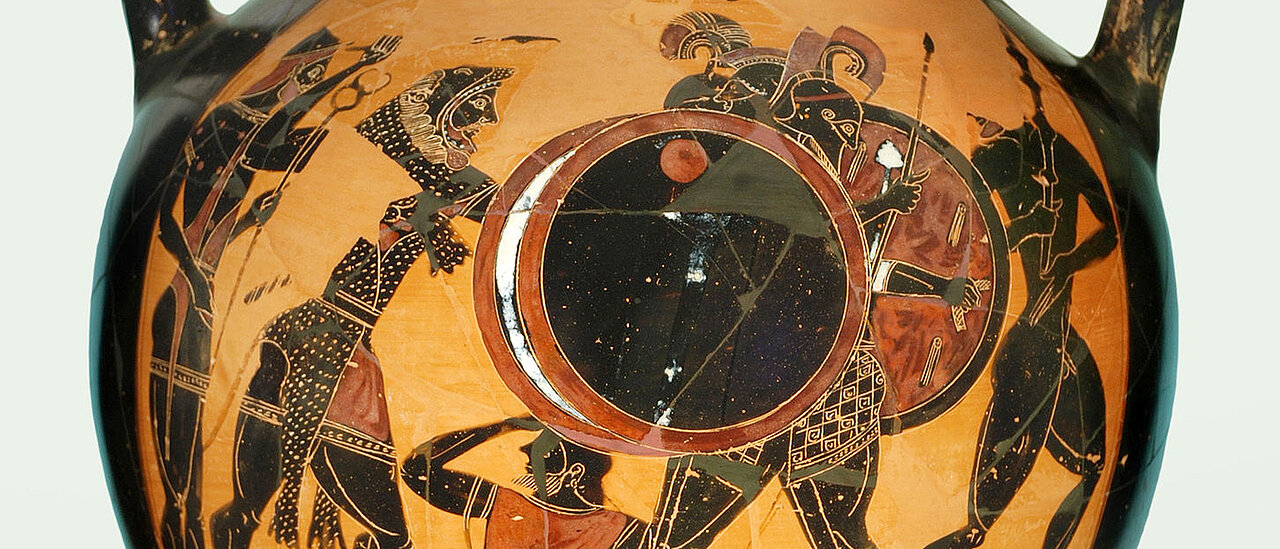
He is the strongest of all heroes in Greek mythology: Heracles, also known by his Latin name Hercules. To earn his extraordinary heroic status, the demigod had to complete twelve heroic deeds. One of his most difficult battles was against the Hydra, a water snake that grew two heads when one was cut off.
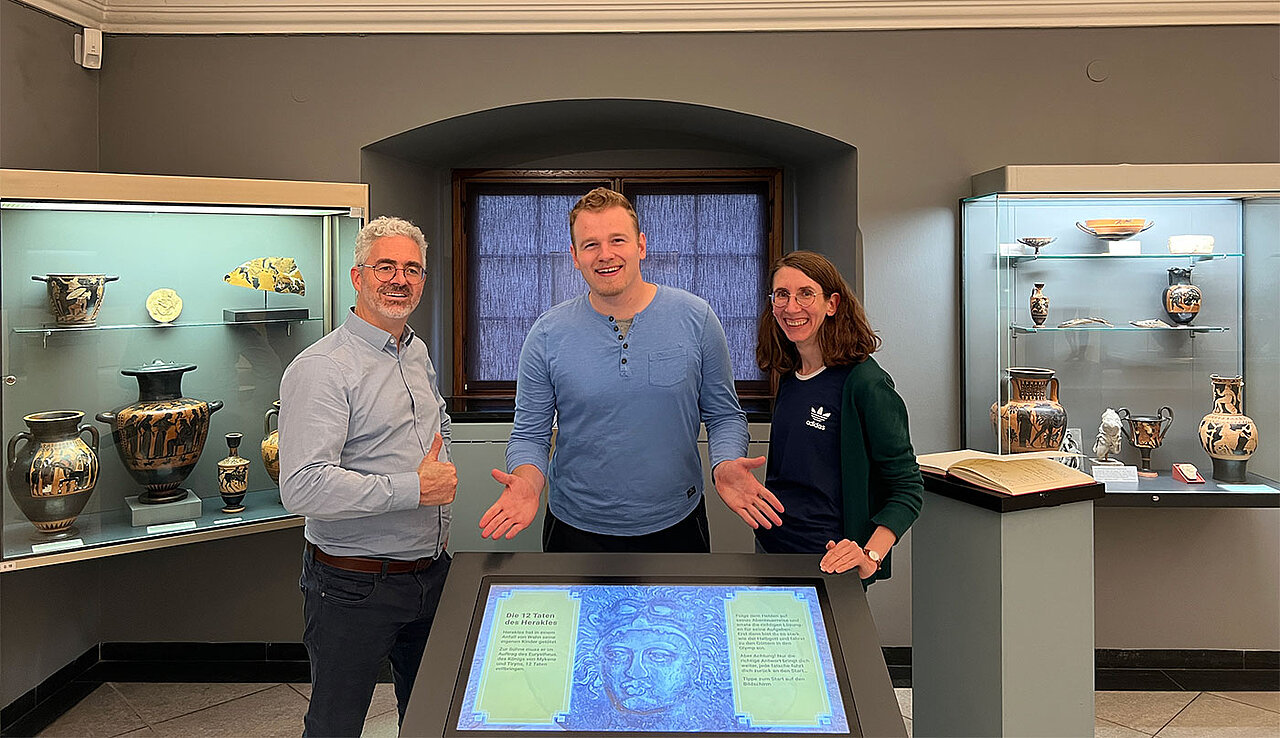
Visitors to the Martin von Wagner Museum's antiquities collection at Julius-Maximilians-Universität Würzburg (JMU) can now immerse themselves in the legend of Heracles in a playful way: The Heracles Game is available to them on a touch table. In an interactive quiz, those interested can follow in the footsteps of the hero through the Mediterranean region. A tip: for each question, an image appears in the top right-hand corner of the screen, providing clues to the correct answer.
Johannes Sebastian Troll, software engineer and graduate of the JMU Games Engineering programme, programmed the game. It is suitable for all age groups and can be found in the front domed hall. There are also vases depicting Heracles. "I developed the interactive hero's journey visualization tool during my studies as part of the Game Lab II module under the supervision of Prof. Dr. Sebastian von Mammen. It is an interactive hero's journey visualization tool that makes it relatively easy to implement the Heracles Game and other similar games. The museum's designer, Christina Kiefer, created outstanding graphics for the Heraclec Game,” says Troll.
The twelve heroic deeds of Heracles
The legend of the twelve heroic deeds of Heracles starts anything but heroic: in a fit of madness and rage, the demigod killed his own children. Hera, goddess of marriage and wife of Zeus, the father of the gods, drove him into this madness. She sent Heracles into servitude under Eurystheus, king of Mycenae.
He sent the demigod to remote regions of the ancient world until Heracles finally reached the realm of Hades, the ruler of the underworld. On his adventurous journey, Heracles accomplished his twelve heroic deeds and fought many animals and monsters, including the Nemean lion and the Hydra. The hero also captured other creatures such as a hind and a boar.
Depictions of the hero first appeared in large numbers on Attic vases from the sixth century BC. The order in which Heracles carried out his tasks was still variable at the time; it was not until the Greek historian Diodorus laid it down in 30 BC. A fixed selection of motifs developed in the cycle of images. Images can be found on the metopes of the Temple of Zeus at Olympia as well as on vessels, mosaics and sarcophagi.
The touchtables in the museum
The antiquities collection team, led by Professor Jochen Griesbach-Scriba, officially put a touch table into operation in April 2025. A grant from the Bürgerstiftung Würzburg und Umgebung made the purchase possible. The initial content was developed by students in a seminar led by Dr. Florian Leitmeir from the Chair of Classical Archaeology. André Mischke, IT expert at the Institute of Art History, provided support with the technical implementation. The touch table was built by Erwin Seelmann, master carpenter and supervisor at the museum.
Heracles Game, which can be played on a second touch table, expands the museum's interactive offering. The director of the antiquities collection thus kept a promise he made on 30 April 2025: "For us, today's inauguration is just the beginning. Digital offerings will generate new ways of making antiquity accessible in an academic yet easy-to-understand way."
More information on the inauguration of the touch table can be found in the press release.
Contact
Prof. Dr. Jochen Griesbach-Scriba, Director of the antiquities collection at the Martin von Wagner Museum, T. +49 931 31-89453, jochen.griesbach@uni-wuerzburg.de
Additional images