
Our research profile: future-oriented and internationally recognised
True to its guiding principle of "Science for Society", Julius-Maximilians-Universität Würzburg (JMU) strives to gain new insights in Research Areas relevant to the future. In interdisciplinary Focal Research Areas and innovative Emerging Research Areas, scientists are working on solutions for the challenges of tomorrow.
Focal Research Areas
At the University of Würzburg, excellent research achievements at the highest international level are already being made in four Focal Research Areas.
Functional Materials for the Future: Bridging Quantum Innovation and Molecular Design

This Focal Research Area is dedicated to the development of novel functional materials that form the foundation for future (quantum) technologies, sustainable energy processes and their mechanistic understanding. Rooted in chemistry and physics and with its Cluster of Excellence ctd.qmat, the research spans a broad materials spectrum from macro- and supramolecular nanosystems to solid-state quantum materials.
Prime examples include topological insulators, organic materials, and boron chemistry. JMU’s remarkable success in engineering novel functional materials lies in its unique capacities for rational materials design, (molecular) synthesis and nanofabrication across chemistry and physics, combined with utilising, investigating, and describing light–matter interactions.
Strong interdisciplinary collaborations in this Focal Research Area drive pioneering progress, fostering the development and optimisation of next-generation solutions, such as energy-efficient and fault-tolerant computing.
- ctd.qmat – Complexity, Topology and Dynamics in Quantum Matter (EXC 2147)
- Topological and Correlated Electronics at Surfaces and Interfaces (ToCoTronics, CRC 1170)
- Photoluminescence in Supramolecular Matrices (RTG 2991)
- EMPHASIS – Efficient materials and processes for high-energy supercapacitors for smart textiles and electromobility applications
- NaKlaR – Component development and customized recycling for sodium-ion batteries
- Quantenrepeater.Link (QR.X)
- Measurement-based photonic quantum processors (PhotonQ)
Molecules of Life: Pioneering a Healthier Future
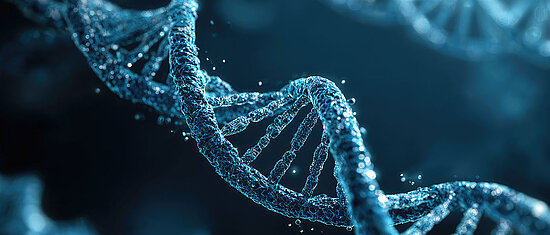
This JMU Focal Research Area represents an internationally recognised research hub dedicated to deciphering the molecular mechanisms by which cells perceive and process signals. Central to these processes are multifunctional molecules such as RNA and DNA, which orchestrate cellular signalling, respond to perturbations and influence inter-species interactions – they act as pivotal molecular decision points and represent promising targets for intervention.
To identify and characterise molecular determinants, JMU’s scholars combine innovative research strategies with advanced technologies, including high-throughput screening, structural biology, synthetic chemistry, and super-resolution imaging. JMU’s Cluster of Excellence NUCLEATE exemplifies this approach and serves as a catalyst for innovation and high-impact research, paving the way for novel nucleic acid-based technologies and therapeutics.
Building on JMU’s outstanding research achievements at the interface of RNA biology and infection, this research area expands its focus to molecular mechanisms that govern cross kingdom interactions between microbes and their host during colonisation and infection – aiming to determine key molecules that mediate host response and protective immunity as well as pathogen invasion and tissue damage.
Decoding the molecular language of life paves the way for novel strategies to modulate biological processes with potential applications in disease prevention and treatment.
- NUCLEATE – Cluster for Nucleic Acid Sciences and Technologies (EXC 3113)
- DECIDE – DECisions in Infectious DisEases (CRC 1583)
- Pathogenic fungi and their human host: Networks of interaction (CRC 124)
- 3D Tissue Models for Studying Microbial Infections by Human Pathogens (RTG 2157)
- Metabolism, topology and compartmentalization of membrane proximal lipid and signaling components in infection (RTG 2581)
- ERC Synergy Grant "ULTRARESOLUTION: Beyond super-resolution: ultra-resolution imaging provides solutions for synapse physiology and brain pathology"
- RNAmed – Future Leaders in RNA-based Medicine
Disrupting Disease Dynamics: A Gateway to New Therapeutic Interventions
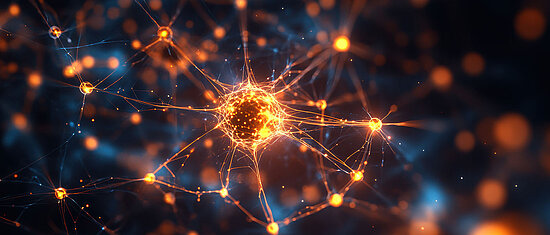
This JMU Focal Research Area combines outstanding expertise in exploring human disease networks with the aim of deciphering key regulatory nodes and the dynamics of disease-associated functional and structural changes. Collaborative, interdisciplinary efforts – spanning from basic research to clinical science – elucidate the composition and higher-order architecture of cells, tissues and entire organisms during health and disease.
Disease networks are examined across a broad spectrum of pathologies, including cardiac disease, cancer, neuropsychiatric disorders, and chronic pain. JMU researchers reveal novel pathomechanisms by integrating advanced 3D tissue models, organoids, and complex model organisms with cutting-edge biochemical techniques and analytical approaches.
Special assets are JMU’s unique translational institutions and infrastructure (e.g. National Center for Tumor Diseases, Comprehensive Heart Failure Center, Early Clinical Trial Unit and in-house GMP facility) including access to relevant patient collectives.
This research paves the way for new diagnostic and therapeutic strategies, including cell-based immunotherapies, brain-machine interfaces, biosensors, and next-generation biomaterials.
- Cardio-Immune Interfaces (CRC 1525)
- LETSIMMUN: Lymphocyte Engineering for Therapeutic Synthetic Immunity (CRC 338)
- From the fundamentals of biofabrication towards functional tissue models (CRC 225)
- Functionalizing the Ubiquitin System against Cancer – UbiQancer (CRC 387)
- The Adrenal: Central Relay in Health and Disease (CRC 205)
- Retune: Retuning dynamic motor network disorders using neuromodulation (CRC 295)
- Modulation of graft-versus-host and graft-versus-leukaemia immune responses after allogeneic stem cell transplantation (CRC 221)
- ResolvePAIN: Peripheral mechanisms of pain and their resolution (CRU 5001)
- ERC Synergy Grant "TREATLIVMETS: Treating Liver Metastasis"
- ERC Synergy Grant "ULTRARESOLUTION: Beyond super-resolution: ultra-resolution imaging provides solutions for synapse physiology and brain pathology"
Where Code Meets Culture: AI and Computational Humanities

This JMU Focal Research Area uniquely integrates AI and Computational Humanities, combining fundamental and applied AI research with the study of text, spoken language, music, and design of immersive virtual simulations.
It encompasses three lines of inquiry:
- applying AI methods, such as Deep Learning, Natural Language Processing and Computer Vision, to the Humanities to generate new knowledge on the structures and patterns of human culture;
- exploring how human and social interactions become affected by AI, focussing on cultural, ethical and legal aspects;
- advancing AI fundamentals to enable efficient, explainable and sustainable machine learning.
By uniting previously separate fields, JMU advances fundamental AI research and unlocks new frontiers in the Humanities. This forward-looking convergence enhances both fields, leading to transformative insights that shape the future of AI and its role in human-centred knowledge creation.
- COMFORT: Compression Methods for Robustness and Transferability
- KILiMod: KI-basierte kontextuelle Verlinkung und Moderation von deutschsprachigem Chat [AI-based contextual linking and moderation of German-language chat]
- TESDA: The Experience of Stories in the Digital Age (RTG 3087)
- AIL AT WORK: Analysis, Development, and Evaluation of AI Systems and AI Literacy in Work Contexts
- Corpus monodicum: Die einstimmige Musik des lateinischen Mittelalters [Corpus monodicum: Monophonic Music from Latin Middle Ages]
- A New Focus in English Linguistics: GeolingualStudies
- Emmy Noether Group "Computational Analysis of Music Audio Recordings: A Cross-Version Approach"
Emerging Research Areas
In addition, the university is strengthening three Emerging Research Areas that are being strategically expanded due to their high development potential.
Global Environmental Challenges: Ecosystems and Human Societies in Transition

This JMU Emerging Research Area advances our understanding of planetary boundaries by interdisciplinary foundational analyses of Earth's systems. Specifically, it investigates
- how environmental change at the intersection of the geosphere, biosphere, and sociosphere can be measured, quantified, and predicted across scales,
- how these spheres interact under current and future conditions shaped by environmental and anthropogenic impacts, and
- how social systems adapt to, cope with, and respond to environmental change and/or natural hazards.
To this end, scholars from biology, geography, social sciences, and the Humanities cooperatively explore biodiversity, ecosystem functioning and societal dimensions of environmental change. Thus, it advances our understanding of complex causal interconnections of the Earth’s systems and promotes inclusive and sustainable societal solutions in a changing world.
- Enhancing the structural diversity between patches for improving multidiversity and multifunctionality in production forests (RU 5375)
- SAFEGUARD – Safeguarding European wild pollinators
- UPSCALE – Upscaling the benefits of push-pull technology for sustainable agricultural intensification in East Africa
- CHARM-EU expansion, inter-institutional campus, governance, higher education, transformation
- Regionale Wege zu klimaneutralen Hochschulen (REKLINEU) [Regional paths to climate-neutral universities (REKLINEU)]
- EO4CAM Earth Observation Laboratory for Climate Adaptation and Mitigation
- ROOT: Real-time earth Observation of fOrest dynamics and biodiversity
Pillars of Change: Insights from History and Society

This JMU Emerging Research Area focuses on Europe’s relationship with the ancient Mediterranean, Western Asian and Arab regions on the one hand, and with modern Asia and Africa on the other, encompassing a wide array of objects, ranging from literature and language to social, religious and magical practices, as well as norms, discourses and ideas.
It examines the relevance of past and present intercultural entanglements for contemporary Europe, shaped by globalisation and shifting geopolitical forces. Entanglements between cultures are embedded in complex interdependencies, framed by interpretation and constituted by interaction. By combining and contrasting seemingly distant temporal and regional perspectives, this interdisciplinary research area generates new knowledge and fosters a deeper understanding of the present.
Through enriched cross-regional perspectives, expanded cross-temporal horizons and enhanced cross-disciplinary methodological learning, this Emerging Research Area contributes to actively shaping our common present and Europe’s future.
- MagEIA: Magic between Entanglement, Interaction, and Analogy – Centre for the study of magical text traditions of West Asia and the Eastern Mediterranean in antiquity (KFG 42)
- Worldmaking from a Global Perspective: A Dialogue with China II
- Die Formierung Europas durch Überwindung der Spaltung im 12. Jahrhundert [The Formation of Europe through the Overcoming of the Schism in the 12th Century]
- Ptolemaeus Arabus et Latinus
- Sprachgitter digital: Die historisch-kritische Jean-Paul-Ausgabe [Digital Language Grid: The Historical-Critical Edition of Jean-Paul]
- Corpus monodicum: The Monophonic Music of the Latin Middle Ages. Genres - Works - Contexts
- Das Corpus der hethitischen Festrituale: staatliche Verwaltung des Kultwesens im spätbronzezeitlichen Anatolien [The Corpus of Hittite Rituals: State Administration of Religious Practices in Late Bronze Age Anatolia]
Complex Minds: Drivers of Decisions and Behaviour

This JMU Emerging Research Area pioneers a transformative framework for uncovering the universal principles and dynamic forces that shape human decision-making and behaviour across contexts. It integrates insights from research on
- interpersonal and dyadic interactions,
- social and educational contexts,
- organisational and socioeconomic environments, and
- virtual and digital spaces of decision-making.
By fostering collaboration among experts in psychology, pedagogy, economics, and computer science, this Emerging Research Area aims to illuminate the core cognitive, emotional, and motivational processes and their interplay with individual, social, and structural factors that drive adaptive and maladaptive behaviour.
Through this integrative lens, the research will generate unique empirical evidence that advances our understanding of how human decisions emerge, stabilise, and change across contexts. These insights will not only enrich foundational theory but also inform innovative approaches across health, education, business, and the public sector, thereby creating pathways for more adaptive, equitable, and sustainable societal outcomes.
- Neural mechanisms of (mal)adaptive approach and avoidance behaviour (RTG 2660)
- Lasting Learning: Cognitive mechanisms and effective instructional implementation (RU 5254)
- VIRTUALTIMES – Exploring and Modifying the Sense of Time in Virtual Environments
- HiAvA – Scalable Hybrid Avatar-Agents-Technology for Everyday Social Interaction in XR
- DynaMINT (Dynamiken MINT-bezogener Bildungs- und Berufsentscheidungen von Kindern und Jugendlichen) [Dynamics of STEM-related Education and Job Decisions of Children and Young People]
- Global Teacher Education + (GoTEd+)
- ERC Starting Grant Neurocomputational mechanisms underlying adaptive flexibility in cognition, emotion and behavior (CogFlex)