
Quality management for studying and teaching
A central concern of Julius-Maximilians-Universität is to ensure and promote quality in teaching and learning. This is determined by both individual and subject-cultural demands and circumstances, multidimensional factors such as the skills of students and teaching staff, organisational framework conditions and, last but not least, constant change. For this reason, there is a need for continuous dialogue with all stakeholders about quality. The University of Würzburg has established a quality management system that provides space and a framework for this, ensures participation and continuity, is organised in cycles and thus enables binding measures to be derived.
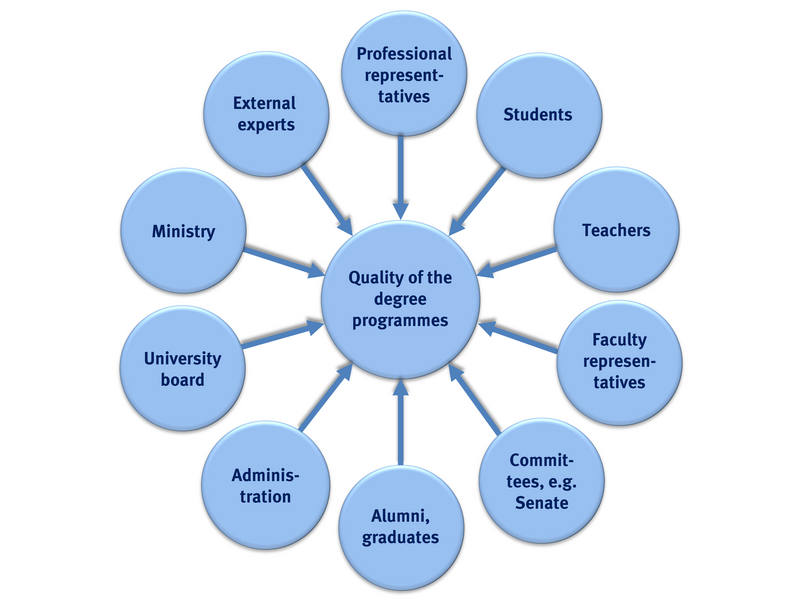
The main focus of quality management at the University of Würzburg is on the degree programmes, which are organised in related subject clusters. The assessment of their quality is made up of contributions from various stakeholders and results in a balanced overall view.
In the quality cycles at degree programme level, the perspective of all groups listed in the following diagram is taken into account within the framework of the degree programmes.
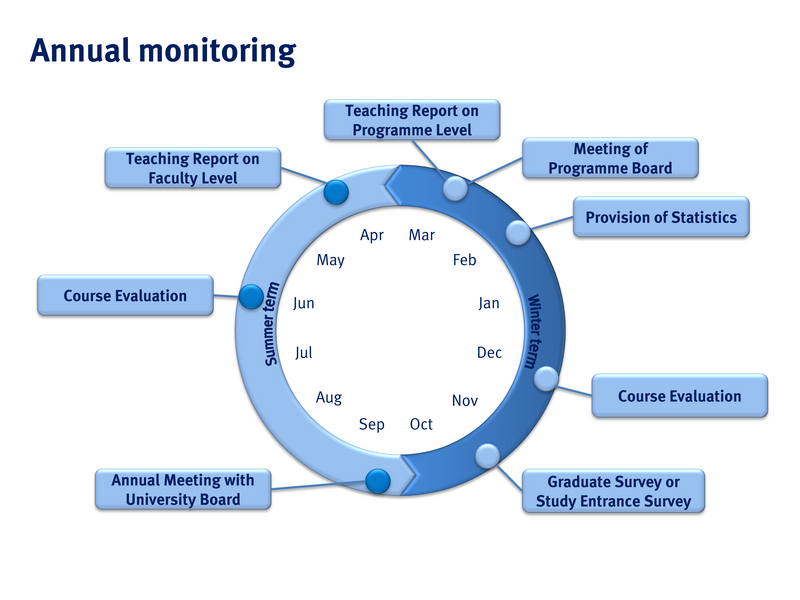
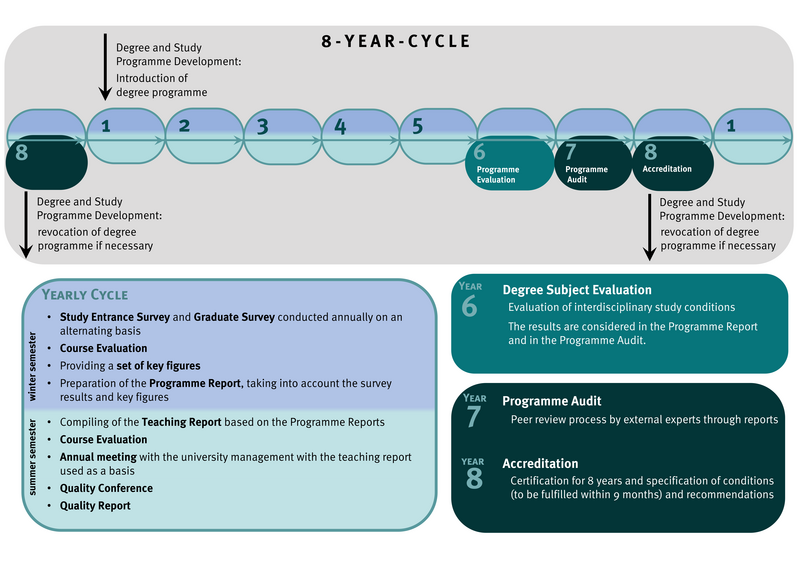
The University of Würzburg relies on annual monitoring at degree programme level in order to keep a constant eye on the quality of the degree programmes and the organisation of studies and to be able to react quickly to critical issues. A degree programme goes through a quality cycle in which results from various surveys, statistics and rankings, qualitative statements from the reporting system and agreements from the faculty meeting with the university management are compiled. The study programme committee, which meets at least once a year, uses these results and other information, for example from discussions with students, as a basis for discussing the quality of the degree programmes in its area of responsibility and initiating further developments. The agreed measures are recorded in the study programme report and the status of their implementation is reviewed by the study programme committee. If these measures lead to significant changes to a degree programme, the process of the same name takes effect, for which precise steps and responsibilities are defined.
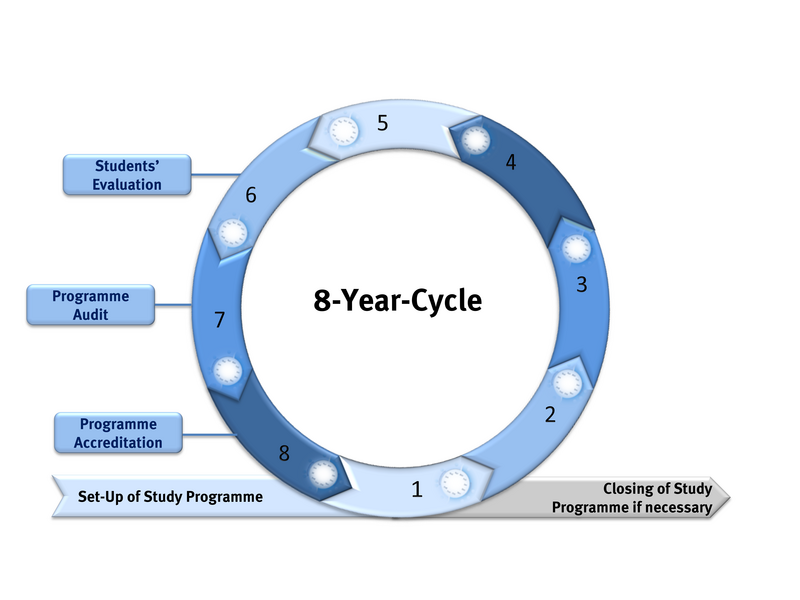
Within a cycle of eight years, the annual degree programme monitoring is supplemented by three further elements of quality development. As part of the study programme evaluation, students are comprehensively surveyed about the organisation and implementation of the degree programmes. In addition to the course evaluation, students also assess overarching aspects of study and teaching such as advice and support as well as the organisation of examinations.
The results and measures from this survey, together with the set of key figures from the annual degree programme monitoring, serve as the basis for a study programme audit. At the centre of this instrument is the assessment by a group of experts made up of external and internal representatives from academia, professional practice and students.
After receiving the final report from the group of experts and a statement from the subject, the Presidential Commission for Quality in Teaching and Learning discusses the results of the study programme audit as well as further data and information on the quality criteria for degree programmes and makes a recommendation on binding conditions and recommendations as well as on the (re-)accreditation of the degree programmes under review.
The chairperson of the commission (a member of the University Board) then issues the accreditation valid for eight years on behalf of the University Board- with or without conditions and recommendations. Conditions must be fulfilled within nine months. If a condition is not fulfilled, the (re-)accreditation is withdrawn. If conditions imposed on a degree programme result in significant changes to its study and examination regulations, the process is followed accordingly.
The eight-year cycle is based on the idea that the University of Würzburg - in contrast to the cycles applicable for programme (re)accreditation - reviews the quality of its degree programmes every year, identifies any undesirable developments and can respond promptly with measures. Furthermore, as all degree programmes are comprehensively evaluated in the sixth year via the study programme evaluation and assessed in depth in the seventh year as part of the subject audit with the involvement of external expertise before the decision on internal (re)accreditation is made in the eighth year, thorough examinations of the degree programmes are carried out every six years in principle. In order to allow sufficient time for the development of the degree programmes, but also to deploy the resources of the faculties and subjects as well as the administration in a planned manner, the University has agreed to schedule eight years for the internal accreditation process. This results in an average of three to four study programme audits per year and the same number of study programme evaluations.