
Light-structured vacua for quantum materials design: a new frontier in QEDFT
Physikalisches Kolloquium
| Date: | 01/26/2026, 2:15 PM - 4:45 PM |
| Category: | colloquium |
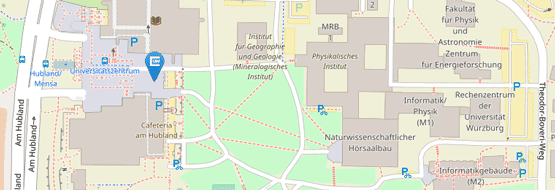
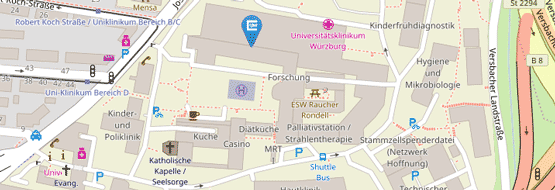
| Location: | Hubland Süd, Geb. P1 (Physik), Röntgen-Hörsaal, Online |
| Organizer: | Fakultät für Physik und Astronomie |
| Speaker: | Prof. Dr. Angel Rubio (Max-Planck-Institut für Struktur und Dynamik der Materie, Hamburg) |
Am 26. Januar 2026 um 14:15 Uhr findet das nächste Physikalische Kolloquium zum Thema "Light-structured vacua for quantum materials design: a new frontier in QEDFT" im Röntgen-Hörsaal des Physikalischen Instituts und online via Zoom statt.

The electromagnetic vacuum is a dynamical quantum object whose fluctuations can be structured and harnessed by optical and microwave cavities. When matter is embedded in such light-structured vacua, coherent interactions between vacuum fields and electronic degrees of freedom can reshape material properties at equilibrium, even in the absence of external driving or real photons. This “dark” cavity regime opens a fundamentally new avenue for quantum materials design, where cavity geometry and boundary conditions effectively engineer the ground state.
Quantum Electrodynamical Density Functional Theory (QEDFT) provides a first-principles framework to describe these phenomena, treating electrons and quantized electromagnetic fields on equal footing. Within this framework, vacuum-dressed excitations—endyons—emerge as polaron-like quasiparticles whose mass, interactions, and response are renormalized by zero-point fields rather than lattice vibrations. Unlike polaritons, which require real photons and excited states, endyons encode static, cavity-induced modifications that persist in the dark, offering a universal mechanism for controlling correlated, topological, and emergent phases. In two-dimensional and van der Waals materials, vacuum fluctuations can drive charge localization, renormalize band structures, adjust interlayer spacing, and tune superconducting, magnetic, and ferroelectric order, as well as optical and nonlinear responses. In graphene and transition-metal dichalcogenides, anisotropic cavity modes can open Dirac gaps and reshape the electronic spectrum, while isotropic modes preserve gapless states but strongly renormalize Fermi velocities. Recent experiments observing photon-mediated superconductivity and vacuum-induced changes in material properties provide direct validation of this paradigm.
I will conclude by outlining open challenges and future directions, highlighting light-structured vacua as a new quantum control parameter for correlated and topological matter and positioning QEDFT as a foundation for the rational design of next-generation quantum materials.
Teilnahme
Präsenz im Röntgen-Hörsaal und online.