
Initiating the next phase in quantum computing
01/20/2026A junior research group in Würzburg is developing a key technology for scalable quantum systems. The Federal Ministry of Research, Technology and Space is providing more than 6.6 million euros for this.

Julius-Maximilians-Universität Würzburg (JMU) is currently developing a technology that could be decisive for the future of quantum technologies: a new type of phase modulator that controls light signals extremely quickly and almost loss-free. The Ferro35 junior research group led by Dr. Andreas Pfenning, Chair of Technical Physics, is receiving more than 6.6 million euros from the Federal Ministry of Research, Technology and Space (BMFTR) to develop this component.
Quantum computers, quantum sensors and tap-proof communication are seen as key technologies for the coming decades. However, despite great progress, one component that is indispensable for scalable photonic quantum systems is still missing: a modulator that precisely influences quantum states without interfering with the sensitive light signal. This is precisely where the junior research group comes in.
A component that makes all the difference
Phase modulators have long been established in conventional optical networks. However, existing solutions are not sufficient for quantum technologies. "We need components that enable high speed and at the same time have extremely low optical losses," says Pfenning, "this combination has not existed until now - and it is crucial for complex quantum circuits."
The junior research group is therefore pursuing a new approach: it is integrating barium titanate (BTO) into III-V photonics platforms that are already being used for efficient quantum light sources. The combination of the two material systems is considered technologically challenging, but opens up completely new possibilities for controlling light on the chip.
Crystals from in-house production
To make this approach work, the team produces the required crystals themselves: layer by layer, in a clean room and under high vacuum. The method is called molecular beam epitaxy (MBE) and is one of the most precise processes in materials research. The group already has several MBE systems at its disposal in the Gottfried Landwehr Laboratory for Nanotechnology, and another one is being set up specifically for Ferro35. "We need a particularly clean process environment for ferroelectric materials," explains Pfenning, "even the smallest impurities can change the properties of the crystals."
Like Lego: from component to quantum circuit
In addition to the modulator, the group is developing other components that are necessary for photonic quantum circuits, such as waveguides, couplers and integrated quantum light sources. These components are first simulated and then manufactured in the clean room.
"We are building a component library with which we can design, assemble and directly manufacture circuits," says Pfenning. "In a way, this is reminiscent of putting Lego together: when the right element is in the right place, a functional circuit is created step by step. The designs developed in this way can be fabricated immediately and tested experimentally."
This not only makes development easier, but also opens up new possibilities in teaching. In future, students will be able to experiment with the models - a playful approach to a highly complex field of research.
It will be some time before fully scalable quantum computers become a reality. However, the components developed in the project could create fertile ground even sooner. "Fast and low-loss modulators are also interesting for telecommunications," says Pfenning. "Our technology can provide important impetus here."
The "Quantum Futur" funding measure
Ferro35 is being funded as part of the "Quantum Futur 3" funding measure. The BMFTR initiative supports young scientists in setting up independent research groups that create new technological foundations for the second generation of quantum technologies. For Dr. Andreas Pfenning, the funding means the opportunity to establish a clearly defined research direction at JMU: ferroelectric quantum photonics.
Ferro35 will create a technology platform that will contribute to strengthening the technological sovereignty of Germany and Europe in the long term. The funding includes the establishment of its own infrastructure, the training of scientific staff and the development of central components for photonic quantum systems
About the person
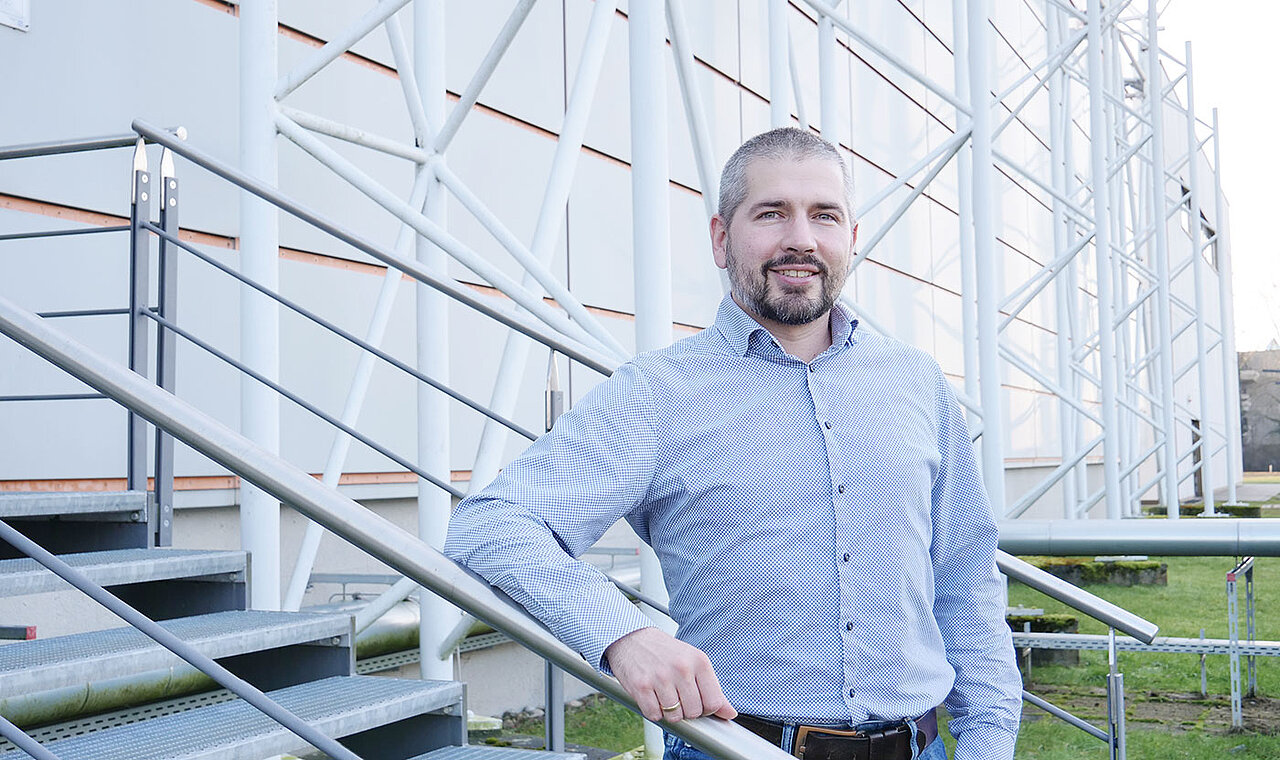
Dr. Andreas Pfenning has headed the Ferro35 junior research group at the Chair of Technical Physics at JMU since 2026. Since the end of 2022, he has headed the Semiconductor Quantum Photonics working group there and is pursuing his habilitation in experimental physics.
After his PhD, he did postdoctoral research at the Quantum Matter Institute of the University of British Columbia in Vancouver, where he worked on silicon-based photonic quantum information processing. His current research combines integrated quantum photonics, novel ferroelectric materials and the development of scalable quantum technologies.
Contact
Dr. Andreas Pfenning, Chair of Technical Physics, T. +49 931 31-89851, andreas.pfenning@uni-wuerzburg.de
Additional images