
On the Way to the 6G Network of the Future
12/02/2025The amount of data sent and received via the 5G mobile network is constantly increasing. Now, an international team involving the University of Würzburg is working on a globally standardized 6G concept.

Since 2019, the fifth generation (5G) has been the standard in mobile communications. It enables worldwide live transmissions to billions of mobile devices simultaneously. As the amount of data to be transported continues to grow, the standard must evolve to meet higher performance requirements and function reliably. The future model for this is called 6G.
To pave the way for this, an international joint project is working on the development of a globally standardized 6G network. The project is based on the existing 5G architecture and identifies the weaknesses of the network to subsequently improve it.
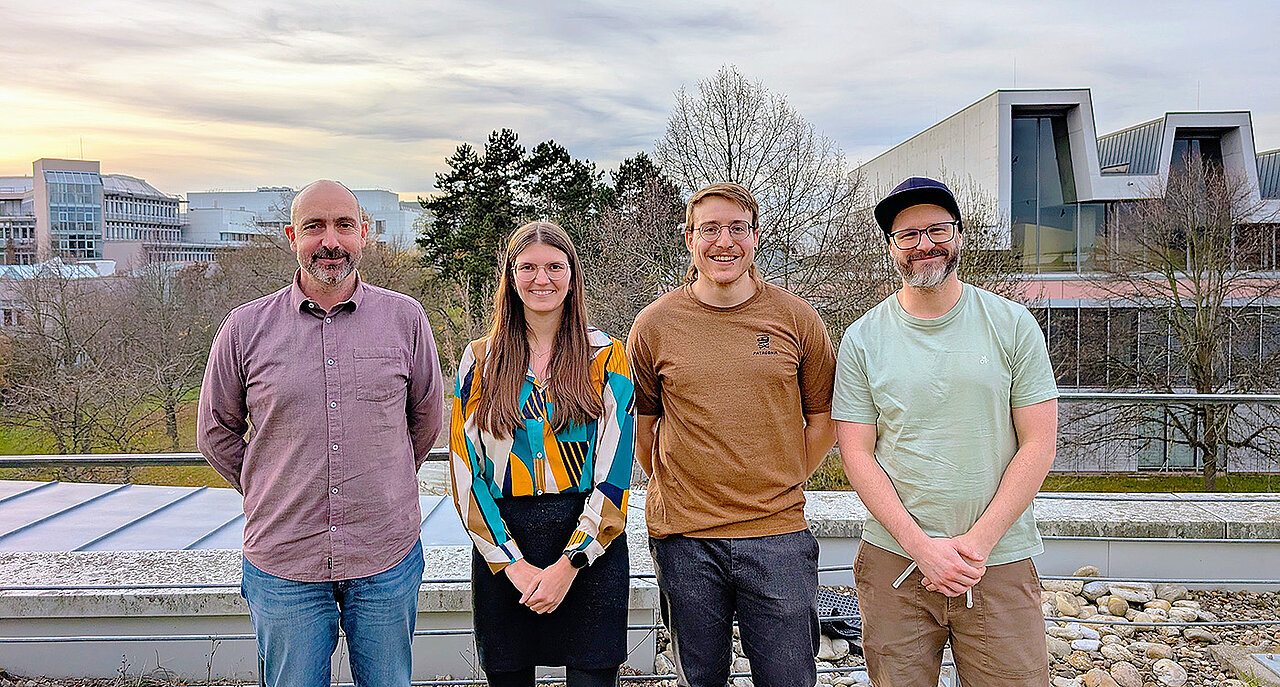
A research team led by Professor Tobias Hoßfeld and Dr. Stefan Geißler at the Chair of Communication Networks at Julius-Maximilians-Universität Würzburg (JMU) is involved in this project. Doctoral students Viktoria Vomhoff and Simon Raffeck are playing a key role in the project. Together with two other universities, the Würzburg team is responsible for the basic research, i.e., the design of the new network.
A New Era of Mobile Networks
“6G marks the beginning of a new phase in mobile communication, which will be characterized by higher data rates, lower latencies, and improvements in energy efficiency and reliability,” says Hoßfeld. To achieve this, 5G must undergo fundamental further development. To this end, the team is investigating several parameters that are crucial for optimal network connections. One such quality factor is latency, i.e., the time delay in data traffic between a sender and a receiver.
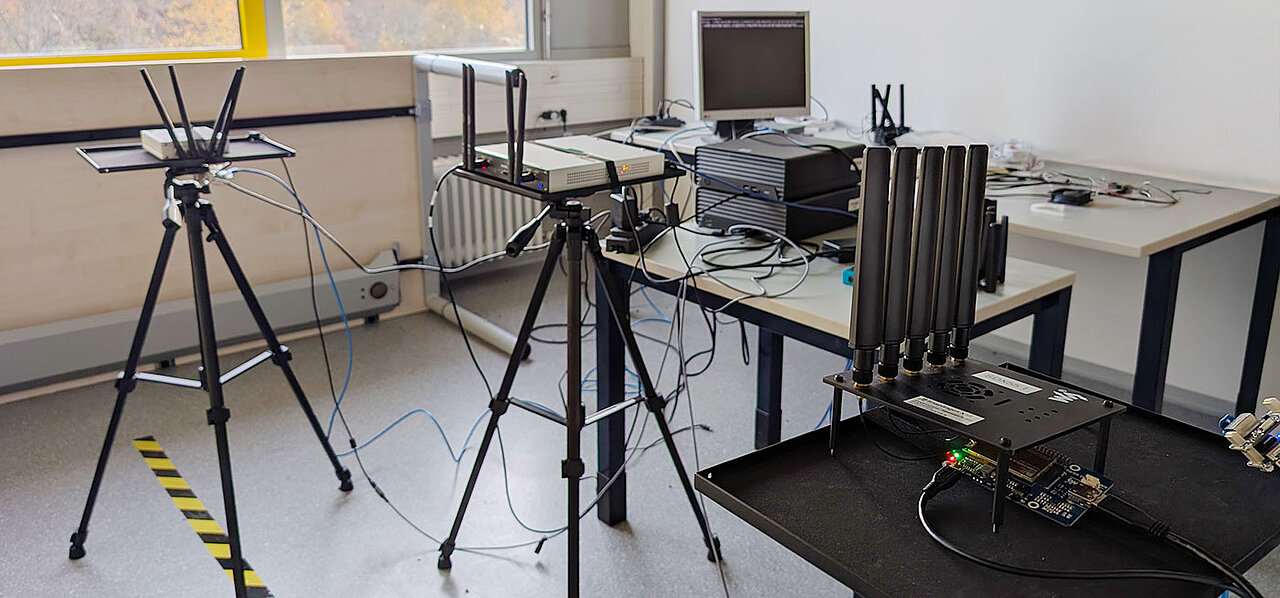
“In the future, 5G will no longer be sufficient to transport the increasing amount of data quickly and reliably,” explains Stefan Geißler. Ensuring ultra-low latency is therefore an important development step. To analyze the problem, the researchers have built their own functional 5G network at the chair, consisting of several transmitters and receivers that simulate the interaction between smartphones and 5G cell towers.
"It would be very time-consuming and impractical to request data from mobile network providers for analysis for our tests. With our own 5G network, we can observe and evaluate all data directly," explains doctoral student Simon Raffeck. The team uses an anomaly detection algorithm to identify problems in the network. If a data point deviates significantly from normal operation, it is marked as an anomaly. The researchers can then start solving the problem.
They have already conducted tests on roaming, i.e., the use of mobile data via foreign mobile networks: “We investigated how data traffic routes can be shortened,” says Viktoria Vomhoff. This will then result in concrete proposals for a functioning architecture.
About the Joint Project
The joint project ORIGAMI (Optimized Resource Integration and Global Architecture for Mobile Infrastructure for 6G) is funded by the European Commission with over 4.3 million euros. It is also funded by the Smart Networks and Services Joint Undertaking (SNS JU) and runs under the European Union's Horizon Europe research and innovation program under grant agreement number 101139270.
Funding will continue until January 1, 2027. The project is led by the Madrid-based telecommunications company Telefónica Innovación Digital. A total of twelve other project partners is involved, including universities, technology and device manufacturers, and mobile network operators:
- NEC Laboratories Europe GmbH
- Telecom Italia SpA
- Emnify GmbH
- Fogus Innovations & Services P.C.
- Cumucore Oy
- ISRD Sp. z.o.o.
- Net Ai Tech Ltd
- Universidad Carlos III de Madrid
- Fundacion IMDEA Networks
- Fundació i2CAT, Internet I Innovació Digital a Catalunya
- Technische Universiteit Delft
- Julius-Maximilians-Universität Würzburg
Contact
Prof. Dr. Tobias Hoßfeld, Head of the Chair of Communication Networks (Computer Science III), T. +49 931 31-86031, tobias.hossfeld@uni-wuerzburg.de
Dr. Stefan Geißler, Chair of Communication Networks (Computer Science III), T. +49 931 31-83134, stefan.geissler@uni-wuerzburg.de
Additional images