
WueLAB celebrates its fifth anniversary
11/03/2026The University of Würzburg’s WueLAB sustainability laboratory has been in existence for five years. At the anniversary celebrations, the speakers looked back on its achievements in research, teaching and practice.
If you walk across the university campus with your eyes open, you can easily spot one or two examples of the work carried out by all the people who collaborate with WueLAB: recycling points that improve waste separation, recycling and disposal; campus benches that invite people to rest and strike up conversations; or a digital lending cabinet offering sports and games equipment for use during breaks after lectures or work.
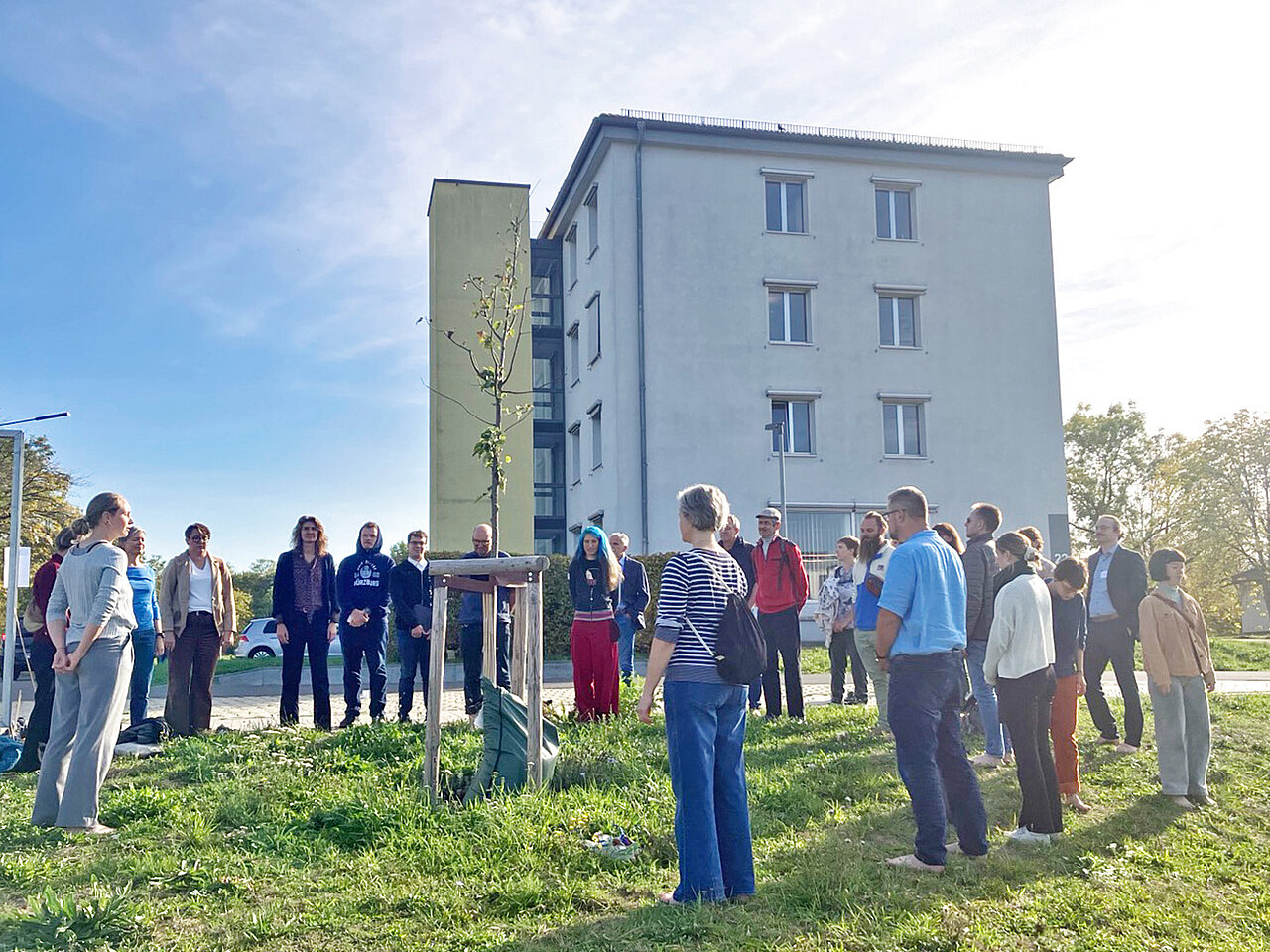
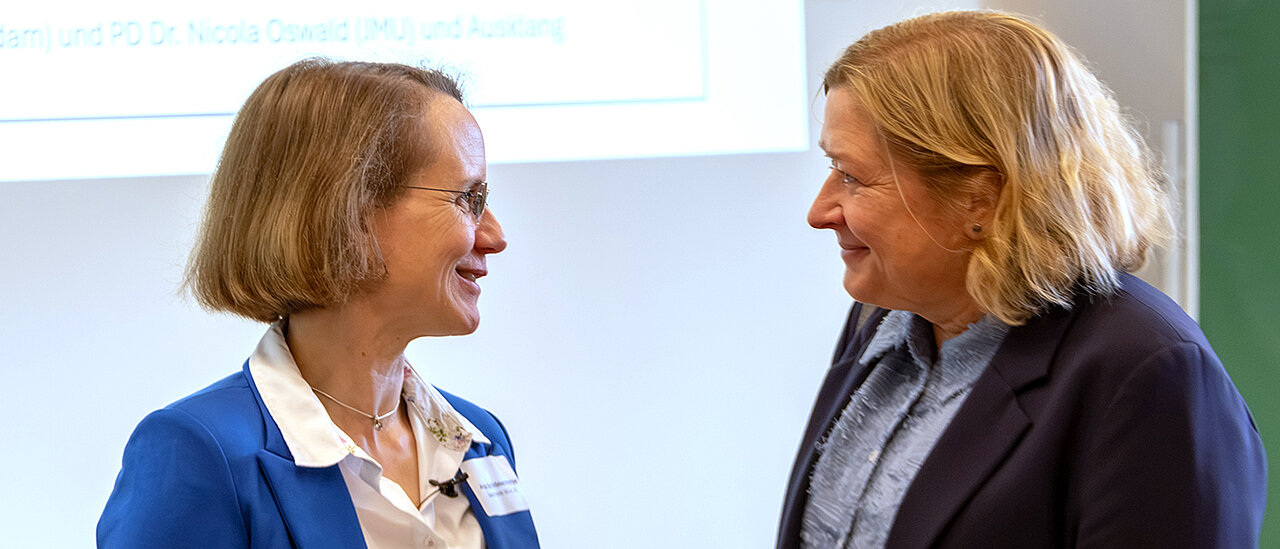
But of course, the work of the WueLAB extends far beyond promoting such initiatives. Far more numerous are the research projects undertaken by the team at the University of Würzburg’s Sustainability Lab, or new initiatives in teaching. The facility was officially launched five years ago. To mark its anniversary, those in charge have now organised a ceremony attended by numerous guests from the university and beyond.
“We are not merely a knowledge transfer centre; rather, we develop research designs in collaboration with the various core disciplines on sustainability topics. We consider: where are the scientific intersections that allow us to combine existing strong research and teaching and channel them specifically into interdisciplinary exchange or knowledge transfer.” This is how Nicola Oswald describes the principle behind the work at WueLAB. The mathematician, who holds a habilitation, has been managing director of the sustainability laboratory since July 2023.
Real-world experiments with a focus on transformation
Linking scientific methods and data collection from different academic disciplines and translating them into practical applications – always with a focus on sustainability, of course: this, says Nicola Oswald, is the idea behind WueLAB. As a scientific platform, the institute has, in recent years, brought together various fundamental disciplines – ranging from psychology to biology and the social sciences to ethnology – in an inter- and transdisciplinary manner, and has jointly developed novel research designs.
A central element of this work is what are known as ‘transformation experiments’. These follow a science-led, exploratory approach and are designed to test and investigate sustainable changes directly within the day-to-day life of the university. The process follows a set pattern: “We always start with a meeting where the applicants explain their idea,” explains Nicola Oswald. After that, it is usually possible to decide quickly whether the idea can be implemented without too much effort, or whether a transformation experiment should be launched.
In this context, the WueLAB managing director refers to “real-world experiments with a transformative aim”. The team then helps to identify further stakeholders and attempts to connect the applicants with other academic institutions or non-academic contacts. In this way, for example, experts from computer science come together with those from the social sciences, network with the city’s transport authorities and citizens’ initiatives, and work to improve mobility in Würzburg – “on a scientific basis”, as Oswald emphasises.
It can take anywhere from one month to two years before it becomes clear: “That’s a brilliant idea!”. If that is the case, WueLAB, together with the University’s Research Advancement Centre, helps to submit applications for third-party funding – to WueLAB itself, to government departments, to foundations or to local authority funding schemes. WueLAB itself has 10,000 euros available each year for student projects, and 100,000 euros for non-student transformation experiments.
Three pillars: network, research and education
WueLAB’s work is based on three main pillars: “Firstly, we are a network and a platform,” explains Oswald. After five years, the staff are able to organise a wide-ranging exchange, even beyond the university – for example, with the city administration, politicians, the business community and business incubators.
Secondly, a dedicated research design for real-world experiments has now been established. Thanks to this concept and the scientific evaluation of the experiments supervised by WueLAB, Nicola Oswald and her team are represented at conferences and in publications throughout Germany. Supraregional research collaborations have been established on this topic and on themes of the BMFTR-funded REKLINEU II consortium project, such as the culture of sustainability and digital twins of the campus grounds.
Education for Sustainable Development (ESD) forms the third pillar, linking a wide variety of university departments. For example, thanks to WueLAB’s support, the University of Würzburg now offers a certificate enabling lecturers at the Centre for Language Teaching (ZBL) to demonstrate that they have completed further training in higher education pedagogy in the field of sustainability. In addition, a new digital degree programme, ‘Interdisciplinary Sustainability Sciences’, has recently been launched, with around 50 participants from all faculties and other institutions, such as the ‘Gesunde Hochschule’, having contributed to its development. Among other things, this programme is also eligible for credit towards CHARM-EU students’ degrees and as part of a GSiK supplementary qualification.
A productive challenge for the university
“The WueLAB institutionalises exploratory thinking, reflexivity, innovation and dynamism.” This is how Dr Andrea Sakoparnig described the work at the WueLAB in her keynote address. Sakoparnig is a philosopher and an expert on sustainability in higher education at the German Rectors’ Conference (HRK). By establishing the sustainability laboratory, JMU has institutionalised the opportunity to “allow itself to be continually challenged”. The university has thus established a space “in which stability may be productively challenged”. In doing so, it has succeeded in firmly embedding innovation and self-reflection within its own structures.
Anja Schlömerkemper is Vice-President for Equal Opportunities, Career Planning and Sustainability at the University of Würzburg and spokesperson for WueLAB, which she helped to launch five years ago. In her welcoming address, she said: “This anniversary is an occasion to look back with pride on what we have achieved together, whilst at the same time looking ahead to continue driving change forward with courage.”
As far as looking ahead is concerned, Nicola Oswald is optimistic. She is certain: “WueLAB will continue to serve as an inter- and transdisciplinary bridge for basic research at JMU, bringing findings together and further strengthening the culture and practice of sustainability in research, teaching and campus life.”
On the WueLAB website, you can find more photos here, as well as the programme for the anniversary celebrations, including a digital brochure on the academic keynote speech by Michaela Fenske (Ethnology) and links to the welcoming addresses by Chancellor Dr Uwe Klug and Mayor Dr Sandra Vorlová.
Contact
Dr Nicola Oswald, T +49 931 31-80494, nicola.oswald@uni-wuerzburg.de
Additional images